

A soldier’s remains, a solemn reminder: 10 things to know for April 4
The return of the body of Zachary Baumel, missing since a 1982 battle in Lebanon, closes a circle for some and pours salt on painful wounds for others
 Add ToI as a Preferred Source on Google
Joshua Davidovich is The Times of Israel's Deputy Editor
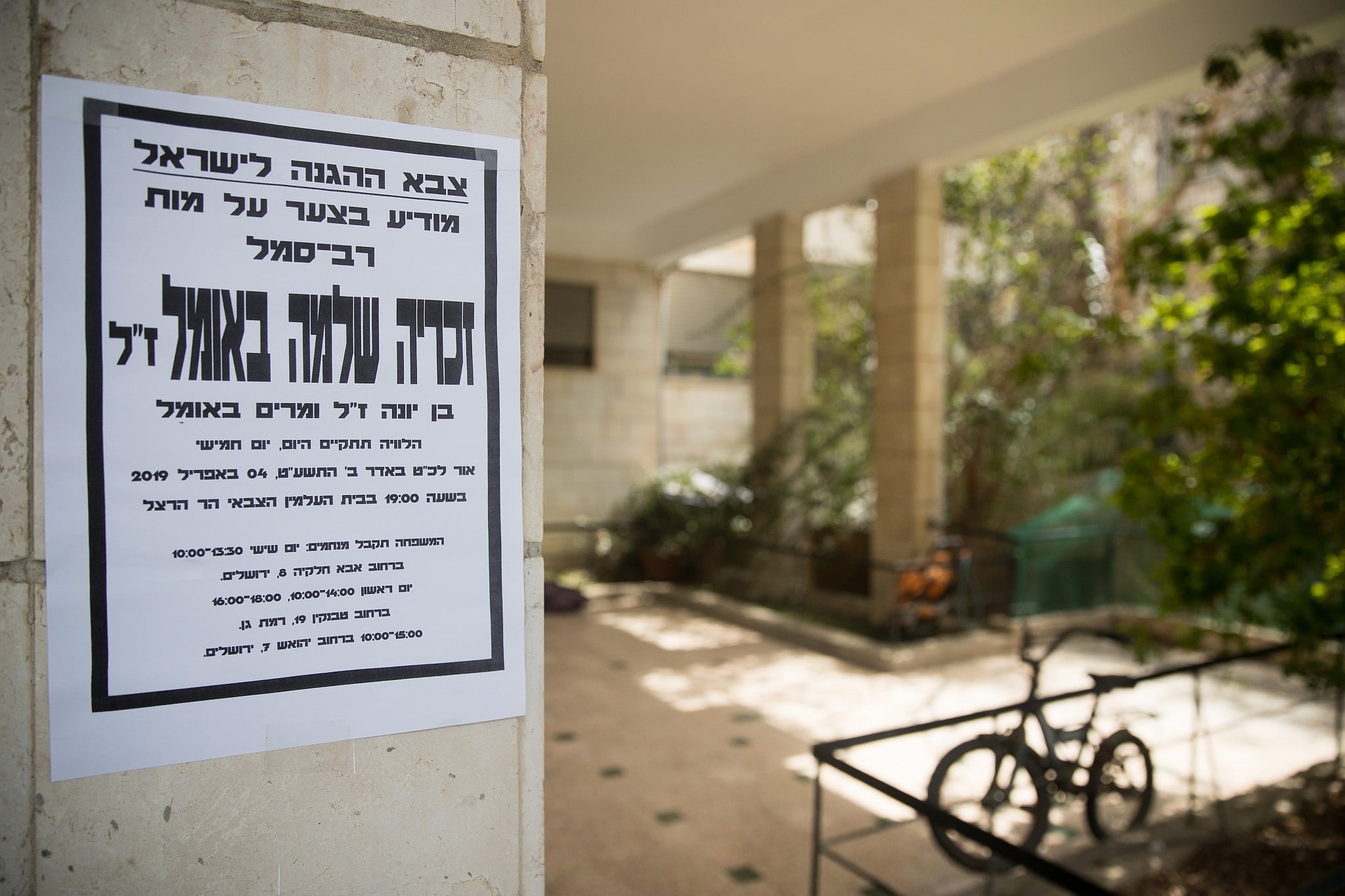
1. Bittersweet return: Israel is at once mourning and solemnly celebrating the return of the remains of Zachary Baumel, almost 37 years after he disappeared and was presumably killed in the disastrous Battle of Sultan Yacoub against Syrian forces in Lebanon.
- The biblically inspired phrase “Veshavu banim legvulam” (“And the sons will return to their borders”) appears again and again in coverage of Baumel’s return.
- Military spokesman Jonathan Conricus calls the announcement unqualified “good news,” while Rabbi Baruch Vider, who was friends with Baumel, tells Army Radio that when he heard the news “I just broke out sobbing.”
- Hezi Shai, one of two soldiers captured in the battle (in which 20 soldiers were killed) and later returned to Israel, tells Walla news that Baumel’s return “is a relief … but this is happiness mixed with sadness.”
- The Yedioth Ahronoth daily notes that “the [Baumel] family believed for all those years that Zachary was alive and the return of his body puts an end to those hopes,” though it says the sad part isn’t that he’s dead, but rather that Baumel’s father Yona died 10 years before being able to find out the fate of his son.
2. National responsibility: The Associated Press notes that “Cases of missing soldiers have a powerful emotional and political resonance in Israel, where military service is compulsory for most Jewish men. In his remarks, [Prime Minister Benjamin] Netanyahu lauded the repatriation of Baumel’s remains as an ‘expression of mutual responsibility and feeling of unity’ that epitomizes Israel.”
- Yuval Cherlow, a prominent modern Orthodox rabbi who helped evacuate the wounded from the battle, says in a statement that “Israel had a moral and human responsibility” to do everything it could to bring those captured home. “Bringing Zachary Baumel to his final resting place in Israel is the fulfillment of a national responsibility, both as a nation and to our soldiers.”
- “This won’t bring the dead back to life, but it will give their families a burial place over which to mourn, and the soldiers currently serving the knowledge that if heaven forbid something were to happen, the country would turn over every stone for them,” writes columnist Yoav Limor in Israel Hayom.
3. Not just Israel: Limor also claims that Israel is the only country that would continue searching for a missing soldier after all these years.
- He’s not alone. Several politicians and commentators also use the return of the body as proof of Israeli exceptionalism or something like it.
- “Every Israeli should be proud that the Jewish state does not forget, does not abandon its sons,” Minister Naftali Bennett told Channel 12.
- In actuality, many countries work hard to repatriate the bodies of soldiers lost in war, like the US, which recently got bodies of servicemen back from North Korea after decades of efforts.
4. Body of lies: Seemingly completely missing the point is TV critic Rogel Alpher in Haaretz, who chides journalists for claiming that Baumel’s body was returned, when it was actually just remains, writing that “it’s a lie” that the family will get closure.
- “Israel betrayed Baumel twice,” he writes, calling it “utter absurdity” that the return of the remains 37 years later would give anyone relief.
5. Not forgetting the rest: The return of Baumel’s body also brings back to the fore the cases of other missing soldiers.
- “We, the Katz family, continue to wait for Yehuda,” Pirhiya Heyman, the sister of one of the two other soldiers still missing from the battle, tells Channel 12. “We aren’t losing hope, and even though it seems unreasonable, still hope he’s alive.”
- The sister of Zvi Feldman, the third soldier missing from the battle, tells Israel Hayom that “I’m very happy for the family of Zachary, but on the other hand hurt that my brother still has not been found.”
- It’s also shining a light on other Israelis held in captivity elsewhere: “On a day like this, it’s impossible not to think of someone whose heart is still beating and who is alive in the hands of the enemy: Avraham Mengistu,” writes Hen-Artzi Srour in Yedioth, referring to a civilian believed held in Gaza.
6. More remains: The army released few details about the operation, but many have leaked out anyway, including wide speculation that it was Russia that helped locate the remains and bring them home — speculation that was confirmed Thursday.
- Channel 13 news reports that the remains of at least 10 others were brought from Syria, though almost all have been ruled out as belonging to Feldman, Katz or any other Israeli. Yedioth reports that the remains of up to 20 people were brought to Israel.
- According to Haaretz, the announcement about Baumel, who was brought to Israel days ago, was delayed as forensics experts ruled out the possibility that the remains belonged to Feldman, who was in the same tank during the battle.
- “When they told me there were tzitzit (ritual fringes) I knew it was it,” an investigator tells Walla news.
- Lior Lotan, who was tasked in the past with finding missing Israelis, credits intelligence gathering with helping find Baumel’s remains.
- “Our intelligence research capabilities are a powerful point. These efforts continued all the time, gradually and it was also possible to gather more and more testimony from people who participated in that battle on the enemy side. As usual, everyone provides a different version of efforts and covers the actions of others, but gradually an intelligence picture emerged that permitted us to make progress,” he tells Haaretz.
7. Insurgent help? Israel also won’t say where Baumel’s body as found, but Anwar Raja, a Syria-based official with the Palestinian terror group PFLP-GC, tells Lebanese news site al-Meyadeen that insurgents excavated graves in the Yarmouk refugee camp near Damascus in search of the three missing Israeli soldiers.
- He says that their remains had been transferred from Lebanon to Syria after the 1982 battle, and were then taken out via Turkey.
- Last year the a PFLP-GC official said much the same, and Russia confirmed in September that it was helping search for the bodies in Syria.
8. Election gift: Haaretz’s Amos Harel notes that the return of Baumel’s remains just a few days before elections will likely be another boost for Netanyahu.
- “Retrieving Baumel’s remains … proves to the public that the prime minister is not indifferent to the fate of missing soldiers. Furthermore, Netanyahu can say that only his experience and contacts permitted Israel to involve a third country and retrieve the remains of Baumel who had been buried as an unknown person for years in enemy territory,” he writes.
- Lebanese politician Walid Jumblatt also alleges an election connection, using it to aim criticism at Syria, who he hints was involved in the search.
- “The handover of the body of an Israeli soldier via unknown mediators is a free but precious gift to Netanyahu for his elections,” Jumblatt tweets, according to Naharnet.
- “A big salutation to the Syrian regime, the spearhead of Arab, regional and global defiance,” he adds sarcastically.
9. Pork-shwarma politics: The New York Times’s David Halbfinger takes a look at the wacky world of Israeli election ads, where pretty much anything goes.
- “Israeli politics is not subtle. Threats are always existential, opponents are out to destroy everything voters hold dear, and the enemies aiming rockets at residential neighborhoods from the Galilee to the Gaza periphery can seem only scarcely more menacing than the supposed enemies within,” he writes.
- “The ads are in Hebrew and Arabic, but much of what is shown in the ads requires little or no translation.”
- Also strange is an tiny ad in the back of Yedioth, saying only that “Bibi the millionaire loves Regev, the police, the prosecution, the attorney general, the country and Gideon Sa’ar. Bibi-baressement. Strong.” The ad is signed by a lawyer near Tel Aviv with no obvious political connections.
- Perhaps craziest of all is an ad put out by the Shas party alleging that a Blue and White win will mean a gay pride parade at the Western Wall, pork shawarma on every corner, and (gasp!) leavened products for sale on Passover.
אין אחד ברשימת ש"ס לכנסת שמאמין שאם לפיד ינצח, יהיה חזיר בכל הקניונים או מצעד הגאווה בכותל המערבי. הפחדה צעד אחד רחוק מידי מבית היוצר של ש"ס pic.twitter.com/P4qlOz6fHz
— יקי אדמקר (@YakiAdamker) April 3, 2019
10. If only: ToI’s Adam Rasgon, reporting from a Blue and White event in the Arab town of Tamra, writes that the event was turned into something of a farce by oppressive Shin Bet security for former defense minister Moshe Ya’alon.
- “Shortly before it was supposed to start at 7 p.m., one Tamra resident, overcome with frustration, raised his voice at Shin Bet agents, who he said demanded he undress as part of a security inspection,” he writes.
- “We welcome you into our village and then you ask us to remove our belts and lower our pants,” the resident yelled out. “Why can’t I be treated like a normal person?”
- Rasgon, an American who speaks Arabic and Hebrew, was also given the business by a Shin Bet agent, who refused to believe that he was Jewish: “I know you are Arab because of the way you speak Hebrew,” the agent told him.
- Blue and White and Ya’alon himself seemed embarrassed by the invasive security. “I am happy to be here, but I first would like to say I am sorry. If it makes you feel better, when I go to other places, they check me,” Ya’alon is quoted telling the crowd. “In any case… I must apologize. It is a shame that some of the people who came are not here.”








The Times of Israel Community.