

AG opening immunity panel for MK Haim Katz: Don’t become ‘refuge for criminals’
In first of 2 committee debates before vote, Mandelblit says former minister exercised authority ‘while in a serious conflict of interest’; Katz: ‘He is turning me into a crook’
 Add ToI as a Preferred Source on Google
Raoul Wootliff is a former Times of Israel political correspondent and Daily Briefing podcast producer.

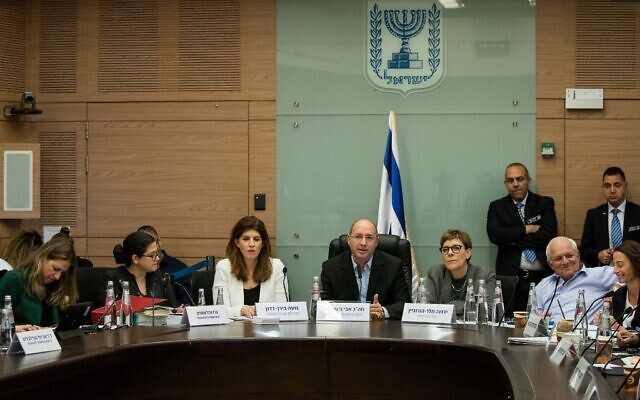
The Knesset House Committee began deliberations on Thursday over former welfare minister MK Haim Katz’s request for parliamentary immunity from fraud and breach of trust charges, opening the first of two debates before a vote on the request.
The debate represented the first meeting of the committee since the Knesset disbanded, before the previous two elections, in December 2018. On Tuesday, Knesset members voted to form the committee hours after Prime Minister Benjamin Netanyahu withdrew a separate request for immunity in the three criminal cases he faces which would have been debated by the newly-formed panel. He will now stand trial in the coming weeks or months.
Opening Thursday’s debate by presenting the indictment against Katz, Attorney General Avichai Mandelblit explained that he was bringing charges against the former minister for allegedly advancing legislation meant to benefit a financial consultant to major Israeli firms who was also a close friend and financial adviser to Katz himself.
Mandelblit, in a long exposition of his indictment and in response to questions from MKs, said that Katz “committed wrongful acts that amount to a criminal offense.”
Mandelblit noted that he had not pushed the most serious charge for which Katz had been investigated: allegedly receiving bribes in his dealings with friend and businessman Mordechai Ben Ari while serving as chairman of the Knesset Labor and Welfare Committee from 2005 to 2006 and again from 2009 to 2013.
The indictment, Mandelblit said, instead centers on allegations that Katz advanced Amendment 44 to the Securities Law at Ben Ari’s request, which stipulates that companies must repay bond debt to small bond holders before it repays controlling owners. Ben Ari’s business represents groups of bond holders in multiple companies.
Mandelblit said that Katz’s relationship with Ben Ari was more than friendship, and said the minister earned large sums of money by investing according to Ben Ari’s advice and even through Ben Ari himself. That relationship created a significant conflict of interest in Katz’s advancing of the amendment as a committee chairman, Mandelblit alleges, even if no money directly changed hands.

Mandelblit also accused Katz of withholding information about his ties to Ben Ari from both the Knesset Welfare and Labor Committee and its Ethics Committee.
Katz has denied wrongdoing, defending his work on Amendment 44 as key to protecting small investors.
The veteran Likud MK had also been a criminal suspect in a second separate corruption investigation relating to his time as head of the Israel Aerospace Industries (IAI) workers’ union, but Mandelblit decided to close that case against the minister.
After Mandelblit’s August decision to indict Katz in the first case, the then-welfare minister resigned from the government following a practice established in the 1990s with the court-upheld resignations of indicted cabinet members Aryeh Deri and Raphael Pinhasi.
While sitting quietly throughout most of the debate, Katz interrupted twice, once shouting at Mandelblit, accusing him of “turning me into a crook and spilling my blood,” and then later demanding that committee chairman, Blue and White MK Avi Nissenkorn, allow MKs to ask more questions of Mandelblit.
“This is my life we are talking about,” Katz shouted.
Responding to questions from committee members on the scope of the conflict of interest laws and their ability to pass legislation, Mandelblit said that Katz crossed a line.
Praising his many years of public service, Mandelblit said, “Katz is a long-serving and skilled public servant and I worked on the premise that he did not see only his personal benefit in the legislation, MK Katz did not directly hurt the public and I am convinced that he thought he was working for the good of the public.”
“But,” Mandelblit continued, “he was in a serious conflict of interest by concealing information from the public.”
“MK Katz’s actions severely and significantly impaired the enshrined values of the Knesset’s work,” Mandelblit charged. “We are talking about exercising authority while in a serious conflict of interest while gaining personal benefits and benefits for one’s best friend.”
In a plea to Knesset members not to accept Katz’s request for immunity, Mandelblit said that “Prosecution in this case will only strengthen public confidence in the Knesset institution. ”
“We cannot allow the Knesset to turn into a refuge city for criminals to flee justice for ever.”
According to the 2005 law on immunity, there are four “grounds” that MKs can cite in their bid for protection from legal prosecution.
A parliamentarian can request immunity if: a) the alleged crime was committed in the fulfillment of his or her parliamentary duties; b) the indictment is served in “bad faith”; c) the alleged wrongdoing was committed in the Knesset building and was already dealt with within the Knesset; d) prosecution would “cause real damage to the actual functioning of the Knesset or any of its committees, or to the representation of the electorate, and failure to conduct such a proceeding — taking into account the severity of the offense, its nature or circumstances — would not cause significant harm to the public interest.”
In Katz’s immunity request, he cited the first reason, claiming that his actions were part of his work as an MK and all carried out in good faith. According to the law, “substantive immunity” — a form of parliamentary immunity that would permanently block an indictment and not just while the accused is a serving MK –can be provided for an alleged crime that the committee finds was committed in the fulfillment of parliamentary duties.
Katz’s lawyer, Navit Negev, argued on Thursday that the indictment represents “a lack of understanding or reference to the norms required by Knesset members.”
“The rules of conflict [of interest] that apply to Knesset members are completely different from those that apply to public servants. The norms that have been argued that Katz broke do not exist in reality and have no legal and normative basis,” she said.
The committee deliberations on the immunity request will resume on Tuesday before a vote in the evening. If the committee approves the request, the bid then goes to the Knesset plenary for a final vote by the 120 Knesset members.








The Times of Israel Community.