

As Bad Bunny plays the Super Bowl, he’ll be cheered on by the Israeli-American producer on his team
Yuval Chain helped create music for Latin rapper’s Grammy-winning album, and has worked with stars including Drake and Post Malone
 Add ToI as a Preferred Source on Google
Zev Stub is the Times of Israel's Diaspora Affairs correspondent.

When Latin rapper Bad Bunny takes the stage at the Super Bowl LX halftime show on Sunday, Israeli-American producer Yuval Chain will be watching to see whether the song he co-produced, “El Clúb,” made the set list.
For Chain, it would be an additional flex after the 2025 Bad Bunny album “Debí Tirar Más Fotos,” which featured his song, won the Grammy earlier this week for the best album of the year.
“It all feels surreal,” Chain told The Times of Israel. “This is stuff that I would have dreamt of when I was younger.”
The 33-year-old Chain, who grew up in Jerusalem and Tel Aviv, has gained significant recognition within the Latin and hip-hop music sectors in recent years for his versatile production style, which blends modern trap, reggaeton, and pop elements. In addition to Bad Bunny, who is arguably the top name in the music world right now, Chain has produced music for superstar rappers Sleepy Hallow (“2055“), Drake (“Rich Baby Daddy“), and Post Malone (“Back to Texas“).
Chain doesn’t yet know whether “El Clúb” will be among the songs Bad Bunny performs in his 12-minute Super Bowl set, he said. The singer, who has won six Grammy Awards, 17 Latin Grammy Awards, eight Billboard Music Awards, and 13 Lo Nuestro Awards, has a lot of great material to choose from, Chain noted.
Chain works under the stage name UV Killin Em, which is a nod to his Hebrew name, Yuval, and the 2010 Fabolous song “You Be Killin Em.” He is open about the fact that he is Israeli, and hasn’t suffered at all from it professionally, he said.

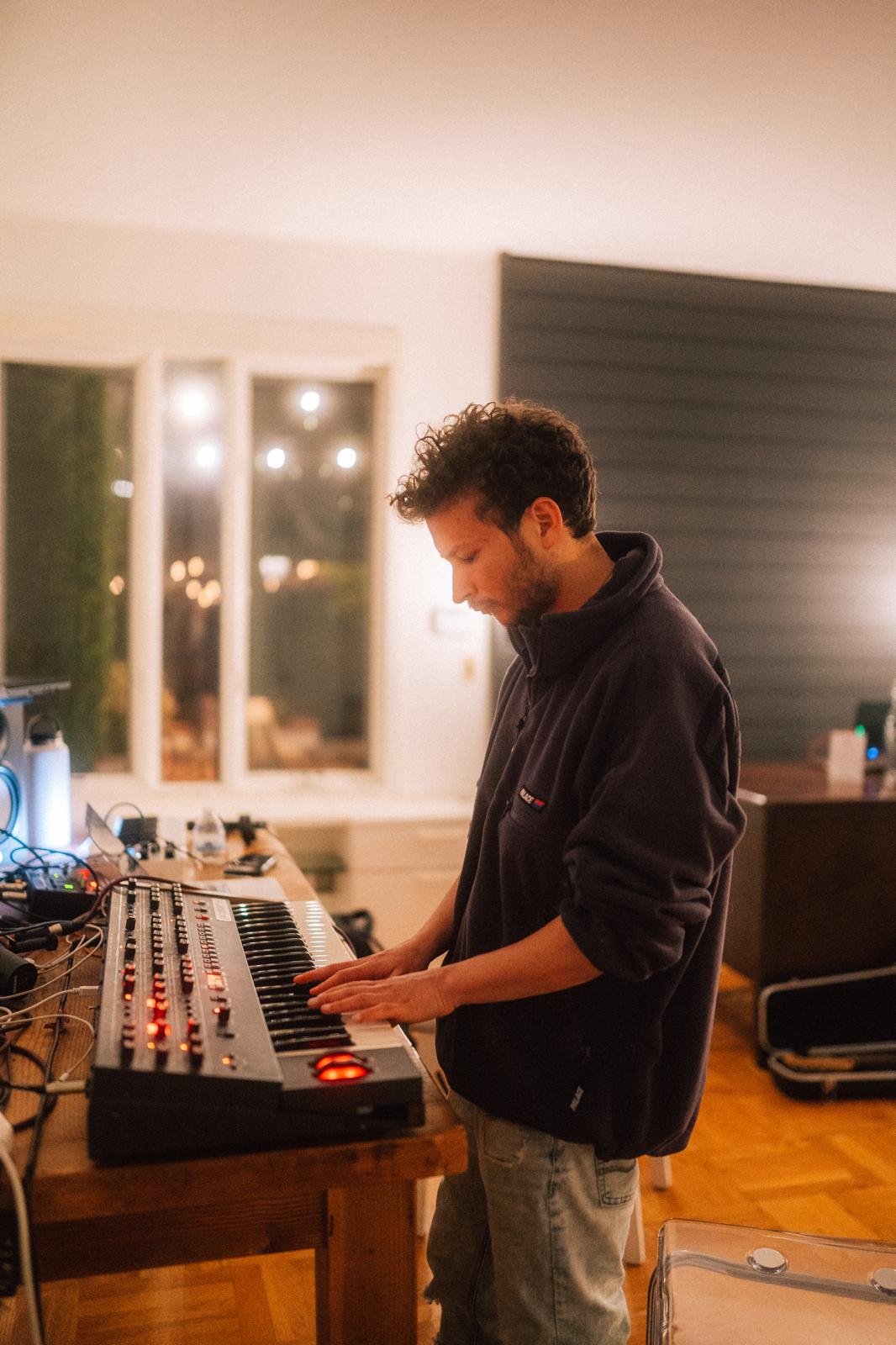
Music production is a complex process that can involve many different talents, including songwriting, arranging, and sometimes even playing the instruments used in a song, Chain explained. While producing songs was a much simpler process decades ago, many tracks today involve multiple producers located in different studios around the world, collaborating in a process that can take years. Some contributions can be as small as a several-second beat used in part of a song.
Chain was one of nine producers of the song “El Clúb,” and his contribution appears during the first minute of the song. Asked whether that makes him, technically speaking, a Grammy winner himself, Chain seemed a bit unsure.
“I need to figure it out,” Chain said disarmingly. “I’m pretty sure everyone who was involved gets a certificate, but only people who were involved with more than 50 percent of the album actually got a trophy. It might be safer to word it as ‘a producer on the Grammy Award-winning album.'”
Encounters with antisemitism
Chain, who moved from Tel Aviv to Los Angeles during the coronavirus epidemic, wears a Star of David when he works, posts online about Israel’s war with Hamas, and doesn’t hide his Jewish identity.
“At just about every session, someone comes over and asks where I’m from. I never hide that I’m from Israel,” he said. “I’ve never lost any work because of it.”
Chain recalled one incident when he was harassed online after he appeared in the credits for a K-Pop song in South Korea.
“As soon as people found out, I started getting flooded with messages and comments. Some of them were kind of crazy,” Chain said. “But when I went into the profiles of some of these people, I saw that they were almost all from Malaysia and Pakistan.”
“I saw a whole K-Pop Reddit thread about whether it’s okay to hate me because I’m Israeli,” Chain continued. “I just find it amusing that people are spending their time deciding whether to hate someone because of where they are from.”
Amazing breaks

Chain’s venture into music production started relatively quietly. Born in New York in 1992 to an Israeli mother and British Jewish father, he moved to Jerusalem with his family when he was 5 years old. (Chain’s paternal grandfather was Ernst Boris Chain, who shared the 1945 Nobel Prize in Physiology or Medicine with Alexander Fleming for the discovery of penicillin.) After serving for three years in the army, Chain studied music production at Hebrew University, and when the pandemic hit, he moved in with his mom in Tel Aviv.
During that time, when much of the world was stuck indoors, Chain picked up the guitar he’d received as a bar mitzvah gift and started playing again. He also started following Reddit threads about people creating and selling music from their bedrooms. He began to do the same.
“I started getting good feedback from total strangers, and that led me to posting on social media and building a site,” Chain recalled. “And that’s when I met a few producers who asked me to move to LA and be part of their musical collective.”
There, he pursued musical collaborations, including one with a friend named Shiv based in New Jersey. On one of Chain’s visits to the East Coast, he and Shiv made some tracks in Shiv’s basement just for fun. But Shiv was part of a group that worked with Drake, and four months after their session, Shiv told Chain that Drake (who happens to be Jewish) liked their track and was thinking about using it. It ended up in the song “Rich Daddy Baby” on Drake’s album “For All the Dogs,” which eventually became the best-selling rap album of 2023.
“That story was very different from the Bad Bunny story, actually,” Chain said. “In that case, I wasn’t even trying to get there. But with Bunny, I was actively working for about two years trying to get into his camp.”
Chain worked with a Spanish producer named Saox, who sent a few tracks to Bad Bunny’s team. Shortly before Christmas in 2024, Bad Bunny teased on social media a short snippet from his upcoming album using Chain’s track. “Debí Tirar Más Fotos” came out the following January, and eventually received six Grammy nominations. On February 1, it won Album of the Year, the first Spanish-language album in history to do so.

Officially a Grammy winner or not, Chain has been enjoying the moment.
“It’s been an amazing few years,” he said. “I know people who have been working here for many years and still haven’t gotten their break yet. I’m incredibly lucky to be in this position, and I would tell others to pursue their dreams as well.”










The Times of Israel Community.