

Bogus Nazi hunter Twitter account jump-starts UK comedy book
Farcical diary ‘Alan Stoob: Nazi Hunter’ incorporates the best of British humor with social media surrealism
 Add ToI as a Preferred Source on Google
LONDON — In February 1994, Alan Stoob – having had a moderately successful career as a police officer in Bedfordshire, England – was clearing away his desk in advance of his retirement when he received a phone call. On the other end of the line was Simon Wiesenthal, “the most famous Nazi Hunter the world has ever known,” in his own words. Wiesenthal tells Stoob that in his pocket is a plane ticket to Vienna and to come at once.
There, Wiesenthal tells Stoob that he needs him to carry on his work back in the United Kingdom, where there are 248 surviving Nazi war criminals, including “193 in Bedfordshire alone.”
“There are Nazis everywhere, Alan, elderly wizened ones emerging from drains and cul-de-sacs, seeking out cheap plastic surgery in Houghton Regis, integrating into the community. You must find them,” Wiesenthal says.
“Alan Stoob: Nazi Hunter” – the new novel published by Hodder & Stoughton by the British journalist and comedy writer Saul Wordsworth – subsequently follows the attempts by Stoob to live up to Wiesenthal’s challenge. By 2012, when the novel-as-diary begins, his position as Britain’s top Nazi hunter is under threat. But, subsequent to a tipoff from a mystery informant, Stoob ends up being drawn into a Nazi plot that implicates the British government and the American presidency.
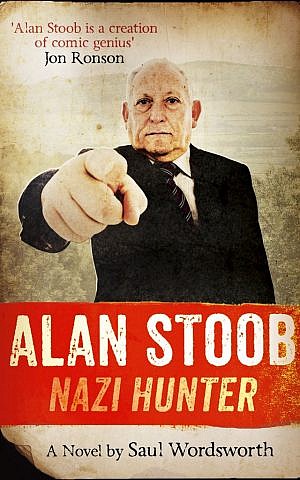
The Times of Israel sat down with Wordsworth at the Rustique Café in Tufnell Park, north London, to discuss his work and the character of Alan Stoob, who began life on Twitter (Stoob tweets @nazihunteralan) before migrating swiftly to the novel, a book which has recently been optioned by Hollywood.
Who is Alan Stoob?
He’s both a figment of my imagination, my own creation, but he’s also part me, part my father, and part my grandfather. He’s probably an amalgamation of all three of us, with a bit of the surreal thrown in for good measure.
In what respect are you Alan Stoob?
There’s definitely some Jewish neuroticism in there that’s more me and indeed my grandfather than my father. He’s got a great love of cycling which is something I’ve discovered over the last three years.
But beyond that I have to say that a lot of it is the work of my own imagination combined with the influence of my grandfather. My grandfather was very big on elevenses, which was hot Ribena and sliced apple and that’s exactly what Alan Stoob has. There’s an early reference to glucose tablets which my grandfather took, and plenty of afternoon naps. I’m not opposed to an afternoon kip myself.
Do you think Jewishness informs the character or the book?
I didn’t want Stoob to be Jewish, even though I am, and one of the things he frets about is whether that means he’s not as dedicated or vigilant a Nazi hunter as Simon Wiesenthal or whoever.
I’m definitely informed by the Jewish sensibility, particularly in relation to comedy. All my favorite comedy is probably of Jewish descent. There’s a lot of surrealism in the book which appeals to me. I think if you were to ask someone who the book had been written by, I’d say there’s a fair chance that that person would say, Someone Jewish.
Where was Alan Stoob conceived from?
‘I was with two of my cousins, and we were joking around, riffing about jobs that were going out of fashion, and I think it’s fair to say that Nazi hunter would be a good example’
On a particularly wet Sunday afternoon in Norfolk, I was with two of my cousins, and we were joking around, riffing about jobs that were going out of fashion, and I think it’s fair to say that Nazi hunter would be a good example of that. And someone said, ‘Nazi hunter’ and as an aspiring comedy writer, a light went on in my brain.
I remember lifting a finger and saying, “Watch this space,” because already I could feel the genesis on an idea coming on.
From there, what appealed to me was the idea of a man running around performing a role that, for all intents and purposes, doesn’t really exist anymore. So from there I created a website, simply for my own amusement. I then started tweeting in character and fairly quickly I gathered a few thousand followers. People seemed to get the joke, like the joke, and I had a lot of positive feedback. I engaged with a lot of celebrities, writers, and comedians.
Do you think this character would have been launched in the same way without Twitter?
I started working on the novel around six weeks after I began tweeting as Alan Stoob, but by that time I’d already fleshed out a lot of his character, so when I did start writing I hit the ground running. Obviously I got to know him a lot better by the end of the novel.
‘I’m sure there are parts of Stoob that came to me as a result of interactions on Twitter’
Twitter was a natural and organic progression. Twitter reinforced the idea that I was onto something that was at the very last mildly amusing – people were laughing and seemed to get the joke. I think if I’d just gone in cold without tweeting in character, I wouldn’t have known if I was onto anything.
It also an opportunity to expand and develop the idea. It helped me explore different aspects of the character that I wouldn’t necessarily have explored were it not for the interactive process. I’m sure there are parts of Stoob that came to me as a result of interactions on Twitter.
What was your process for writing this novel?
There wasn’t a lot of method in the madness. There’s an awful lot of very good advice about turning up at your desk and writing every day. But my book was written in around five or six strong bursts because I had to work around deadlines which I tried to manage to give me space before and after to work on the book. The best and most conducive thing for my work was to get out of London and go to Norfolk and to do a good week’s work there.
What’s the arc of your career?
So school, and a year out where I traveled to Israel, stayed with relatives, spent some time on a kibbutz. University, where I did politics and history. Busking in Brighton for three months. Falling into sales, quite enjoying it, and then moving into my thirties, managing people, marching them up a hill that they don’t want to be marched up on a daily basis which wasn’t making me happy.
‘I think I’m more in touch with my Jewishness now than I ever was, and a trigger for that was my trip to Israel’
Prizing myself out of that environment, finding my way into journalism even though I don’t have any formal qualifications, getting ready lucky with a publishing company that I still write for, and that giving me the confidence to start working on my own creative writing, collecting the odd column here and there, writing jokes.
Like a lot of freelancers, the work was many and varied, but what I have focused on is comedy writing. I don’t know how my career will pan out now. I’m working on a play for theater and a screenplay, while keeping a keen eye on what’s happening in Hollywood, where the treatment of my book is being worked on.
What was your Israeli experience like?
It was a very powerful experience. Growing up in Harpenden in Hertfordshire, as opposed to say north London, I wasn’t surrounded by Jewishness in the same way, and so you can lose sight of that aspect of yourself when it’s just you and your family.
I think I’m more in touch with my Jewishness now than I ever was, and a trigger for that was my trip to Israel, speaking to my Israeli relatives. I remember having a very profound conversation with my second cousins who basically lectured me in a park in Jerusalem on what it means to be Jewish and that certainly left its mark and stayed with me. I was impressed by the forthright qualities of my Israeli relatives, very strong and direct people.









The Times of Israel Community.