

Diplomats and emissaries worldwide get in their votes ahead of Israel’s election
From Wellington to the US west coast, some 5,000 Israelis stationed abroad had the chance to cast an early ballot for April’s national election over the last 36 hours
 Add ToI as a Preferred Source on Google
Raoul Wootliff is a former Times of Israel political correspondent and Daily Briefing podcast producer.
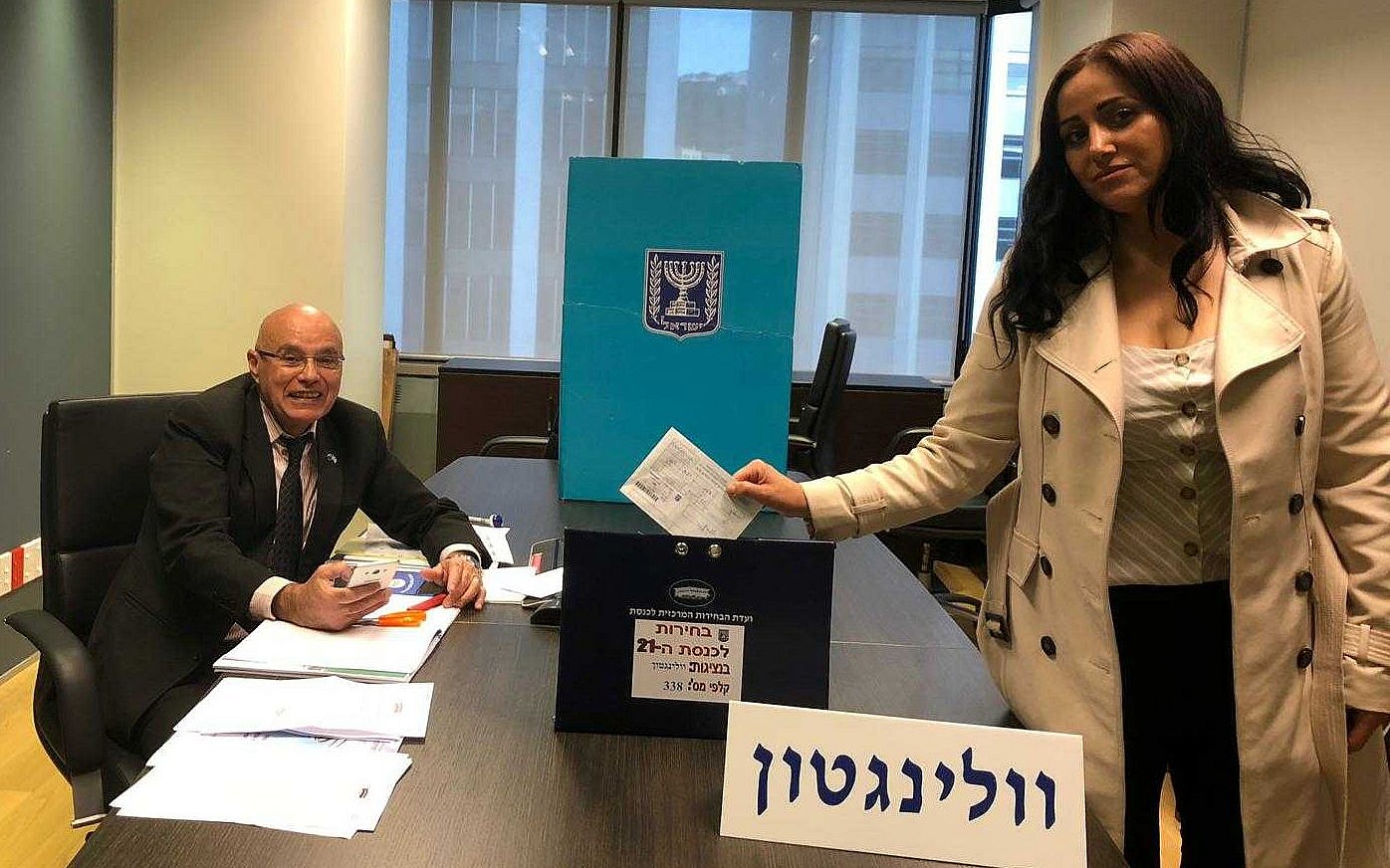
It was Friday morning in Israel by the time the polling station at the Israeli consulate in San Francisco closed up shop, marking the last opportunity for diplomats stationed abroad to vote in April’s national election and completing a 36 hour stretch in which ballots were cast in 77 countries across the globe.
While the vast majority of Israel’s 6.3 million eligible voters will have to wait until April 9 before they can cast their ballot, a total of 5,137 Israelis stationed in 96 embassies and consulates were able to vote from 8 a.m to 9 p.m., their local time, on Thursday.
Voting kicked off on in Wellington, New Zealand — 8 p.m. Wednesday evening, Israel time — when Anat Amichai, the wife of the head of security at the Israeli embassy became the first Israeli to vote in the elections for the 21st Knesset.
As the sun moved west, ambassadors from Bangkok to Jordan to Romania posted photos of themselves proudly fulfilling their democratic right, in a mini-preview of the national vote in a week and a half.
From Wellington to San-Francisco, Israel’s diplomats in 96 missions across the world ???? are voting ???? today in elections for the 21st Knesset! pic.twitter.com/w5A3HjnsBU
— Yiftah Curiel (@yiftahc) March 28, 2019
In one video posted by the Foreign Ministry, Senegalese embassy workers at the Israeli embassy in Dakar brought cake to first-time voter Elissa Aschheim, who recently wed Deputy Ambassador Daniel Aschheim after immigrating to Israel last year from Germany.
“I’m so excited to be voting for the first time in Israel’s elections, especially here in Senegal,” she said after casting her ballot.
אליסה אזרחית ישראל רק משנה שעברה, לאחר חתונתה עם דניאל אשהיים, סגן השגריר שלנו בסנגל . מאד מתרגשת להצביע בפעם הראשונה בבחירות בישראל, ודווקא בסנגל.כל הכבוד !!!!@IsraelMFA @IsraelinSenegal pic.twitter.com/gXKEwnyRAF
— Emmanuel Nahshon ????️ (@EmmanuelNahshon) March 28, 2019
According to Israeli law, private citizens living abroad cannot vote unless they come to Israel. But the exception made for diplomats also applies to emissaries sent abroad by the Jewish Agency, KKL-JNF, Keren Hayesod and the World Zionist Organization. In addition, their spouses and children (aged 18-20) can also cast a ballot abroad.
“We are talking about a very complicated process, but everything is done to ensure both an easy process for voters around the world and complete transparency,” said veteran Israeli ambassador Yizhak Bachman, who currently serves as chair of the Foreign Ministry’s election committee.
In Israel, the head of the Central Elections Committee, Supreme Court Justice Hanan Melcer, oversaw the process from the “election situation room” in the Foreign Ministry in Jerusalem alongside Deputy Foreign Minister Tzipi Hotovely.
מארחת היום בחדר מצב את השופט חנן מלצר וצוות ועדת הבחירות המרכזית לאירוע פתיחת ההצבעות בנציגויות ישראל ברחבי העולם. 5000 מצביעים יצביעו במעטפות כפולות. pic.twitter.com/StQeinzpJH
— Tzipi Hotovely (@TzipiHotovely) March 28, 2019
“The entire operation is done extremely carefully and to the exact letter of the law, all over the world,” Bachman said.
To manage the vote, every embassy has a mini-election committee of sorts, which usually consists of the consul and another high-ranking official, preferably not from the Foreign Ministry but rather a military or cultural attaché. Every voter enters the voting booth and places their ballot in a sealed envelope. They then exit the booth and the envelope is placed in a second envelope with the voter’s name and identity number on it.
Now, all the envelopes will be sent to Jerusalem, where they are held in a safe until Election Day. Members of the Knesset’s election committee will then look at the names on the envelopes and check back with the polling stations where the citizen is registered to ensure they haven’t voted twice.
The first sealed envelope containing the voting slip is then placed in a special ballot box, together with all the other envelopes from abroad. After the polls close in Israel and the counting starts, the diplomats’ box will be counted as well.
Final results in the national ballot are expected to trickle in overnight on April 9-10.
Raphael Ahren contributed to this report.









The Times of Israel Community.