

‘Exiteers’ pitch a range of on-off lockdown proposals to get Israel back to work
Scientists, mathematicians and strategists are devising all manner of plans to beat the virus and revive the economy. The government is listening… and weighing its next moves

 Add ToI as a Preferred Source on Google
Nathan Jeffay is The Times of Israel's health and science correspondent

One team of scientists, from Bar-Ilan University, is convinced they can “kill” the coronavirus in Israel within six weeks, and allow everybody to return to work and school in the meantime on a week-in, week-out basis. It briefed the National Security Council with its proposal on Tuesday.
Another team, from the Weizmann Institute of Science, proposes a four days on, 10 days off model — with everyone, including schoolkids, out and about for those four days, and everyone locked down for the other 10. This plan has been presented to the Health Ministry.
And these are not the only exit strategies being devised by thinkers across a wide spectrum of fields, from doctors to scientists to military minds — the exiteers. They are being developed as Israel’s leaders start to talk with wary optimism about a possible easing of anti-virus restrictions if — and it’s a fateful if — Passover does not yield a new phase of contagion.
“There is a realistic chance that if the trends continue, we’ll begin to gradually exit from the lockdown after Passover,” Prime Minister Benjamin Netanyahu said on Monday in an address to the public. “It depends on you. It depends on adherence to the tough directives… Don’t get complacent.” For his part, Gabi Barbash, director-general at Tel Aviv Sourasky Medical Center and one of the country’s top medical experts, suggested on Tuesday that return to normality will involve a slow seven-stage process, which would see schools stay shut until stage five.
Bar-Ilan’s ‘speedy’ approach
A seven-person interdisciplinary team from Bar-Ilan University presented its exit strategy to the NSC on Tuesday. The team, which includes a virologist, proposes that half the population should stay in lockdown each week, and the other half should return to work and school. After each weekend, the locked-down second half of the population would be released, and the first half would be confined to their homes, and so on in an alternating week-in, week-out pattern.

Bar-Ilan mathematician Baruch Barzel said this approach would allow for a speedier result than that posited by Barbash, Channel 12’s resident medical expert, and that while it should be paired with vigilant hygiene and social distancing, it would be so effective enough to succeed even without those measures.
“Even if we live exactly as we did a month ago [before the introduction of “stay home” restrictions] but in weekly shifts, and even if 15 percent of the population completely violates the rules, you still kill the disease [in Israel] in six weeks,” Barzel told The Times of Israel. He said hoped his model would be adopted by Israel, and by other countries.
When Barzel talks of “killing” the virus, he explained, he means that there will be an “exponential decrease in the number of cases until it is nearly zero.”
Coronavirus could be a long-lasting problem if there are things we don’t understand, like mutations, but it doesn’t look like that right now
The exit strategy architects acknowledge the risks of subsequent waves of infection and virus mutations, but they tend to be optimistic.
Uri Alon, a systems biologist at the Weizmann Institute of Science, whose team briefed the Health Ministry with a different proposal for ending the crisis, shares that mindset: “Coronavirus could be a long-lasting problem if there are things we don’t understand, like mutations, but it doesn’t look like that right now.”
“There is a possibility that if you keep social distancing, keep testing and have good strategies, you can have each person infect less than one other person, on average. It’s the equivalent for the virus of what would happen to humanity if people had less than one child for generations and generations: we could become extinct,” Alon said.
Others counsel patience
Former Israel Defense Forces intelligence chief Amos Yadlin has warned that a swift “exit strategy” is urgently needed, and even that it must be put in place by the end of Passover.
He said earlier this week that “if we wait according to what experts on health are saying, that new cases should be only 10 a day and only then will we release the population, we will doom ourselves to self-destruction for months, many months, until the end of the year, and we cannot afford it.” Yadlin appeared to be referring to Health Ministry Director-General Moshe Bar Siman-Tov’s talk Tuesday of a need to get new cases down to dozens a day ahead of a phased exit from the current restrictions.
But other experts are warning that, while it makes sense to start planning an exit strategy, Israelis should slow down. “We need to be more patient and more cautious,” said Nadav Katz of the Hebrew University of Jerusalem’s Racah Institute of Physics, part of a research group that produced a coronavirus analysis reviewed by the government.
“What’s taken several months everywhere in the world will probably take months here. We shouldn’t lose patience after three or four weeks because we’re bored,” Katz said.

Katz insisted that projections like Bar-Ilan’s should be handled with caution. “In a mathematical model everything looks great, but reality is more complicated,” he said.
“We strongly believe in evidence-based modifications and not model-based. We also have models and simulations, but the most important thing is to not plan too far ahead because we have a lot of unknowns,” Katz said.
Barzel’s model relies, in part, on the fact that workplaces and the public sphere will be less crowded than normal if half the population is required to stay at home at any time. But its main aim is to tap into the infection patterns of the virus.
Barzel has adopted research that suggests that it takes around five days after infection for people to develop symptoms, and on day five, they are at their most contagious. With his approach, he believes, the majority of people who become infected will, by the time they reach this stage in the virus cycle, be in lockdown mode.
He said that in his model, timing is everything. “It’s like when you’re pushing your child on a swing,” he explained. “You don’t just need to push with power, you need to push with the right timing. The synchronization is why our model works so well.”
He argued that there is no need to wait for new cases to peak before putting his model into action, that it could be instituted immediately after Passover — and that politicians could try it cautiously. “If I were advising the politicians I’d say, ‘don’t be as bold as my models show, but in the north of Israel, where things are calmer, try a pilot and try my model there.’ Once we see how it works, assess it.”
Try, and then reassess
This idea of experimenting with part of the population is popular in exit strategy discussions.
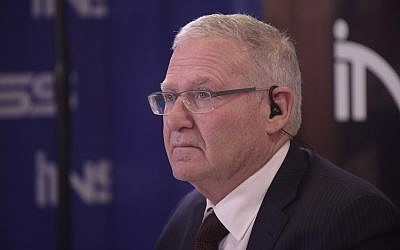
Yadlin, and the Institute for National Security Studies, which he heads, have argued for a gradual rollback of restrictions.
“In the first instance, release 200,000 people and see what the reaction is,” Yadlin said at a press briefing on Sunday. “There is a huge margin here. If we release too many, and our calculations are too optimistic, you take them back like Singapore did, but not with hysteria.”
Singapore, after rolling back its restrictions, was forced to reinstate them when cases started to rise.
In Yadlin’s view, “differentiation is the name of the game,” and people should be released from lockdown based on assessments of how much their jobs contribute to the GDP and how vulnerable they are in health terms. Another factor, he said, should be how much infection there is in particular regions of the country — something that he wants to see assessed by extensive testing.
“There are places that should be in quarantine, and there are populations that should [based on vulnerability] stay at home, but there are a lot that should go out,” Yadlin said.
Yadlin said that Israel’s citizenry “shows very well they are disciplined if they can trust what they are told in the media, and if they get instructions that can be trusted. I’m sure they can go back and restart the economy — wearing masks and keeping two meters from each other. Seventy percent of the economy can come back, and not the 15% as is the case today, which is unacceptable.”
Economic breathing space
The Weizmann team’s Uri Alon thinks that talk of percentages is unnecessary. He believes that as soon as Israel has a five-day stretch with decreasing numbers of new cases, the “entire economy” could be reopened.
He wants everyone — except for people at high risk from the virus — working for four days, while observing strict hygiene and social distancing, and then the whole nation in lockdown for a ten-day stretch, which includes two weekends. Schools would follow the same rhythm, he said.

Like Barzel’s model, his proposal relies on the principle that if people catch the virus at work or school, by the time they are at their most contagious, they will be in lockdown.
He believes that as periods of confinement are longer and active periods shorter in the Weizmann plan than in Barzel’s model, it would prove more effective.
He told The Times of Israel: “It’s better to have people out for four days rather than a week, as it gives the virus less time exposed, and also, enforcement is much easier if everyone has the same schedule. And if the whole country is meant to be at home during the ten-day period, it’s clear if people are out that they aren’t complying with the lockdown, whereas if the nation is in shifts, it’s harder to tell and to enforce.”
Alon is convinced that his model could prove a lifeline to the economy.
“People who are [currently] unemployed can, at least, have a 40% job,” he said. “It gives you the potential to eradicate the pandemic and gives you economic breathing space.”
He said that if the routine of ten-day lockdowns followed by four days of normal routine is observed, that would restore confidence to the economy, “and confidence is so important for economic stability and growth.”
“If the whole world did this,” he asserted, “then barring any mutation, the virus could be eliminated.”










The Times of Israel Community.