

Less awe than shucks for the Holy Land’s first US visitors
Rev. Levi Parsons, a true pioneer in 1821, was dead after several months here. Herman Melville spent 19 years writing a tortuous book about his visit. But a young future president kept his sense of humor
 Add ToI as a Preferred Source on Google
Mitch Ginsburg is the former Times of Israel military correspondent.
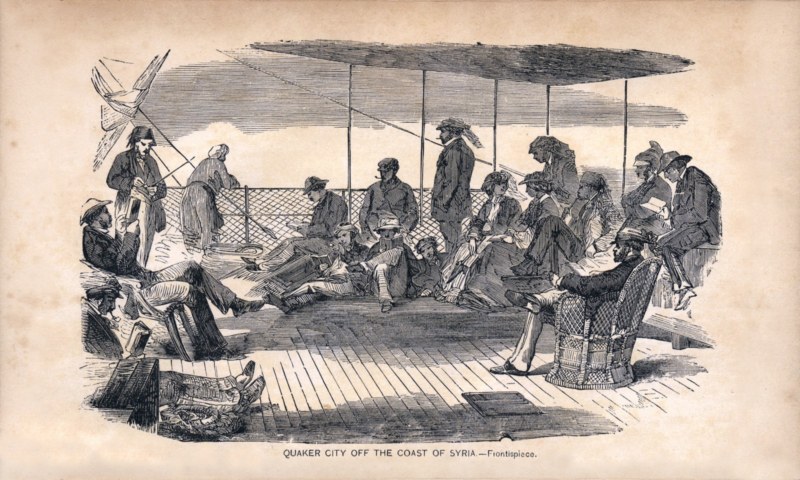
The Hebrew Bible can be exceedingly succinct — allotting virtually no verbiage at all to descriptions of landscape — but it was the verses of the Old Testament, along with the advent of the steamship, that drew many Americans to the Holy Land in the 19th century.
This Wednesday, the Fourth of July, the National Library of Israel and the Shapell Manuscript Foundation are celebrating those early Americans who came to, but were not always charmed by, the Holy Land.
The exhibit is called “Dreamland: American Travelers to the Holy Land in the 19th Century.” It tells the stories of pilgrims, explorers, presidents and authors. Their paintings and prints, letters and books, maps and charts and photographs reveal a great deal about themselves and about pre-Zionist Palestine during the waning and neglectful years of the Ottoman Empire.
Surprisingly, the exhibit opens with the handwritten document of a Frenchman. Written to the quarter-general of the 30th Germinale on April 19, 1799, the letter orders the payment of salaries to four generals and 300 troops stationed outside Acre. It is signed simply, in an unlovely hand, “Bonaparte.”
Napoleon, despite his defeat at Acre, opened Palestine to the West. Missionaries followed him to the Holy Land. The first American arrived in Jerusalem on February 12, 1821. His name was Reverend Levi Parsons, he was from Boston and he did not last long. By spring of the following year he was dead, at the age of 29.
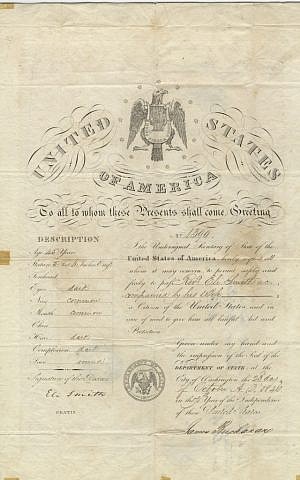
Reverend William McClure Thompson arrived in the early 1830s — the United States forged diplomatic ties with the Ottoman Empire in 1832 — and seems to have penned his memoir with an eye toward the heavens: “In a word, Palestine is one vast tablet whereupon God’s message to men have been drawn, and graven deep in living characters by the Great Publisher of glad tidings.”
Many of his successors were less complimentary. Reverend Edward Robinson, the founder of biblical archaeology, came to Palestine in 1838. A skilled linguist and geographer, he identified the biblical cities of Beersheba and Anathoth — birthplace of Jeremiah — and discovered the remains of a Second Temple arch that has since carried his last name. His measurements of Jerusalem enabled German cartographer Heinrich Kiepert to create the first reliable map of the holy city in 1841. Yet upon contemplation of the city, he wrote: “The glory of Jerusalem has indeed departed… she has sunk into the neglected capital of a petty Turkish province… she sits sad and solitary in darkness and in dust.”
Naval officer William Francis Lynch arrived in 1847 at the head of the United States Expedition to the Jordan River and the Dead Sea. He was primarily interested in scientific research and keeping himself and his party members alive.
“He was a man of science and research; he didn’t publish his opinions of the place,” said Dr. Milka Levy-Rubin, the humanities curator at the National Library of Israel, which is hosting the exhibit. Lynch’s party mapped the Jordan River and the Dead Sea and were the first to authoritatively pronounce it the lowest spot on earth. They also traveled in style, with boats and camels, and were armed with “14 carbines with long bayonets,” 14 pistols and 14 knives. “They were armed to the teeth,” said Levy-Rubin. “Which was wise.”
Bandits ruled the nights and the lonely stretches between towns in those days.
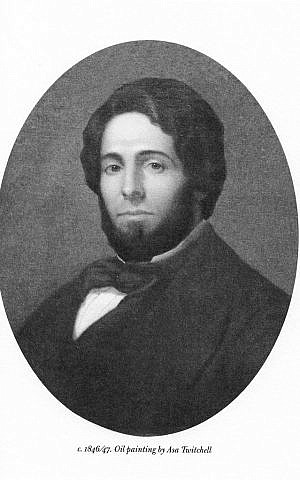
Ten years later, and some six years after completing the great novel that was never appreciated during his lifetime, Herman Melville arrived in Palestine. The 19 days he spent here were disastrous to his marriage and his writing career. The book he wrote after the visit took 19 years to produce. It is called “Clarel” and is set in Palestine. It consists of some 18,000 lines of rhyming verse. According to the exhibit catalogue, his wife said it “undermined all their happiness,” and nine years after its completion he referred to it as a “corpse.” He produced no further literary works.
Part of his trauma may be traced back to the fate of his hosts in Mount Hope, a Christian agricultural settlement outside of Jaffa. One year after he left, Arab marauders attacked the family he had stayed with, killing his host’s son-in-law, Freidrich Groβsteinbeck, and raping his wife and daughter. The family returned to the United States later that year, moving from Boston to Florida and then to California. Some members of the family performed in a crude traveling show depicting life in Palestine, “the most interesting spot on the Globe,” according to the original flyer on display. The daughter, Mary Dickson, was great aunt to John Steinbeck, who hinted at the tragedy in “East of Eden” and visited the scene of the crime when he came to Israel in 1966.
‘The idea of making farmers of the Jews is in vain. In the first place Judea is a desert with few exceptions. In the second place, the Jews hate farming’ — Herman Melville
The settlement Melville stayed in was devoted to making farmers out of the Jews. Johann Adolf Groβsteinbeck, the founder of Mount Hope, believed that the ingathering of the Jews was a stage on the path to Christian salvation.
Melville did not think that feasible: “The idea of making farmers of the Jews is in vain. In the first place Judea is a desert with few exceptions. In the second place, the Jews hate farming. All who cultivate the soil in Palestine are Arabs. The Jews dare not live outside walled towns of villages for fear of the malicious persecution of Arabs and Turks. Besides, the number of Jews in Palestine is comparatively small. And how are the hosts of them scattered in other lands to be brought here? Only by a miracle.”
During the American Civil War, tourist traffic stopped almost entirely.
Nonetheless, Ottoman grand vizier, Fuad Pasha, peered into the future and was concerned. In 1865, he stated: “I shall never concede to these crazy Christians any road improvement in Palestine, as they would then transform Jerusalem into a Christian madhouse.”
In September 1867, some two and a half years after the war, a rather impious reporter stepped off the stately Quaker City steamboat and began his tour through Palestine. He followed the same route as Commander Lynch, riding on horseback and sleeping in tents for much of his journey. To say he was disappointed is to put it too mildly.
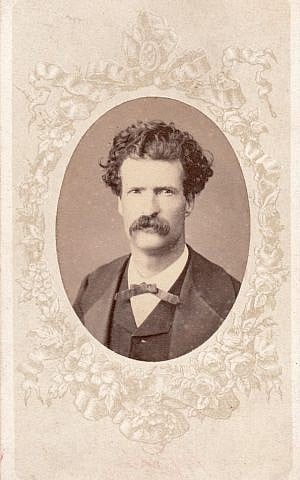
Mark Twain, writing for the Alta newspaper in San Francisco, several years before he sat down to write “Tom Sawyer” and “The Adventures of Huckleberry Finn,” had this to say of the Land of Milk and Honey: “Of all the lands there are for dismal scenery, I think Palestine must be the prince. The hills are barren, they are dull of color, they are unpicturesque in shape. The valleys are unsightly deserts fringed with a feeble vegetation that has an expression about it of being sorrowful and despondent…It is a hopeless, dreary, heart-broken land.”
Nazareth, in his writing, “is forlorn”; Jericho a “moldering ruin”; the “hallowed” spot outside Bethlehem “where the angels sang Peace on earth, good will to men, is untenanted by any living creature, and unblessed by any feature that is pleasant to the eye”; Jerusalem is “a pauper village”; Capernaum is “a shapeless ruin”; Magdala “the home of beggared Arabs”; Bethsaida and Chorazin “have vanished from the earth, and the desert places round about them where thousands of men once listened to the Saviour’s voice and ate the miraculous bread, sleep in the hush of a solitude that is inhabited only by birds of prey and skulking foxes.”
He called the entirety of the Holy Land “desolate and un-lovely” and pronounced it a “dream-land.”
He did, however, buy a handsome olivewood Bible for his mother.
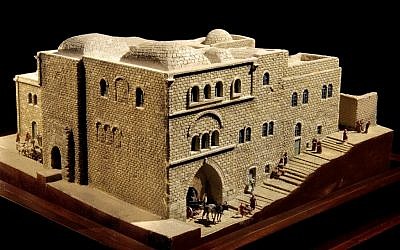
His comically venomous diatribes did little to staunch the tide of American tourism. Ulysses S. Grant, an admirer of Twain’s, according to the curators, set out for a tour of the Levant shortly after the end of his presidency. He was treated like a king.
American women had a different perspective. Mrs. Stephen Griswold, author of “A Woman’s Pilgrimage to the Holy Land,” wrote in 1872 that the local women “are meant to do the drudgery and are the slaves of men…The Bedouin Arab often thinks more of his horse than of his wife. Give him a piece of bread and he will share it with his horse.”
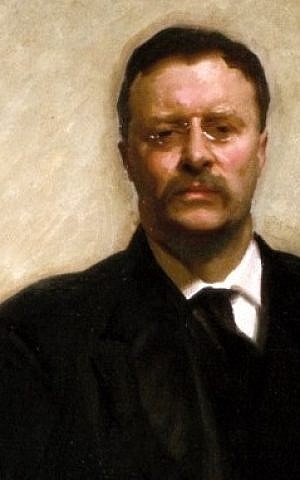
Perhaps most amusing are the writings of Prime Minister Benjamin Netanyahu’s favorite American, the young Theodore Roosevelt. Enamored with the “very pretty” women of Jaffa and surprised by the “remarkably small” city of Jerusalem, the 15-year-old future president described his visit to the Western Wall in his diary. “In the afternoon we went to the Wailing Place of the Jews. Many of the women were in earnest, but most of the men were evidently shamming.”








The Times of Israel Community.