

Hebron soldier claims company commander slapped him
Sgt. Elor Azaria, on trial for manslaughter of incapacitated Palestinian terrorist, begins testimony in military court
 Add ToI as a Preferred Source on Google
Stuart Winer is a breaking news editor at The Times of Israel.
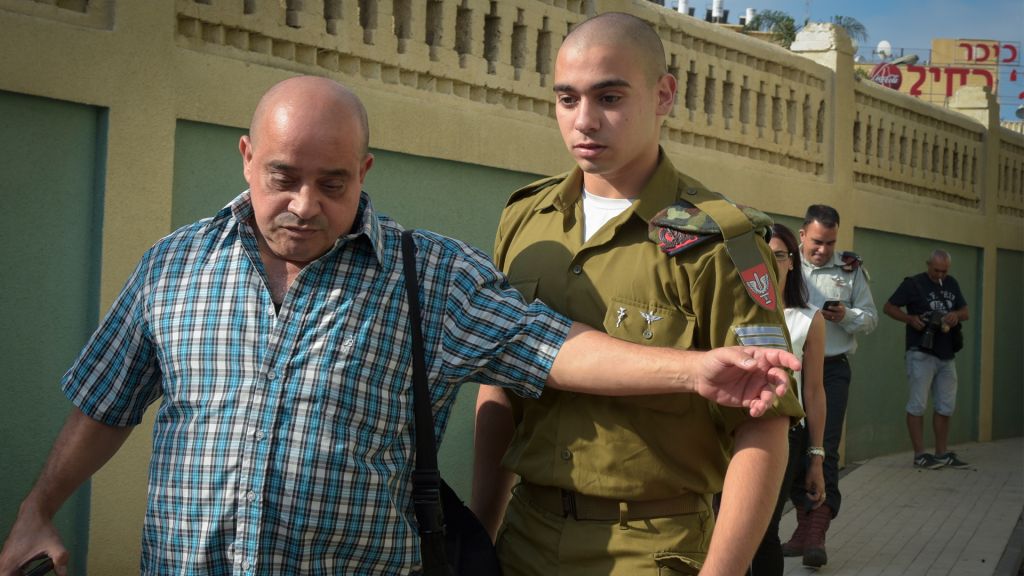
An Israeli soldier facing manslaughter charges for killing an incapacitated Palestinian attacker in March began to give his testimony Sunday at the Jaffa Military Court, claiming that his commanding officer slapped him in the minutes immediately after the shooting.
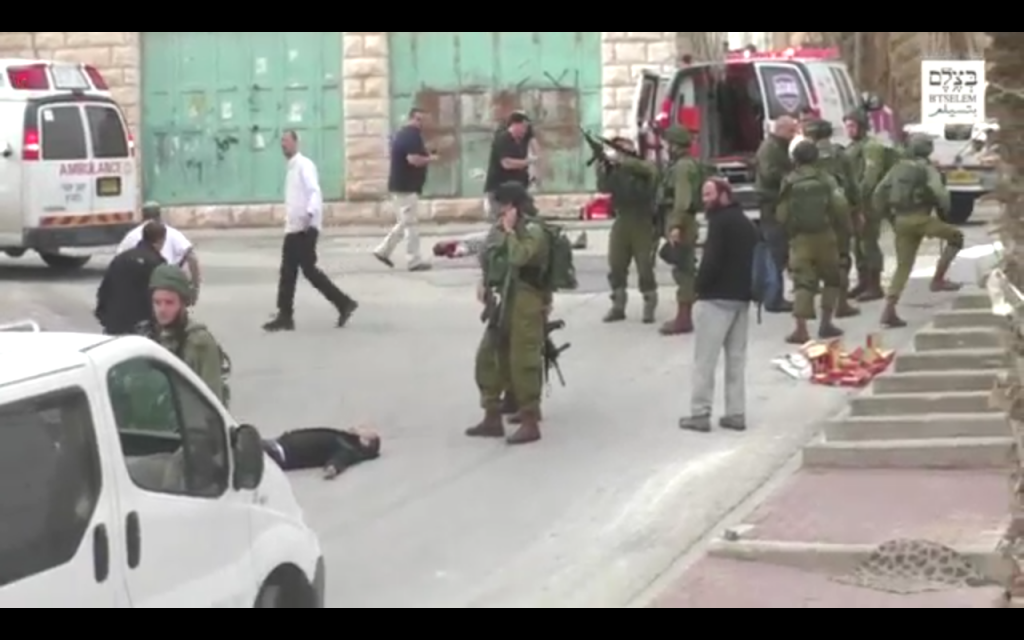
Sgt. Elor Azaria was describing the events of March 24, when he was filmed shooting Palestinian assailant Abdel Fattah al-Sharif in the head, nearly 15 minutes after Sharif was shot by soldiers as he attempted to stab an IDF soldier in Hebron.
Azaria was arrested by the Military Police later in the day, and was indicted on manslaughter charges on April 18.
At the beginning of Sunday’s proceedings, IDF prosecutor Nadav Weisman said the defense had notified prosecutors last week that Azaria had recalled more details about the incident.
In the letter, Azaria claimed his company commander, Tom Na’aman, slapped him shortly after the shooting. The defense called for a military police investigation into the incident.
Weisman told the court that the prosecution had no objection to including the new details in the trial, although he claimed it was “at least the fourth development in the defendant’s version [of the events].”
“We will of course bring this up in the cross-examination,” he said.
Azaria’s attorney Eyal Besserglick explained that his client was under a lot of pressure, which affected his mental state, and was “refreshing his memory four months after the event.”
Azaria opened with a description of his private life and his induction into the army. He noted that he grew up in Ramle, a city with Jewish, Arab, and Christian residents.
“I have Jewish, Arab, and Christian friends. There is no difference between them,” he said.
Despite health difficulties relating to having been overweight and having a bad knee, he told the court, he sought to serve in an elite combat unit in order to “contribute as much as possible to the country.”
He eventually joined the Kfir Brigade, an infantry unit, and was later selected for further training to become a combat medic.
Azaria also spoke of the difficulties soldiers serving in Hebron must endure.
“The magazine is always in [the rifle] and you are exposed to dangers,” he said. “It is a pressured place, and there is an atmosphere of fear. When you sleep you hear gunfire and explosions.”
He noted that although there is a lot of friction between Israelis and Palestinians in Hebron, “I treated everyone the way you treat people.”
His testimony is scheduled to last three days. It comes after the prosecution finished calling its witnesses to the stand, including Azaria’s commander and a B’Tselem activist who filmed the incident.
On Sunday, he was being questioned by his own attorneys, followed in the next two days by cross-examination by prosecutors.
His defense has argued that Azaria had reason to believe that his life was in danger when he fired the single bullet into Sharif’s head.
Most of the testimonies heard thus far in the trial, including from Azaria’s company, battalion and brigade commanders, contradicted his defense.
Earlier this month, Azaria’s battalion commander, Lt. Col. David Shapira, testified that Azaria was an exemplary soldier until the incident, but that he believed Azaria had fired in order to exact revenge and not out of fear that he was in danger.





The Times of Israel Community.