

Iran hits back at Trump after Islam speech, Saudi arms deal
Zarif suggests US ‘milking’ Riyadh of billions in various agreements, scorns president’s visit to ‘bastion of democracy & moderation’
 Add ToI as a Preferred Source on Google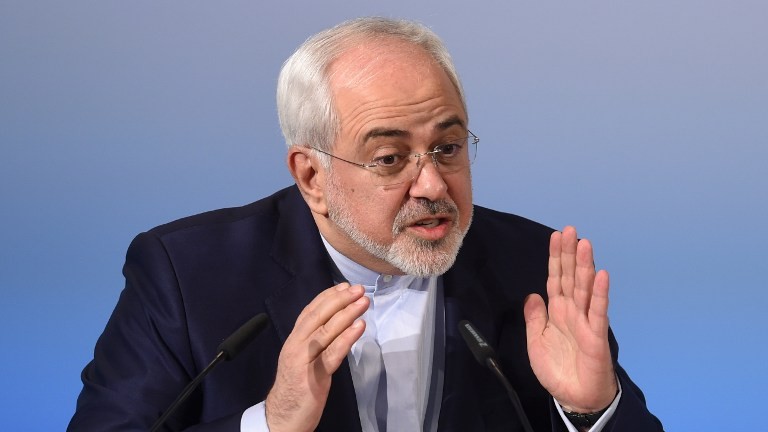
Iranian Foreign Minister Mohammad Javad Zarif tweeted on Sunday that the United States may be “milking” Saudi Arabia of $480 billion after Washington signed major deals with Tehran’s regional rival over the weekend, incluing a $110 billion arms deal effective immediately.
“Iran — fresh from real elections — attacked by @POTUS in that bastion of democracy & moderation. Foreign Policy or simply milking KSA of $480B?” Zarif tweeted on Sunday, a day after relative moderate President Hassan Rouhani won re-election in Iran.
Trump on Saturday attended a signing ceremony Saturday to cement a number of defense and business deals between the US and Saudi Arabia that US and Saudi officials said were “in excess of $380 billion.”
US and Saudi officials indicated that the $110 billion defense deal was included in that sum; Zarif’s calculation suggests it was separate.
Iran—fresh from real elections—attacked by @POTUS in that bastion of democracy & moderation. Foreign Policy or simply milking KSA of $480B? pic.twitter.com/ahfvRxK3HV
— Javad Zarif (@JZarif) May 21, 2017
Zarif’s was the first Iranian reaction to US President Donald Trump’s visit to Saudi Arabia, and came on the same day the US president delivered a long speech on Islam in Riyadh while slamming Iran.
In his speech Trump called on Middle Eastern leaders to combat a “crisis of Islamic extremism” emanating from the region, casting the fight against terrorism as a “battle between good and evil,” not a clash between the West and Islam.
Trump’s address Sunday was the centerpiece of his two-day visit to the kingdom, his first stop overseas as president. During a meeting of more than 50 Arab and Muslim leaders, he sought to chart a new course for America’s role in the region, one aimed squarely on rooting out terrorism, with less focus on promoting human rights and democratic reforms.
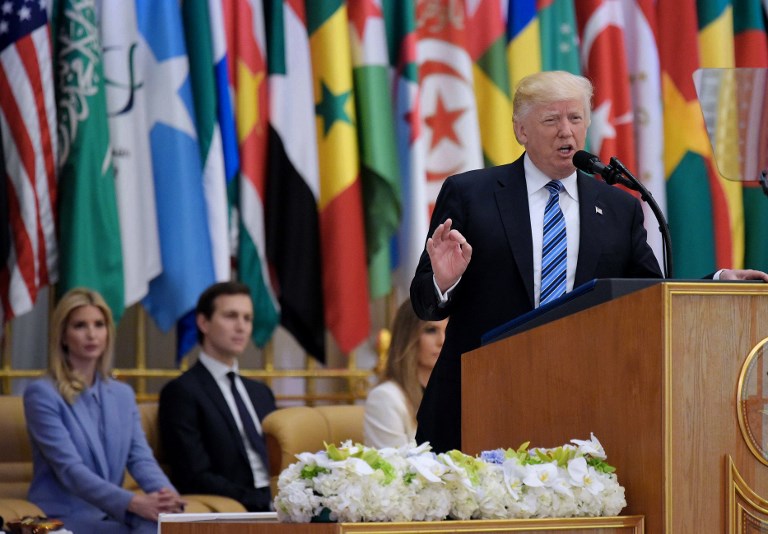
“We are not here to lecture — we are not here to tell other people how to live, what to do, who to be, or how to worship,” Trump said, speaking in an ornate, multi-chandeliered room. “Instead, we are here to offer partnership — based on shared interests and values — to pursue a better future for us all.”
He urged Muslim countries to ensure that “terrorists find no sanctuary on their soil” and announced an agreement with Gulf countries to fight financing for extremists.
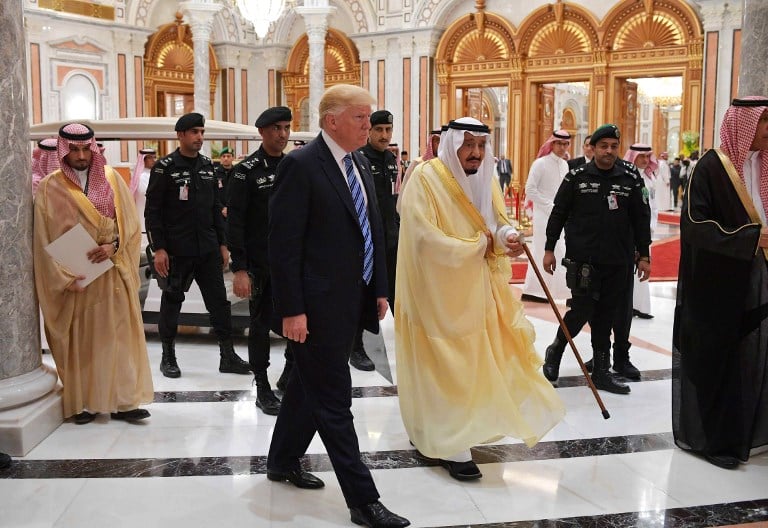
Even as the American president pledged to work alongside Middle Eastern nations, he put the onus for combating terrorism on the region. Bellowing into the microphone, he implored Muslim leaders to aggressively fight extremists: “Drive them out of your places of worship. Drive them out of your communities.”
But he said Middle Eastern countries must “honestly confront the crisis of Islamist extremism and the Islamist terror groups it inspires. [And stand] together against the murder of innocent Muslims, the oppression of women, the persecution of Jews, and the slaughter of Christians.”
Trump made almost no mention of Israel, his next stop on the tour Monday, leaving it off a list of countries fighting terror. But he briefly referred to his upcoming meetings with Prime Minister Benjamin Netanyahu and Palestinian Authority President Mahmoud Abbas.
“If three Abrahamic faiths can join together, then peace in this world is possible, including peace between Israelis and Palestinians,” he said.
Trump also devoted much of his speech to railing against Iran, accusing it of trying to destabilize the region.
“The people of Iran have endured hardship and despair due to their leaders reckless pursuit of conflict and terror. Pray for the day that the Iranian people have the just and righteous government they so richly deserve,” he said.
“It is a government that speaks openly of mass murder, vowing the destruction of Israel, death to America, and ruin for many leaders and nations in this room,” he added.
Read the full transcript of Donald Trump’s speech here.
He notably refrained from using the phrase “radical Islamic terror,” which had been a staple of campaign speeches and which he had chided predecessor Barack Obama for refusing to utter.
Trump’s trip to Saudi Arabia served as something of a reset with the region following his presidential campaign, which was frequently punctured by bouts of anti-Islamic rhetoric. He once mused that he thought “Islam hates us.”
But on Sunday, Trump was full of praise for Muslim world’s history and culture. He declared Islam “one of the world’s great faiths.”
For Trump, the visit has been a welcome escape from the crush of controversies that have consumed his administration in recent weeks. He’s been besieged by a series of revelations about the ongoing federal investigation into his campaign’s possible ties to Russia and his decision to fire FBI director James Comey, who had been overseeing the Russia probe.







The Times of Israel Community.