

Iran negotiator: No promises of nuke deal by Tuesday
Abbas Araqchi says nuclear talks in last ‘breathtaking’ moments; Zarif says negotiations to continue ‘as long as necessary’
 Add ToI as a Preferred Source on Google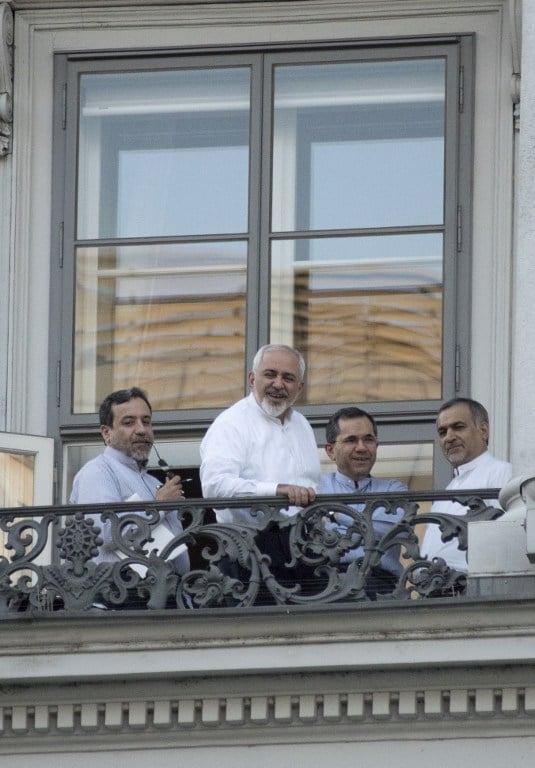
As the negotiations on Iran’s nuclear program were reportedly approaching their end on Monday, an Iranian negotiator said some issues remain unresolved, adding he could not promise an accord would be reached by Tuesday night.
Another Iranian diplomat said the parties were working to hammer out the deal by Monday, as the Iranian foreign minister said talks would proceed “as long as necessary.”
“Talks have reached the final breathtaking moments; certain issues still remain,” Abbas Araqchi said, according to the Iranian Press TV. “As long as these issues are not settled, one cannot say we have reached an agreement.”
“I cannot promise that the [outstanding] issues will be resolved by tonight or tomorrow night,” Araqchi added.
“No one is thinking of another extension. Everyone is working hard to get the yes today, but political will is still needed,” said Alireza Miryousefi on Twitter, according to the semi-official Fars News Agency.
Earlier, Iran’s foreign minister said he believed there should be no further extension to nuclear talks with major powers but he would negotiate “as long as necessary.”
“I always believe there shouldn’t be any extension but we could work as long as necessary to finish this,” Mohammad Javad Zarif said in English as he met his Chinese counterpart Wang Yi in Vienna.
Another member of the Iranian delegation, however, said the sides were working to finalize a deal by Monday night.
After more than two weeks of intense political haggling in Vienna aimed at ensuring Iran does not get a nuclear bomb, diplomats said an agreement was tantalizingly close.
Chinese Foreign Minister Wang Yi said the time had come to wrap up the talks, now in their 17th straight day.
No deal could be “perfect” but “conditions are already in place for a good agreement,” he told reporters as he arrived for discussions in the Austrian capital, speaking through an interpreter.
Foreign ministers from the so-called P5+1 — the United States, Britain, France, Germany, Russia and China — were gathering “to bring the negotiation to its conclusion,” he added.
“We believe that there cannot and should not be further delay.”
Iran’s President Hassan Rouhani was to address the nation about the nuclear talks on state television on Monday night, a media official told AFP in Tehran.
The official IRNA news agency said Rouhani would speak when the nuclear talks have concluded, but it did not give a time.
The six major powers want Iran to scale down its atomic activities in return for an easing of crippling sanctions.
They have already missed several deadlines in the highly complex discussions in Vienna, but diplomats were hopeful that this time would be different.
There had been optimism that a deal would be clinched over the weekend, but finalizing a framework accord struck in April has proved difficult, with talks stumbling on the exact timing of sanctions relief and Iran’s desire to have a UN conventional arms embargo lifted.
Such an accord, if it can be agreed, approved and implemented properly — which is also no small challenge — would draw a line under 13 years of failed diplomacy and threats of military action.
In return Iran will be granted staggered relief from painful sanctions, although the six powers insist on the option of reimposing the restrictions if Tehran breaches the agreement.
The prospect of a thawing of relations between Iran and the United States unsettles many in the Middle East, however, not least Tehran’s rivals Saudi Arabia and other Gulf monarchies.
Israel is deeply concerned about the impending deal, warning that the proposed deal will fail to stop its arch foe getting the bomb.
“We are heading toward a bad deal, and in the period after it we will of course have to continue preparing to protect ourselves on our own,” Defense Minister Moshe Yaalon said on Monday.
“It naturally contains implications on other states which perceive this situation as a threat, neighboring states that are talking about their need to be armed, which could start a regional nuclear armament race,” he said.
US Secretary of State John Kerry huddled with the rest of the P5+1 for fresh talks on Monday morning. When asked whether the deadline might be pushed back again, he did not reply.
Speaking in Brussels, French President Francois Hollande said the negotiations were picking up pace.
“We are not necessarily very far” from an agreement but that “does not mean we are there yet,” he said.



The Times of Israel Community.