

Katsav to seek pardon due to waning mental health — report
Attorneys for ex-president, in prison for rape, said set to appeal to Rivlin amid reports his condition ‘borders on insanity’
 Add ToI as a Preferred Source on Google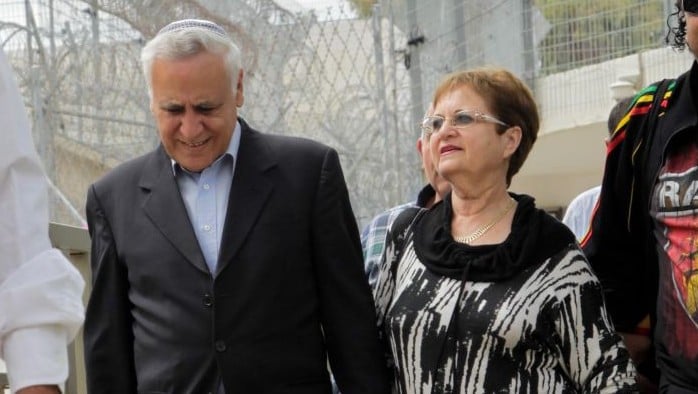
The attorneys for former president Moshe Katsav, who is in prison for rape, reportedly intend to seek a presidential pardon for their client, weeks after a parole board rejected his bid for early release.
Katsav, they intend to argue, fell into a deep depression when the board rejected his request to have one-third of his seven-year sentence knocked off for good behavior, the daily Yedioth Ahronoth reported Sunday.
The pardon request will be submitted to Justice Minister Ayelet Shaked in the coming days, before it lands on President Reuven Rivlin’s desk. According to unnamed legal sources cited in the report, Rivlin is likely to approve the request if a psychiatric evaluation is produced corroborating that Katsav’s mental health has greatly deteriorated.
Rivlin, for his part, said in a statement Sunday that he had yet to receive the appeal, and would mull such a bid “as he does any other pardon request, after receiving the opinions of all the relevant bodies.”
Associates of Katsav have maintained that when his bid for early release after four years behind bars was turned down last month, he became despondent, and chose to not appeal the decision because he lost faith in the parole process. Channel 10 reported the day after the board’s decision that prison authorities had placed the former president on suicide watch and that he was given counseling.
Sources quoted in Sunday’s report said that Katsav’s state now “borders on insanity.”
Katsav, 70, was convicted on December 30, 2010, of two counts of rape along with other sexual offenses, committed against female workers during his term as president as well as earlier, when he served as tourism minister. He was also convicted of obstruction of justice. He began serving his sentence in December 2011, and is slated for release in December 2018.
Rivlin and Katsav are former Likud party colleagues who served in the Knesset together for years before Katsav won the presidency.
In March, the parole board spent 11 hours reviewing Katsav’s case at a hearing during which the ex-president, at times in tears, made an effort to persuade the panel to shave off one-third of his seven-year sentence, while continuing to maintain his innocence.
On April 6, after twice delaying a decision, the board announced that it had rejected his plea. In citing the reasons for its decision, the board noted that Katsav continues to deny his guilt in the crimes for which he was convicted and shows no concern for the condition of his victims.
It is unusual to seek a presidential pardon without first exhausting other possibilities, which in Katsav’s case would include appealing the parole board’s decision. In the immediate aftermath of the ruling, his lawyers did indicate there would be an appeal, although the former president was later said to have lost faith in the process.
Before the parole board hearing, media reports said that both Rivlin and Shaked supported an early release for Katsav, but Rivlin’s office vehemently denied the reports.
According to a Channel 10 report at the time, Shaked asserted that there was no reason for the parole board to not order the release of Katsav.
“He meets the criteria [for early release],” Shaked reportedly said of the ex-president. The justice minister then added that both she and Rivlin would support pardoning Katsav if he were denied parole.
At the end of last month, Katsav was released for a three-day furlough from Ma’asiyahu Prison in Ramle for the Passover festival.
Times of Israel staff contributed to this report.





The Times of Israel Community.