

Ex-president Katsav said placed on suicide watch
Over 4 years into a 7-year prison term for rape, prisoner who ‘sees himself as a victim’ was denied early release by a parole board
 Add ToI as a Preferred Source on Google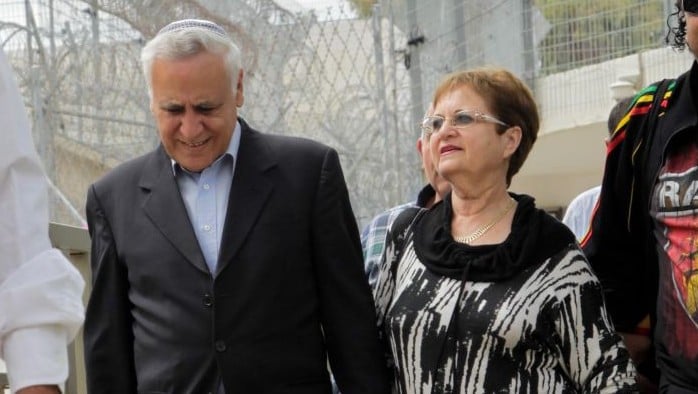
The Prisons Service has reportedly placed former president Moshe Katsav on suicide watch.
The decision follows Wednesday’s ruling by a parole board rejecting Katsav’s appeal for early release for good behavior, Channel 10 reported.
Katsav, 70, was convicted on December 30, 2010, of two counts of rape, among other related charges. He began serving his sentence in December 2011, and is slated for release in December 2018.
He had asked the parole board to cut one-third off his seven-year sentence, which would have meant his release in the coming weeks. After deliberating for over two hours Wednesday, the board unanimously turned down the request.
The board spent 11 hours last week reviewing Katsav’s case in a hearing during which the ex-president, at times in tears, continued to maintain his innocence.
In the public section of its report, the parole board noted Katsav’s troubled mental state.
“In front of us is a prisoner who denies the crimes that he committed, who continues to claim his innocence, despite the court ruling in his matter, and continues to spend time trying to prove his innocence, as though there had been no legal process,” the decision read.
“The board took note that the prisoner sees himself as a victim … and is busy solely with himself, his needs, his loss, and the price that he and his family have paid. Even in light of questions from the board, the prisoner didn’t show regret and/or empathy for the victims of the crime, but once again noted the heavy price he has paid and is paying,” it continued.
Katsav spoke “obsessively” about his own innocence, the board said.
According to Channel 10, the Prisons Service, too, is worried about his mental state, and has been preparing for a possible rejection of his request.
The service is considering assigning a prison guard to accompany Katsav around the clock in order to prevent any attempt to take his own life.
Katsav will also be given psychological counseling.
The former president’s attorney, Zion Amir, said after the announcement Wednesday that Katsav would appeal the decision and continue to fight to clear his name, and suggested the board was swayed by public sentiment against Katsav.
“I very much regret that in our society decision makers are enslaved to outside moods that lead to decisions like this,” Amir said.
Katsav can make another plea for parole in six months’ time.
The decision to keep Katsav in jail was met with praise from many public officials and victims groups.
“This is a clear message to society that the justice system will not tolerate at any level any disregard for crimes against women, especially if the culprit is a senior public figure,” said MK Aida Touma Sliman (Joint List), who heads the Knesset Committee on the Status of Women and Gender Equality. “There is no parole board that can deduct one third of the pain from the women that Katsav hurt.”
Katsav, who has served four years and four months, had told his close friends that he was “not especially optimistic” that he would be granted the early release, according to Channel 2 news.
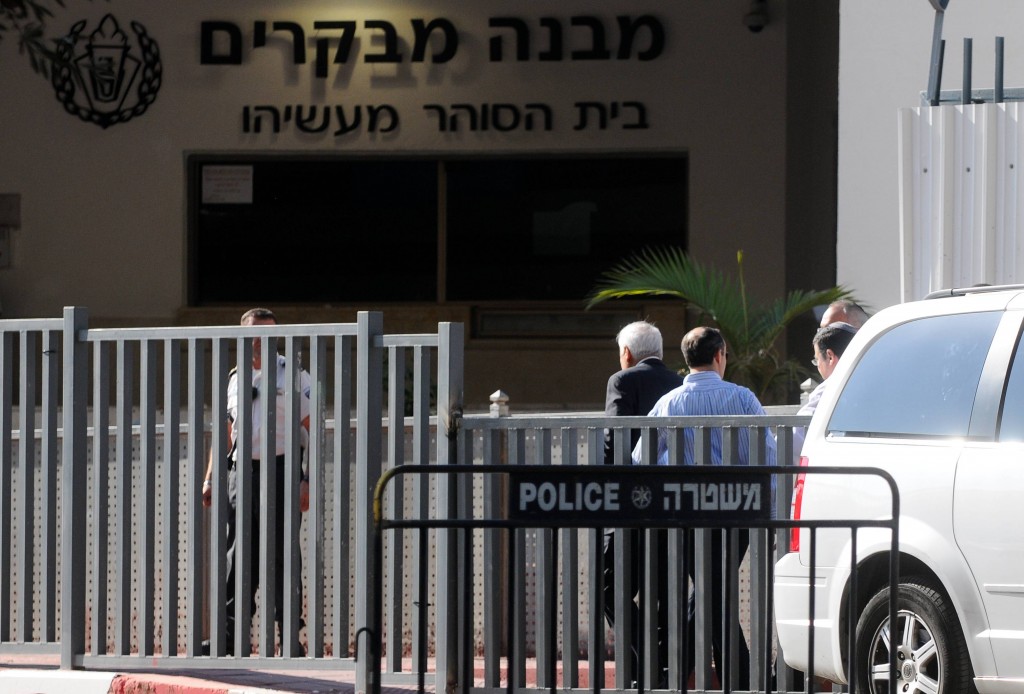
At the parole board hearing last Sunday, Katsav continued to maintain his innocence, as he has throughout his trial and prison term.
Speaking at that hearing, a representative of the Justice Ministry expressed the ministry’s opposition to Katsav’s early release. Katsav had not proven “he was worthy of an early release,” primarily due to his continued refusal to accept the court’s verdict and take responsibility for his crimes, the state representative said. He has also refused to undergo rehabilitation programs in the prison, he said.
Last week’s hearing was expected to produce a decision, but board members asked to delay the decision until this week. A second date, set for Sunday, was also pushed off.
The parole request triggered a firestorm of criticism, including from lawmakers and at least one of Katsav’s victims.
If he went free, “it would be unprecedented in Israel, and would send a very negative message, both about women and about sex offenders,” Odelia Karmon, who was assaulted by Katsav in the early 1990s, told Army Radio last week.
Karmon worked with the former president when he served as transportation minister from 1988 to 1992.
Early parole is very common in the Israeli prison system, with a majority of prisoners managing to obtain the standard one-third reduction to their sentence for good behavior.
The Prisons Service has said Katsav’s behavior as a prisoner has been above reproach.
If his second parole request is denied later this year, Katsav will still be able to appeal for a pardon by President Reuven Rivlin. The two are former Likud colleagues who served in the Knesset together for years before Katsav won the presidency.
Stuart Winer, Raoul Wootliff and Dov Lieber contributed to this report.







The Times of Israel Community.