

Police gear up to enforce nightly curfew; ultra-Orthodox town may resist order
After delays, new rules for 40 virus hotspots to go into effect at 7 p.m.; Beitar Illit says it will comply only if government offers more information; schools also to be closed
 Add ToI as a Preferred Source on Google
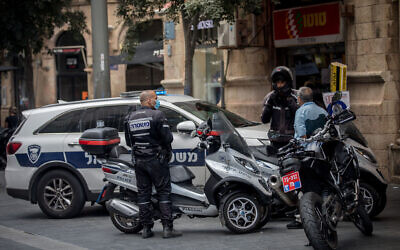
The Israel Police on Tuesday said it was gearing up to impose a nightly curfew in 40 coronavirus hotspots around the country, as one ultra-Orthodox town warned it would only comply with the order if the government provided convincing explanations on its necessity.
Ministers on Tuesday approved nightly curfews of dozens of cities and towns with high coronavirus infection rates, effective from Tuesday evening for a week, after Israel saw its highest-yet number of daily COVID-19 cases.
The curfews will be in effect every day between 7 p.m. and 5 a.m. through September 15. During the curfew, residents must keep within 500 meters of their homes and non-essential businesses will be closed. Schools will be closed at all times, except for special needs programs.
Four hours before the first curfew, acting police chief Motti Cohen concluded a briefing and said he expects officers to exercise judgment while enforcing the closure.
“Our enforcement policy will continue to be based first and foremost on dialogue, education, judgment and earning the public’s cooperation,” he said in a statement. “That is my expectation from every commander and officer tasked with this mission.
“It is expected that the public keep the law and heed police instructions, since we can only protect our public health together and stem the spread of the virus,” he added.
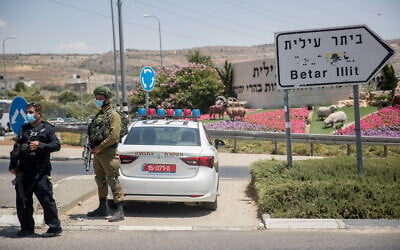
The government decision was met with anger by some of the localities, with Beitar Illit — an ultra-Orthodox West Bank settlement of some 60,000 residents — demanding more information.
“We demand full transparency about infection rates and detailed explanations why a curfew is being imposed on an entire ultra-Orthodox city,” the Beitar Illit municipality said in a statement. “We cannot give our backing to steps taken without transparency. We will be able to cooperate in cutting morbidity rates only when such explanations are provided to the residents.”
Jerusalem Mayor Moshe Lion said he would comply with the government order on the nighttime curfews in parts of the capital, though he strongly criticized the policy.
“I don’t know what a nightly curfew is,” Lion told the Kan public broadcaster. “For two months we’ve been warning about mass weddings in the eastern part of the city. When we speak about a nightly curfew in Ramot, a neighborhood of 55,000 residents, it means they’re going into lockdown because of about 300 patients. I can’t explain that to the residents.”
The list of affected cities and neighborhoods was published by the Health Ministry and the Prime Minister’s Office late Tuesday morning.
The roster includes all of Bnei Brak, Beitar Ilit, Umm al-Fahm, and Nazareth, as well as parts of Jerusalem, Ashdod and Eilat.
A full list can be found below.
The release of the list came only hours before the rules are set to go into effect, after repeated delays by the government.
On Sunday night, the government pulled back from a plan to impose lockdowns on some cities with especially high infection rates, instead announcing the nighttime curfews and the closing of schools.
The curfews were meant to go into effect on Monday night, but were delayed by a day as politicians and health officials argued over which cities should be impacted.
The earlier plans for local round-the-clock lockdowns were shelved after heavy pressure on Prime Minister Benjamin Netanyahu from the ultra-Orthodox community.
Four Haredi mayors published an unprecedented open letter Sunday accusing the prime minister of “trampling” their communities and “turning us into disease vectors and enemies of the people.”
Most of the municipalities on the “red” list are Arab, and with a few exceptions, many Arab Israeli mayors have welcomed new restrictions to fight the spread of the coronavirus in their cities and towns.
Officials insist a nationwide lockdown is still a possibility, especially over the upcoming High Holidays. A key cabinet discussion on the matter is expected on Thursday.
According to the Ynet news site, ministers in the so-called coronavirus cabinet will discuss a proposal by virus czar Ronni Gamzu to shutter all schools across the country over the holiday period, from September 18 through October 10.

The Health Ministry said Tuesday that 3,425 new coronavirus cases were confirmed over the previous day — the highest daily figure since the start of the pandemic, shattering a previous record set last week. According to Health Ministry data, the total number of cases hit 135,288 on Tuesday morning, of which 106,297 have recovered.
Of the 27,962 active cases, 467 are in serious condition, 134 of them on ventilators. Another 154 are in moderate condition, with the rest displaying mild or no symptoms. Overall, 467 people are hospitalized with the disease.
The death toll rose to 1,031, showing nine deaths over the previous 24 hours.
The full roster of cities and neighborhoods being placed under nightly curfew:
- Bnei Brak
- Elad
- Umm al-Fahm
- Taibe
- Tira
- Nazareth
- Netivot
- Abu Snan
- Eilat’s Shahmon neighborhood
- the Gimmel, Zayin, Het neighborhoods of Ashdod
- the Ashkelon neighborhoods of Mitzpe Barnea, Ganei Barnea, Naot Barnea, Givat Zion and Carmei Zion
- Buqata
- Beitar Illit
- the Ramat Beit Shemesh Alef, Ramat Bet Shemesh Gimmel and Menuha and Nahala neighborhoods of Beit Shemesh
- Najidat
- Baqa al-Gharbiyye
- Julis
- Jaljulya
- Jatt
- Daliyat al-Karmel
- Avatan, in the Zemer region
- Yafa an-Naseriyye
- Kasra-Samia
- Kafr Bara
- Kafr Manda
- the municipal area of Kafr Qassem, with the exception of industrial zones Lev Haaretz and Nof Haaretz
- Kafr Qara
- Lakiya
- Musheirifa and Salem in the Ma’ale Iron region
- Ein Mahil
- Emmanuel
- Assafiya
- Fureidis
- Arara
- Qalansawe
- Reineh
- Rechasim
- Sderot’s Naot Yitzhak Rabin and Naot HaNeviim neighborhoods
- Shfaram
- Nine neighborhoods of Jerusalem will also be affected: Kafr Aqab, Beit Hanina, Ramat Shlomo, Ramot, A-Tur, Issawiya, Anata, Shuafat refugee camp and Sanhedria.



The Times of Israel Community.