

Seven-year odyssey puts Israeli-American writer on fantasy map
After crossing continents and traversing the world of Jewish Orthodoxy, Ilana Teitelbaum proved she wasn’t writing ditties with the feminist-tinged ‘Last Song Before Night,’ and now has a second track for the highly touted trilogy on the way
 Add ToI as a Preferred Source on Google
Deputy Editor Amanda Borschel-Dan is the host of The Times of Israel's Daily Briefing, What Matters Now and The Reel Schmooze podcasts, and heads up The Times of Israel's features.

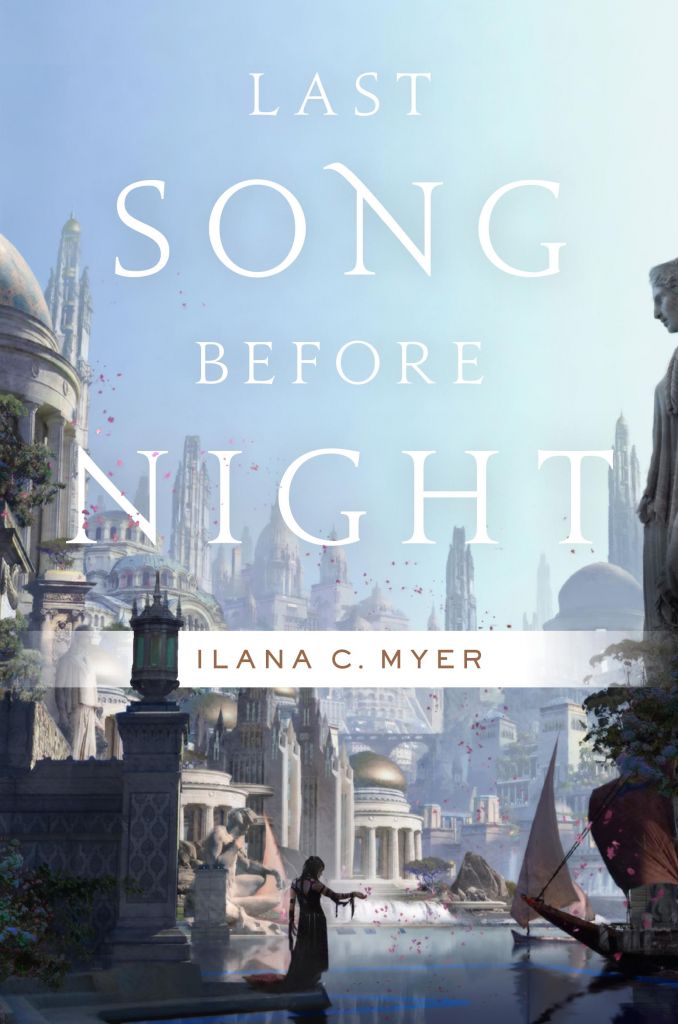
Ilana C. Myer’s lyrical debut novel “Last Song Before Night” is a multi-sensory voyage best taken during a vacation. When reading this blood-pounding odyssey into the bowels of Eivar, the real world will be soundly ignored.
Eivar is a land where music is a conduit to religion, power, and forbidden magic. With all the notes of a fantastical anime opera, the novel’s heroes and anti-heroes pull on your heart — and sometimes make you tear out your hair.
After being published by Tor/Macmillan in October 2015 in hardcover, ebook, and audiobook, the Japanese rights to “Last Song Before Night” were sold in April to Tokyo Sogensha. And now in November, the book is to hit international shelves again in paperback.
Seven years in the writing, the epic is the first of a three-book deal scored by the first-time author. After three years of work, its sequel was recently submitted for revisions, aiming for a 2017 publication date.
This recent success after so many years of dedication to her craft is a dream come true for the American-Israeli author, who once earned minimum wage as a secretary in the Empire State Building. Ilana C. Myer is the pen name of Ilana Teitelbaum, a young writer now living in New York, who grew up between two worlds after her family immigrated to Jerusalem in 1993 when she was 12.

A misfit in Jerusalem at her religious Hebrew-language high school, Teitelbaum spent most of her time in class writing a fantasy novel — longhand and in pencil. And while she learned some Jewish history and math with a tutor, her true masters were C.S. Lewis, Lloyd Alexander, and J.R.R. Tolkien.
“Very early in life I knew I wanted to write books like that,” Teitelbaum told The Times of Israel from her New York home in a phone conversation.
Although in her journalistic writing she appears as “Teitelbaum,” she humorously writes on her website that she “decided early on — since the days of haunting bookstores, in fact — that ‘Teitelbaum’ was too long for a book cover.”
“Myer” is in honor of her grandmother’s family, which was all but wiped out during the Holocaust in Germany. “It is a family with a long history of writers, so it seems appropriate to give credit — or blame — where it’s due.”
“Last Song Before Night” could only be a credit to her family.
At 416 pages, the epic opus was carefully crafted and pruned, and included music as its anchor only after several revisions. Teitelbaum said she was inspired to follow this musical motif after a class in Celtic literature she attended at Queens College.
To create the book’s ruling semi-monastic Order of the Poet, Teitelbaum blended the ideas of the revered Celtic troubadour who spread religious mythology with his later, more sophisticated, counterpart who sang about love in Medieval European courts.
In fictional Eivar, this highly trained league of itinerant men travel the land to teach and entertain its less-educated populace — and control it.
But early drafts of the work did not include the pervasive religious element it now has. Teitelbaum said she originally steered away from it, in fear of introducing avodah zarah or worship of false idols. However, said Teitelbaum, “without a religion animating it, the world was not rich enough.”
One of the book’s main characters is Lin, a fugitive noblewoman in drag who runs away from an abusive home to pursue her true love, music. Playing a “pants role” in the operatic adventure, Lin is strong where many others are weak. But Teitelbaum said she didn’t intentionally create this feminist element in the book.
“It’s so interesting, I was not aware of it most of the time. I see this book now as being very emblematic of my journey — as an Orthodox woman trying to have an identity and a voice in a world that was so antithetical to that,” she said. Today, while she says she is still on the religiously observant spectrum, like Lin, Teitelbaum has often found that “the solution [she found] wasn’t much of a solution at all.”
In retrospect, there is “a lot of unconscious struggle and anger channeled into this book, that I wasn’t aware of at the time of writing.”
Like most successful authors, her big break into publishing didn’t come through luck, but rather hard work.
‘I see this book now as being very emblematic of my journey — as an Orthodox woman trying to have an identity and a voice’
“I concentrated as much energy as I could into writing the best book I could. After I finished, we moved [from Israel] to New York, then I concentrated on meeting people in the literary world and making connections,” said Teitelbaum. “It took a long time to get an agent and get the ball rolling. I’d say I put as much into the networking as into the writing.”
In the near-decade of writing “Last Song,” Teitelbaum moved from New York to Jerusalem, and back to New York. The bulk of the novel was completed in Jerusalem, during a year in which her parents supported her while she wrote 100,000 words — and fell in love with the nice Jewish boy who became her husband.
The much-awaited sequel also has an international origin: It was started in a Parisian cafe.
“This next book required a great deal of research because I was determined not to do the same thing, or even a similar thing, again,” wrote Teitelbaum in a blog post announcing the manuscript’s submission.
But regardless of its setting beyond the borders of Eivar, the sequel aims to retain what made “Last Song” so special — soul.
“No matter how far afield we might go into enchantments and epic battles in fantasy, the human heart is — it seems to me — where it all ends up, and must begin,” said Teitelbaum.










The Times of Israel Community.