Israeli swimmers (from left to right) Ben Enosh, Luc Chetboun, 46, Ud Erel, 66, Ori Sela, 41, Doron Amosi, 45, Oded Rahav, 43, celebrate after swimming in turns 248 miles from the Mediterranean island of Cyprus to Israel in an attempt to break the World record and the Guinness world record for longest swim in open sea and to raise awareness on sea protection, on October 11, 2014 in the Israeli coastal city of Herzliya. (photo credit: AFP/ JACK GUEZ)
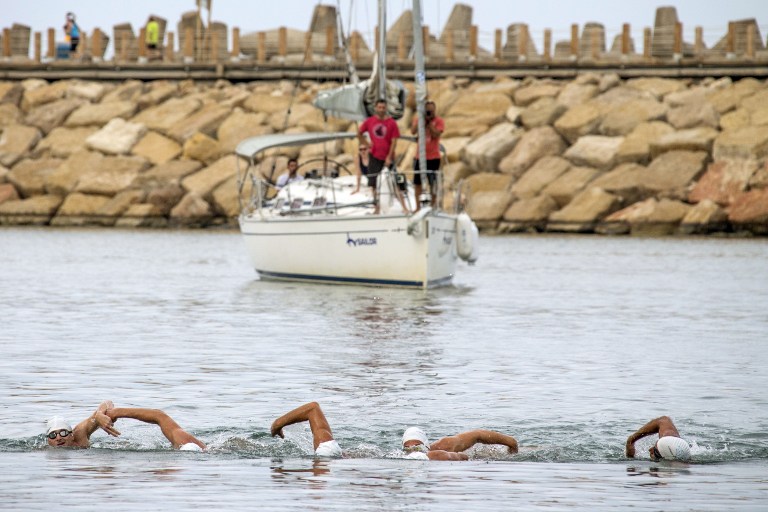
Six Israelis on Saturday claimed the world open water relay record after swimming 380 kilometers (236 miles) home from Cyprus in a challenge also meant to highlight ocean pollution.
One of the obstacles they faced while swimming from the Mediterranean island to the Israeli coast was the proliferation of floating plastic bags.
The men, aged 42 to 66, had left at noon Sunday from the Cypriot resort town of Paphos, accompanied by a support vessel also equipped to document their feat for a crack at the Guinness Book of World Records.
Their eyes were set on a 366-kilometer record held by Americans, swimmer Oded Rahav told journalists in Herzliya.
Israeli swimmers (from left to right) Ben Enosh, Luc Chetboun, 46, Ud Erel, 66, Ori Sela, 41, Doron Amosi, 45, Oded Rahav, 43, arrive in Israel after attempting to break the World record and the Guinness world record for longest swim in open sea and to raise awareness on sea protection, on October 11, 2014 in the Israeli coastal city of Herzliya. (photo credit: AFP/ JACK GUEZ)
Swimming day and night in one-hour relays, with one team-mate watching at any given time and the others resting, they arrived in Rishon Lezion late Friday.
Get The Times of Israel's Daily Editionby email and never miss our top stories
The men had made a previous attempt on the record last year, but a storm forced them to abandon it midway.
This time, aside from jellyfish, curious dolphins and water temperatures a bit chilly for only swimming trunks, the main obstacle was a plague of plastic bags.
“To swim through plastic bags is humiliating and intolerable,” one of them said. “The sea should be a sanctuary for all and conserved for all.”
Advertisement
Help us report truthfully on social media
As a multimedia journalist, my job is to take the quality, fact-based journalism produced by The Times of Israel newsroom and make it accessible across every platform — from Instagram posts to podcasts to short-form videos.
This is how many, especially young people, consume news these days. But misinformation is rampant on social media. Our team at ToI produces accurate, responsible short-form reporting on Israel and the Jewish world.
If you believe in the importance of factual social media journalism, please consider joining our reader support group, The Times of Israel Community. Your financial support is essential to sustain responsible multimedia reporting.
We’re really pleased that you’ve read X Times of Israel articles in the past month.
That’s why we started the Times of Israel - to provide discerning readers like you with must-read coverage of Israel and the Jewish world.
So now we have a request. Unlike other news outlets, we haven’t put up a paywall. But as the journalism we do is costly, we invite readers for whom The Times of Israel has become important to help support our work by joining The Times of Israel Community.
For as little as $6 a month you can help support our quality journalism while enjoying The Times of Israel AD-FREE, as well as accessing exclusive content available only to Times of Israel Community members.
Thank you, David Horovitz, Founding Editor of The Times of Israel


 Add ToI as a Preferred Source on Google