

Tales of love and tolerance told on YouTube
Documentary filmmakers match up social activists with local celebs from the video-sharing website
 Add ToI as a Preferred Source on Google
Jessica Steinberg, The Times of Israel's culture and lifestyles editor, covers the Sabra scene from south to north and back to the center
Not so long ago, Barak Heymann knew very little about YouTube.
The documentary filmmaker — one-half of Heymann Brothers, his company with brother and partner, Tomer Heymann — makes films about Israelis, including “Lone Samaritan,” “Who’s Gonna Love Me Now,” and the award-winning “Mr. Gaga,” about Batsheva Dance Company artistic director and choreographer Ohad Naharin.
The company’s latest project, “Work in Progress” — an initiative of Dibur Aher, or A Different Kind of Talk, promoting moderation and tolerance in cyberspace — focuses on a particular breed of Israeli: the Israeli YouTube star.
This series of eight short clips brings together local Israeli YouTube celebrities, including Sugar Zaza, Guy TV and Noa Filter, with local social activists, aiming to create a meeting of minds and ideas that is broadcast to the millions of viewers who ordinarily tune in to these YouTube stars.
The initiative is part of Dibur Aher, which was begun following President Reuven Rivlin’s 2015 Herzliya conference speech in which he warned against the deterioration of Israeli society and the development of “tribal” society segments of Arab, ultra-Orthodox, national religious and secular Israelis and spoke of the need to better understand and connect to one another.
Dibur Aher, sponsored by Google Israel, the Lautman Foundation and the Shaharit Institute, is an effort to recognize the racism and violence that exists online in Israeli forums and works to find ways for people to get to know the “other.”
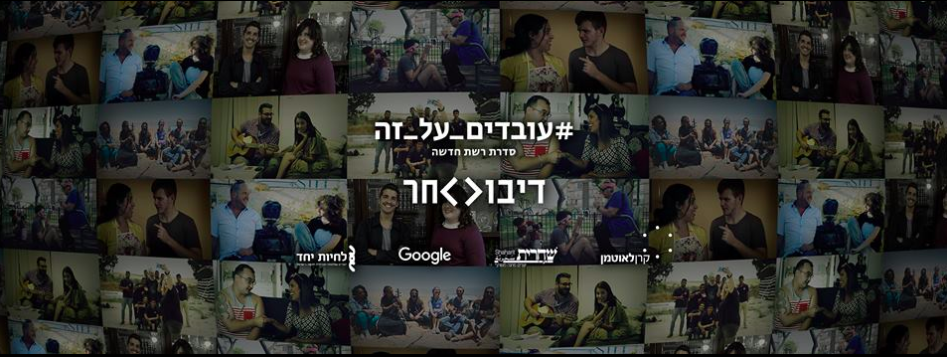
The Heymann Brothers’ part in all of this is “Work In Progress,” eight six-minute videos in which famous local YouTubers who have thousands of subscribers meet Israeli social activists. The whole series was inspired and supported by YouTube Creators for Change, a global initiative tackling social issues and promoting awareness and tolerance.
“In one day of filming, we would create a meeting between them that is curious, but touches upon the conflicts and pain and sometimes causes fireworks,” said Heymann. “There are different kinds of energies and agendas, and it’s a kind of documentary with drama and something that happens.”
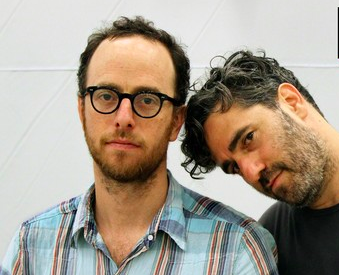
The series, which is shown on the YouTube channel of Dibur Aher as well as on HOT Channel 8, concluded its eighth episode in September and Heymann hopes to continue the project.
“It’s been very interesting for us because it’s somewhat of an antithesis to our work,” he said. “We usually work on these films for five to eight years, with hours of filming, and this is completely different.”
With this project, the Heymann Brothers had to enter the world of the YouTube stars.
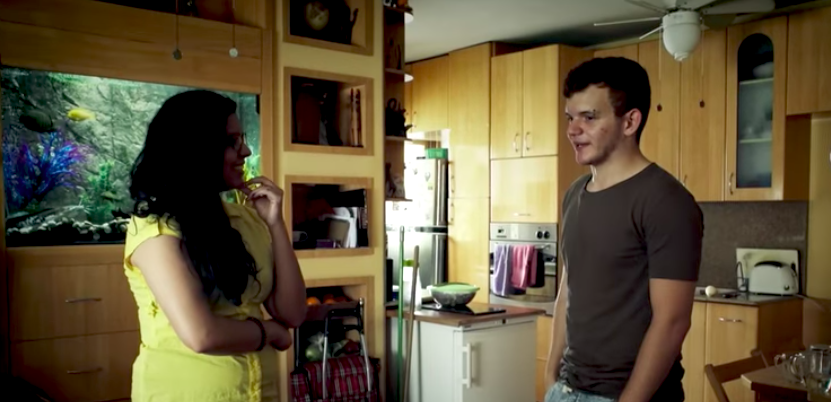
They discovered GuyTV, whose real name is Guy Podolovich, a high school student in Lod with 220,000 subscribers. He met with vegan Palestinian activist and feminist, Kifah Dasuki, who recently published a cookbook, “Kitchen of Peace.”
They’re not exactly a match made in heaven, this redheaded teenager from a Russian immigrant family who appears with Dasuki, a sophisticated, well-spoken twenty-something Arab woman.
Podolovich, in previous episodes, poked fun of Arabic phrases and Hamas songs, but he’s open and (mostly) interested in Dasuki and what she has to teach him.
He’s not a vegan kind of guy, GuyTV tells Dasuki, but as they shop and cook together (she chops more than he does), the two talk about what it’s like being an Arab in Israel, while Podolovich tells a little about where he’s from, a Russian Israeli living in a mixed Israeli neighborhood.
It’s a taste of two personalities that leaves viewers wanting more.
The Heymann Brothers also chose Sugar Zaza, whose real names are Or Paz and Tom Trager, with 194,000 subscribers. The pair met with Bella Bryks-Klein from the Yiddish Books Center, spending half a day together, making jokes about the unlikelihood of Yiddish in Israel and how it sounds to the untrained ear.
YouTube-style, the series developed quickly, with each episode filmed during the course of one day. They chose their YouTube stars from among hundreds of YouTube channels, looking for characters who were smart, open-minded and authentic, and willing to leave their comfort zones and experience something new.
“These are worlds that would never otherwise meet,” said Heymann. “The message is not that we love each other and get along, but that we don’t always get along and we don’t have to be the same, but let’s stop being afraid and get to know each other on the most basic level.”
Another memorable episode paired pastry chef Or Ben Oliel with Zippy Bornstein, a Haredi pioneer of employability training for women in the ultra-Orthodox sector. The two met in Bornstein’s home in Bnei Brak, including a stint in the street when Ben Oliel clashed verbally with ultra-Orthodox men about his recent marriage to his boyfriend.
“I’m super insulted,” said Ben Oliel when one of the other men calls him an “unfortunate person.”
Ben Oliel and Bornstein talked about stigmas and stereotypes while frying up Moroccan cookies in Bornstein’s kitchen, later heading to a local old-age home.
“Let’s wake up,” said Bornstein at the end of the clip. “If we love this country and want to live together, we have to believe in a new language and work hard for it.”
Each episode in “Work in Progress” had one section filmed by the Heymanns and another by the YouTuber. The series has subtitles in English, Hebrew and Arabic available through the settings button on the screen.
The project examined the magic and difficulties in Israeli society, which can be racist and difficult and yet filled with “so many good people who want to connect and don’t know how to do it,” said Heymann.
Heymann said he was surprised by the YouTube stars, who he thought would be kids spoiled by their sudden fame.
“I didn’t know what I was talking about,” he said, adding that his brother, Tomer, had a more balanced view.
“He told me, ‘Yes, there’s junk, but that’s in high art too,'” said Barak Heymann. “‘There are some who are very talented and open and funny, and there’s someone to work with here.'”
Their challenge, said Heymann, was to enter the teenager-populated world of the YouTube stars.
“That opened our minds,” said Heymann. “It created some kind of understanding that what’s happening on YouTube is not something that reflects life itself or an alternative world, but rather life for many people, so you have to understand it.”
Now the Heymanns, along with their YouTube stars and social activists, are traveling around the country, speaking to high school students and their parents about how to take this series and use it for good.
“It’s been eye-opening for all of us,” said Heymann, “and we want to spread the word as much as possible.”
“Work in Progress” will be screened at the Jewish Film Festival at the Jerusalem Cinematheque in December, when the 50-minute version will be shown followed by a discussion with some of the main characters.








The Times of Israel Community.