

Tight security, low turnout as Lebanon holds local elections
Municipal vote held nationwide for first time since 2010; results expected as early as Monday
 Add ToI as a Preferred Source on Google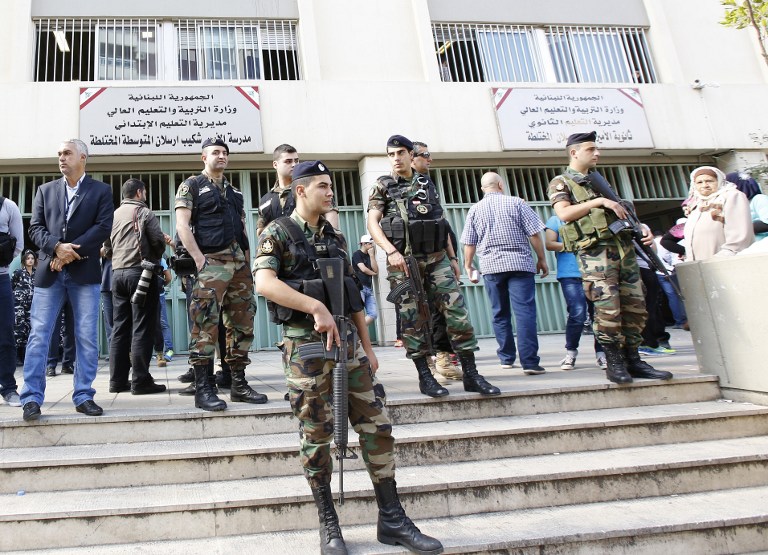
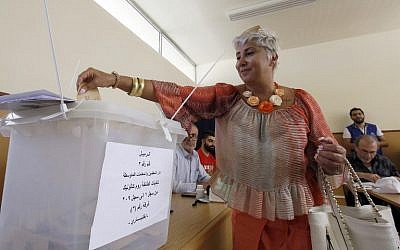
BEIRUT (AP) — Lebanese voted Sunday in municipal elections in Beirut and the Bekaa Valley amid tight security and a low turnout in the capital that has recently seen the largest anti-government protests in years following a months-long trash crisis.
Security was tight in the country as authorities took strict measures to guarantee that the vote passes without trouble. Lebanon was hit by a wave of bombings in recent years that killed scores of people and Syria’s civil war has spilled over in the past.
Sunday’s vote is the first to be held in the country since 2010. The government has postponed parliamentary elections, citing security concerns linked to the conflict in neighboring Syria. Lebanon has also been without a president since 2014, with the parliament failing to elect a leader amid political disagreements, and a paralysis among political rivals often related to their stance on the war in Syria.
Polling stations for the municipal election will be open on Sunday from 7 a.m. to 7 p.m. (0400 GMT to 1600 GMT). Results are expected as early as Monday.
There are 1.8 million voters registered for this round of voting. Three other rounds will take place over the coming weeks in other parts of the country.
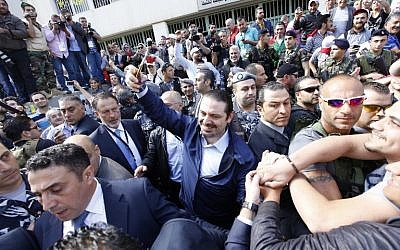
In Beirut, residents are voting for the first time since an eight-month trash crisis ignited anti-government protests, with an outsider group of candidates challenging a political establishment widely seen as corrupt and incompetent.
Beirut Madinati, Arabic for “Beirut, My City,” has vowed to clean up both the city’s streets and its politics. It is running against “Beirutis,” a list backed by several political groups, including the powerful predominantly Sunni Muslim Future Movement of former Prime Minister Saad Hariri, the Shiite Muslim Amal group and the country’s three main Christian groups.
Lebanon’s powerful Hezbollah group is only backing neighborhood mayors, but not municipal candidates, in Beirut. Hezbollah has a strong base in the country’s south and the Bekaa Valley, and is fielding municipal candidates there.
But turnout was low in Beirut by the afternoon. The interior minister said turnout was at 13 percent in the capital. The highest turnout was in Baalbek, a Hezbollah-stronghold near the Syrian border, where 33 percent voted.
Nadine Labaki, a well-known film director and candidate on the Beirut Madinati list, called on voters to “not let us down” in a televised interview.
“It is not necessary that everything related to our daily life must wait for political parties to come to an agreement,” she told Al-Jadeed TV.
Madinati hopes to channel the energy of the protest movement, which emerged in response to the trash crisis that stemmed from a government failure for months to reach an agreement on how to deal with it. The protests went on to challenge the political class that has governed Lebanon since the end of its 1975-1990 civil war.
In one of the Bekaa’s main cities, Baalbek, political groups, primarily Hezbollah and allied Shiite group Amal are pitted against family-backed candidates.
A day ahead of the elections, Lebanese army and police intensified patrols and deployed in front of polling stations. Motorcycles were banned on the day of the vote in an apparent attempt to head off potential attacks or speedy getaways. And to avoid late night crowds, Beirut’s famed nightclubs were ordered closed while bars and restaurants had to shut after midnight Saturday.
In the eastern town of Arsal, a curfew was imposed on tens of thousands of Syrian refugees until the polling stations close.
Lebanon is home to more than a million registered Syrian refugees, the equivalent of a quarter the country’s population of 4.5 million. Another half million unregistered Syrians live in the country.
“Their situation is not right. It is a dangerous thing. Hopefully, when the municipality is elected, they will find a solution for them and they don’t stay in town here and return to their country,” said voter Walid Saramani from Zahleh, a major town in the Bekaa valley.
Successfully organizing the municipal elections will strengthen the argument that delaying other votes for security concerns is unnecessary.
“These (elections) prove that Lebanon’s democracy is in good shape and we can hold elections,” said Hariri, the son of late Prime Minister Rafik Hariri, who was assassinated by a massive bomb in Beirut in 2005.
Copyright 2016 The Associated Press.






The Times of Israel Community.