

Top Likud minister raises possibility of unity government with Blue and White
Tzachi Hanegbi says together, under Netanyahu, parties could have ‘impressive achievements,’ but Likud quickly distances itself from the idea
 Add ToI as a Preferred Source on Google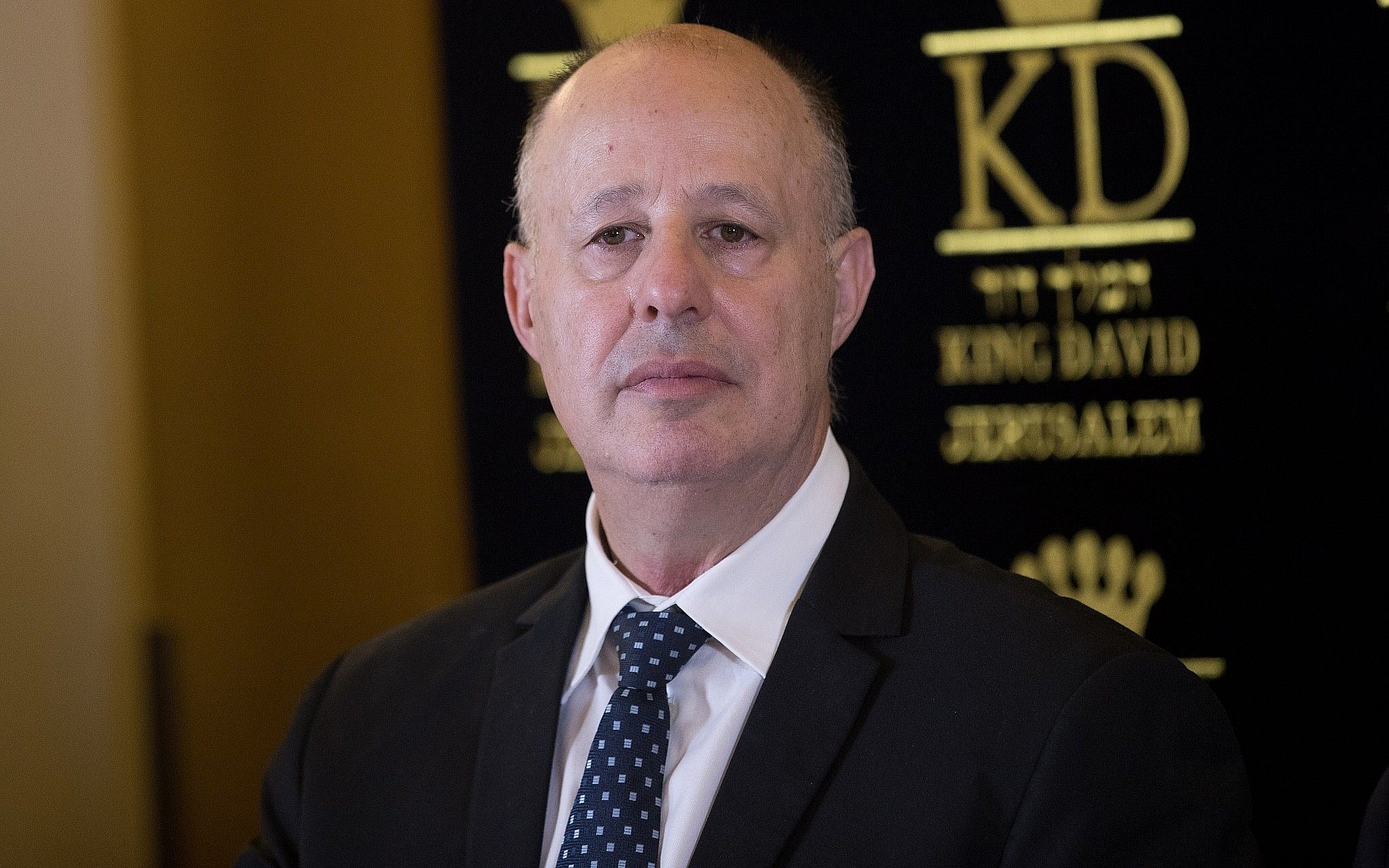
Regional Cooperation Minister Tzachi Hanegbi of Likud said Saturday he could envision Prime Minister Benjamin Netanyahu inviting opposition Blue and White to form a unity government following the next general election if the party stops “ruling out” the prime minister as a potential partner.
Speaking to Channel 12’s “Meet the Press,” Hanegbi indicated a Likud-Blue and White government could solve the political deadlock that led to the collapse of recent attempts to build a coalition and which may very well persist following the September 17 national poll.
Blue and White “ruled out Bibi because they thought it would lead to a [leadership] change inside Likud,” Hanegbi said, using Netanyahu’s nickname. “They didn’t understand Likud’s essence.”
Hanegbi said he believed if Blue and White party leaders Benny Gantz and Yair Lapid “make a switch and say ‘I am willing to sit in a government with Netanyahu,’ we’ll have a unity government with impressive achievements.”
Asked if Netanyahu, who spent much of the recent election campaign attacking Blue and White and portraying it as a “weak left,” would be open to forming a coalition with them, Hanegbi said: “I believe there’s no doubt.”
Doubts were quickly voiced, however, with Likud issuing a statement that “Hanegbi’s comments were his own. Likud and the prime minister wish to form a strong right-wing government led by a large Likud and Netanyahu.”
Meanwhile, Yisrael Beytenu chief Avigdor Liberman, whose refusal to join the government under the terms offered led to the collapse of coalition talks and the calling of new elections, said Saturday evening his party continued to support the formation of a right-wing government after the upcoming vote.
“We are definitely in favor of a right-wing government. I don’t care who leads it,” Liberman told Channel 12. “But we will not agree to an ultra-Orthodox government.
“We are in favor of a Jewish state but against a halacha state,” he said, referring to Jewish religious law.
Liberman had repeatedly said he backed Netanyahu for prime minister, but would only join the government if there was a commitment to pass, unaltered, the Defense Ministry version of a bill regulating the draft of the ultra-Orthodox into the military. That version of the bill is opposed by ultra-Orthodox parties, who want to soften its terms.
Amid reports Likud now seeks to crush his party and ensure it does not pass the electoral threshold, Liberman said he had “no intention of running a personal campaign [against Netanyahu]. I plan to run a campaign on the issues.
“I have no personal issue here. This isn’t a vendetta and I’m not settling scores,” he insisted. “It all depends on the government’s fundamental principles and obligations [it will undertake].”
Liberman’s conduct during coalition talks, and his dogged insistence on the draft bill undergoing no changes, has led many to speculate he was seeking to topple, and perhaps even supplant, Netanyahu.
Liberman did not entirely rule out a bid for the premiership on Saturday, but also downplayed it.
“I see myself heading my own party. I have to succeed. I’ve never said that the dream to be a prime minister dazzles me. We’ll do our utmost. If we have enough seats, we’ll consider [the premiership]. If not, we’re rational people,” he said.
Netanyahu has blamed the Yisrael Beytenu party chief for “dragging the country to unnecessary elections.” On Thursday he said he would have been able to form a coalition had it not been for Liberman’s “delusions of grandeur fueled by personal ambition.”
Netanyahu said the Yisrael Beytenu head scuttled the negotiations because of a personal vendetta against him. “He doesn’t want me to be prime minister so he won’t let anyone.”
Notably, it was Netanyahu who decided to call new elections. The more natural course of events would have been to inform President Reuven Rivlin that he had failed to form a coalition, at which point the president could have tasked another member of parliament with trying to do so.









The Times of Israel Community.