

Turkey, Iran, Egypt blast new Charlie Hebdo Muhammad sketch
British and North American Muslims urge peaceful reaction to depiction of prophet in first post-attack issue
 Add ToI as a Preferred Source on Google
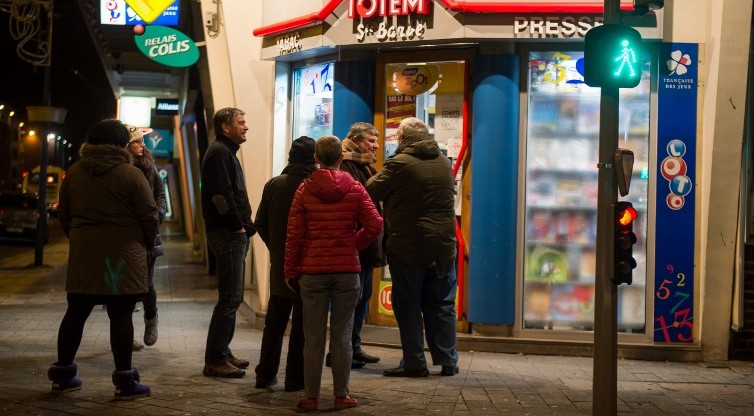
Parisians lined up Wednesday to empty the newsstands of the first issue of Charlie Hebdo, a week after Islamic extremists attacked the satirical newspaper’s office, and French justice officials began cracking down by arresting dozens of people who glorified terrorism or made racist or anti-Semitic remarks.
The editors of the publication again put a caricature of the Prophet Muhammad on the cover, and it quickly sold out by early morning around the capital and elsewhere, with long lines and scuffles at kiosks. Disappointed buyers were told to come back Thursday when more of the increased print run of 5 million copies will be available.
But across the Muslim world, criticism of the cartoon abounded.
In Turkey, a court in a southeastern city ordered a ban on access to websites showing the cover of Charlie Hebdo’s new edition after a lawyer filed a petition saying it would endanger public order, the state-run Anadolu News Agency reported.
The issue was banned in Senegal, in west Africa, and the spokesman for the Brussels prosecutor’s office, Laurens Dumont, said four shops in one neighborhood were threatened in one Brussels neighborhood if they sold it.
In the Philippines around 1,500 people packed the main square in the Muslim-majority city of Marawi, some raising their fists in the air as the Charlie Hebdo poster was burnt. Several hundred also protested in the streets of the Mauritanian capital.
Egypt and Iran also condemned the “provocative” publication.
Egypt’s top Islamic authority, Dar al-Ifta, had warned against publishing the cover after its content became known Monday.
“This action is an unjustified provocation against the feelings of 1.5 billion Muslims,” read a statement from the authority.
“This [magazine] edition will result in a new wave of hatred in French and Western society. What the magazine is doing does not serve coexistence and the cultural dialogue Muslims aspire to.”
The jihadist Islamic State group called the publication of the cartoon “an extremely stupid” act.
The magazine cover “provokes the emotions of Muslims and hurts their feelings around the world, and could fan the flame of a vicious circle of extremism,” said Iranian foreign ministry spokeswoman Marzieh Afkham. She added that the carton was “insulting” and “provocative.”
She added that the new cartoon was “abuse of freedom of speech, which is common in the West these days.”
Iranian Foreign Minister Mohammad Javad Zarif told reporters Wednesday “unless we learn to respect one another it will be very difficult in a world of different views and differing cultures and civilizations,” he said, according to the Huffington Post. “I think we would have a much safer, much more prudent world if we were to engage in serious dialogue, serious debate about our differences and then what we will find out that what binds us together is far greater than what divides us.”
The new issue of Charlie Hebdo followed an attack by Islamist gunmen last week at the magazine’s office in Paris which killed 12 people.
Iran denounced the massacre the day it occurred and Afkham said Wednesday that such attacks “have no closeness or similarity to Islam” and are “in complete contradiction to Islamic teaching.”
The Islamic Society of North America said in a statement that the cartoon “incites already increasing anti-Muslim sentiment.”
“While we respect everyone’s right to freedom of speech, even when it offends and disparages our religious traditions, we also have the right to address and peacefully challenge a narrative that encourages anti-Muslim bigotry, Islamophobia and xenophobia . . . Instead of trying to heal a country and bring the French together in a time of tragedy, cartoons like the new one put out by Charlie Hebdo only incites already increasing anti-Muslim sentiment. Free speech has always come with social responsibility. If speech or expression incites people to commit violence and harm on others then it should not be allowed in our society,” said Edgar Hopida, communications director for ISNA according to HuffPo.
A group of British-Muslim leaders said the cartoon was offensive but urged calm and a measures reaction.
“Most Muslims will inevitably be hurt, offended and upset by the republication of the cartoons. But our reaction must be a reflection of the teachings of the gentle and merciful character of the Prophet (peace be upon him). Enduring patience, tolerance, gentleness and mercy as was the character of our beloved Prophet (peace and Blessings be upon him) is the best and immediate way to respond,” they said in a statement.
In defiance of the terrorists who killed its staff, Charlie Hebdo’s new edition had a cartoon of a tearful Muhammad on its front page holding a sign saying “Je suis Charlie” (“I am Charlie”).
He was shown under the ambiguous title “All is forgiven.” Cartoonist Renald “Luz” Luzier said he cried after drawing it.
Some followers of Islam feel any depiction of the prophet is sacrilege.
The magazine, which printed 5 million copies instead of its usual 60,000, was sold out in many locations in Paris within minutes of going on sale.
In Turkey, police stopped trucks as they left a pro-secular newspaper’s printing center and checked the paper’s content after it decided to print a selection of Charlie Hebdo cartoons, the paper said on Wendesday.
Cumhuriyet newspaper said police allowed distribution to proceed after verifying that the satirical French newspaper’s controversial cover featuring the Prophet Muhammad was not published.
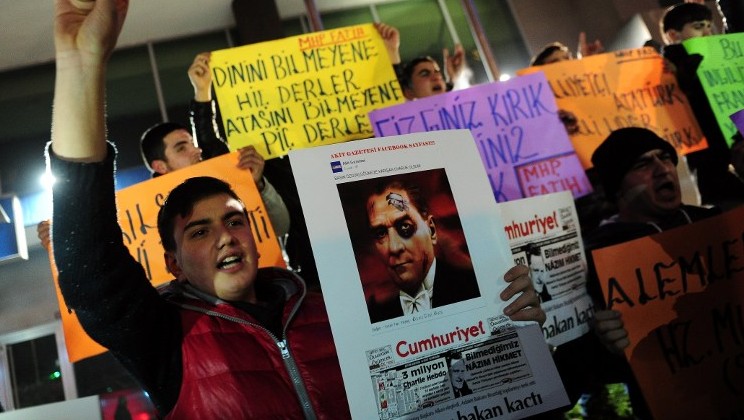
The paper printed a four-page selection of cartoons and articles on Wednesday in a show of solidarity with Charlie Hebdo but left out cartoons which Muslims may find offensive. However, two Cumhuriyet columnists used small, black-and-white images of the Charlie Hebdo cover as their column headers in Wednesday’s issue.
“While preparing this selection, we respected societies’ freedoms of faith and religious sensitivities,” said Cumhuriyet’s editor-in-chief Uktu Cakirozer.
“Following a large number of consultations we decided not to include the magazine’s cover page,” Cakirozer said. He did not mention the two columnists’ decision to use images of the cover in their columns.
Caricatures featured in Cumhuriyet included some depicting Pope Francis and French President Francois Hollande, and one referring to a massacre by Boko Haram in Nigeria.
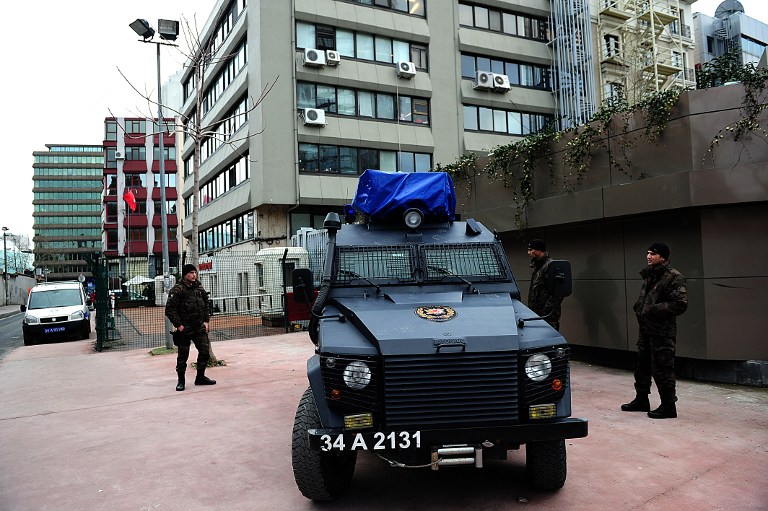
Police intensified security outside Cumhuriyet’s headquarters and printing center as a precaution. A small group of pro-Islamic students staged a protest outside the paper’s office in Ankara, the state-run Anadolu Agency reported.
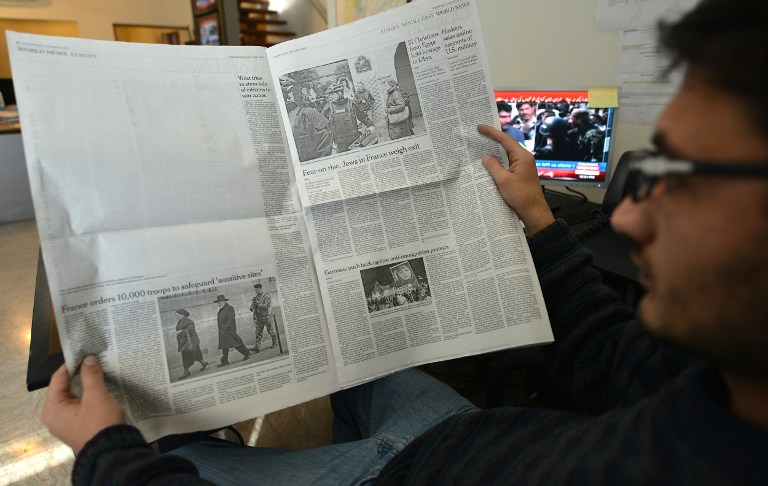
In Pakistan, censors removed an article about the cartoon whole cloth from editions of the New York Times’s international edition.
A statement at the bottom of the section read “The article was removed by our publishing alliance in Pakistan. The International New York Times and its editorial staff had no role in its removal.”
On Tuesday, Al-Azhar, Sunni Islam’s most prestigious center of learning, warned that the new cartoons will only serve to “stir up hatred.”
The drawings “do not serve the peaceful coexistence between peoples and hinders the integration of Muslims into European and Western societies,” the Cairo-based body’s Islamic research center added in a statement.
Last Wednesday Islamic extremist brothers Cherif and Said Kouachi attacked the offices of Charlie Hebdo magazine killing ten workers and two policemen. The brothers declared the shooting was in revenge for the weekly having published cartoons featuring depictions of the Prophet Muhammad. They were both later killed in a shootout with police.
The killings, which came alongside the slaying of a policewoman and four Jewish shoppers at a kosher grocery in the French capital by another Islamic gunman, drawn global condemnation and prompted a unity march in Paris on Sunday, led by 50 world leaders and diplomats, that was attended by over 1.6 million people.





The Times of Israel Community.