

With PM’s seat wobbling, both ultra-Orthodox leaders soften toward rivals
UTJ’s Litzman says could consider unity government if it doesn’t include Lapid; Shas’s Deri says it’s time to end ‘boycotts’ and divisive language
 Add ToI as a Preferred Source on Google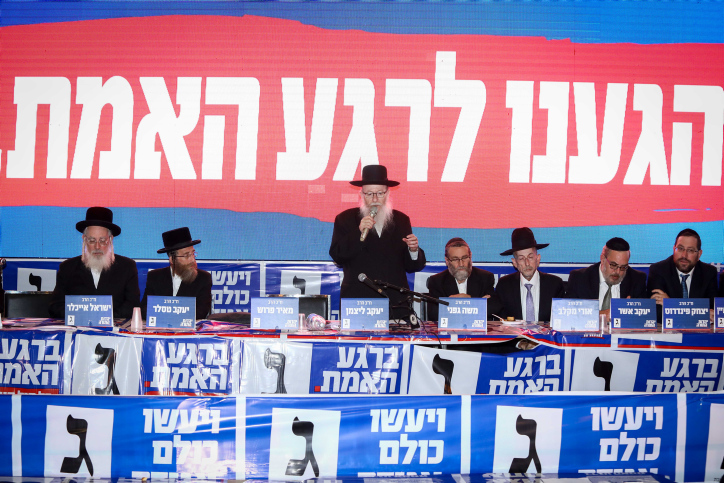
As exit polls in Tuesday’s national election showed Prime Minister Benjamin Netanyahu without a clear path to forming a government, ultra-Orthodox parties continued to insist they would back him as candidate for premier.
But they also appeared to leave the door open to cooperation with Blue and White and other previously hated rivals — or at least parts of it.
TV exit polls indicated that neither Likud nor Blue and White could easily secure a 61-seat majority in the 120-seat Knesset. Talk thus turned to a possible unity government between the two major parties — one that could potentially leave the ultra-Orthodox sidelined.
Both ultra-Orthodox parties appeared to have done well in Tuesday’s elections, but both were clearly allied with a now weakened Netanyahu, and both are bitterly opposed by potential coalition kingmaker Avigdor Liberman.
At a party gathering, United Torah Judaism chief Yaakov Litzman, whose party was projected to win eight seats, told activists he did not rule out a coalition led by Netanyahu that would include Blue and White, so long as it did not include his political partner Yair Lapid.
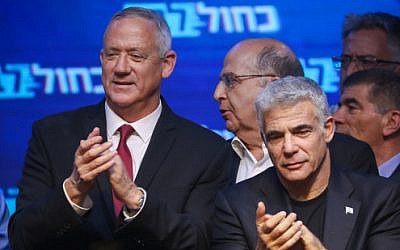
Lapid is loathed in ultra-Orthodox circles for his secularist policies during his stint in the government in 2013-2014, which they claim targeted the Haredi population.
“Unfortunately, these elections were full of incitement and attacks against the ultra-Orthodox and religion,” he said. “We hope and pray that this terrible discourse will end.”
Ahead of the vote the right-wing Yisrael Beytenu party and Blue and White both said they would seek to form a secular coalition. Ultra-Orthodox parties have painted such policies as discriminatory and even anti-Semitic.
Shas party chief Aryeh Deri, with a projected eight-nine seats, was also conciliatory in his comments Tuesday night, saying: “We are one people. We will be in this country together. I call on everyone to forget the language of incitement and rifts and to start talking as Jews.”
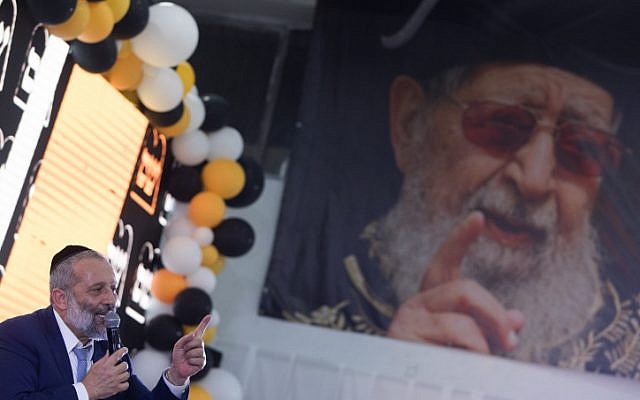
As for the campaigns that vowed to seek a secular coalition, Deri said “I hope the boycotts dissipate, that was just an election campaign.”
The projected results of Tuesday’s election showed that Netanyahu’s Likud party would not be able to form a coalition of ultra-Orthodox and right-wing parties without Yisrael Beytenu. Throughout its campaign, the Yisrael Beytenu party has said it would refuse to serve in a government with the ultra-Orthodox and has also heavily criticized far-right politicians as “messianists.”
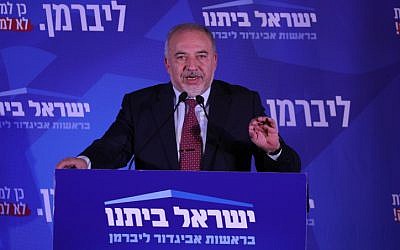
Yisrael Beytenu chief Liberman has vowed to force a secular unity government on Likud and Blue and White and repeated that promise on Tuesday night, saying “We have only one option: a broad, liberal, national government, made up of Yisrael Beytenu, Likud, and Blue and White.”
Liberman is seen as being the main cause of Tuesday’s do-over elections, having been the primary impediment to Netanyahu’s efforts to form a government following the previous vote in April, due to his clashes with the ultra-Orthodox parties.










The Times of Israel Community.