

The silence and the fury
PM may have hit the mute button for 44 seconds at the UN, but the press isn’t about to follow suit, as pundits have much to say about his speech and recent wave of terror
 Add ToI as a Preferred Source on Google
Joshua Davidovich is The Times of Israel's Deputy Editor
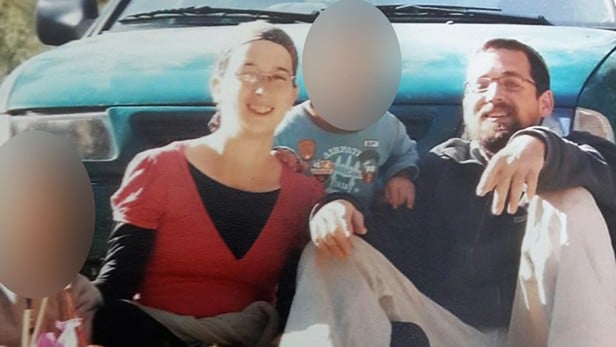
Four kids watch in horror as their parents are gunned down on a West Bank road. Prime Minister Benjamin Netanyahu stands glowering silently at the world. Both events took less than a minute Thursday evening and were but a small part of much larger stories. But in those two separate minutes, Israel’s Hebrew-language press found a font, and let its words — fuming, wretched and thought-provoking words — flow forth.
Unsurprisingly, much of the focus of the papers is on the terror attack, with tabloids Yedioth Ahronoth and Israel Hayom taking a micro view (Both papers’ A1 headlines point out the fact that the couple were “murdered in front of their children”) and broadsheet Haaretz emphasizing the more macro security implications of the tragedy.
Several commentators in the two tabloids point out their personal connections to the victims of the tragedy.
Writing in Yedioth, columnist Hanoch Daum notes that he took the road Wednesday where the attack took place on Thursday, and tries his heartbroken best to demonstrate the enormity of the killings of Eitam and Naama Henkin.
“The murderers, they saw the four little kids. They saw their shocked faces. They heard their pleas. One of them even came close to Eitam’s and Naama’s dying bodies to ‘confirm the kill,’ right next to their kids’ faces,” he writes, using a Hebrew term for a kill shot employed to make sure a victim is dead. “They didn’t want to leave any room for doubt. They didn’t want to take the risk that God forbid the mother or father would survive, and the tragedy of the four little children wouldn’t be so complete.”
Writing in the same paper, Yifat Ehrlich (who also mentions she traveled on the same road Thursday) says that silence in the face of the murders is not the answer, in an apparent reference to the 44 seconds of stone-cold glaring during Netanyahu’s United Nations speech.
“Don’t be quiet. The world cannot continue to be silent in the face of Palestinian terror, of lone wolves and of organizations, of naming streets and schools for martyrs,” she writes. “There can’t be silence in the face of atrocity.”
Israel Hayom’s Emily Amrousi, who was a personal acquaintance of the victims, gives a settler’s view of the shooting, putting it in the context of the near-daily rock-throwing attacks in the West Bank and heightened tensions.
“At night I lock my windows and doors, don’t let my kids sleep in the sukkah, try to push my fears way down. And that’s here. The devil that took the life of Naama and Eitam in front of their kids’ eyes. He goes around like a poison, between our yards, our schools, our roads that we travel on when rushing to the hospital to give birth and where families drive on trips,” she writes.
Unlike its competitors, Haaretz’s coverage of the attack is aimed more at minds than hearts.
Analyst Amos Harel predicts the punishing crackdown on West Bank Palestinians that the shooting (and smaller rock attacks) will bring, as well as the possibility some renegade settlers may decide to exact their own vengeance.
“Even though there’s no clear cycle of attack followed by revenge attack, the Shin Bet is taking the possibility of a revenge attack that could be carried out by right-wing extremists. Tensions among settlers are high — and there’s no guarantee that their response to this latest murder will be limited to a demonstration at the nearest junction, and clashes with police and IDF soldiers,” he writes.
“The IDF chain of command within the General Staff and the Central Command has a great deal of experience dealing with incidents like these. Reinforcements will be sent to the sector to secure the roads and ease settlers’ concerns for their safety. Last night, IDF Chief of Staff Lt. Gen. Gadi Eisenkot ordered that four additional battalions be sent immediately to Samaria. Also, Palestinian villages in the area are being encircled by troops — a step not taken for many long years. At the same time, many suspects will be arrested in attempts to obtain intelligence on the murders. Despite all that, the army doesn’t intend to drastically change the rules of engagement or standing orders for soldiers in the West Bank.”
Silence is golden, or is it?
Haaretz is the only paper to not devote its first several pages to the attack, instead giving its prime real estate (save the front page) to Netanyahu’s speech and Russian attacks in Syria.
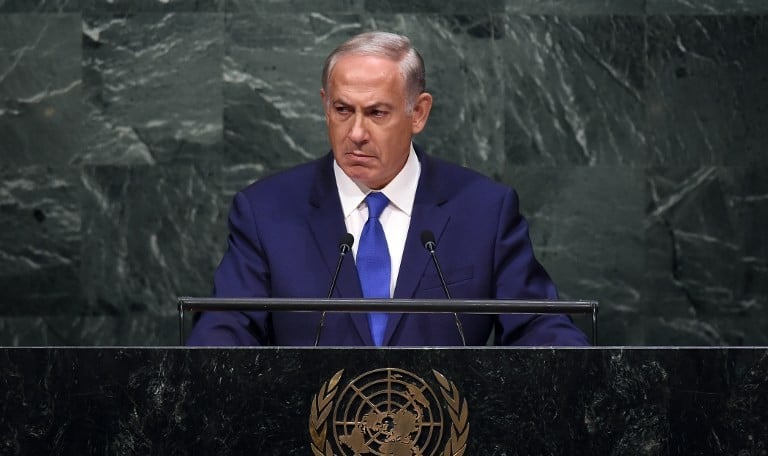
Barak Ravid, ostensibly in New York to cover the address, also goes ahead and offers readers his opinion of the speech and the strange kind of peace he made with Netanyahu’s 44-second tower of glower.
“His current gimmick was his minute of silence on the podium while attacking the nations of the world for doing nothing against Iran and remaining silent in the face of its threats to destroy the State of Israel,” Ravid writes. “In an unexpected way, the gimmick actually represented Netanyahu in the most authentic way. While pouring out words like sand in Congress or at the UN General Assembly, in Israel he is actually silent on most issues. Netanyahu’s silence from the UN podium was the ultimate expression of his foreign policy — passivity.”
Israel Hayom’s assessment of the address couldn’t be any further from Haaretz’s, with the paper calling Netanyahu’s moment of mute “44 seconds of history.” The paper doesn’t have news coverage of the speech per se, instead offering a translated manuscript, with the good bits highlighted, so readers don’t waste their time reading about boring stuff like the prime minister’s call to reach peace with the Palestinians.
Oh, it’s historic all right, or at least historical, writes Yedioth’s Orly Azulay, who sees Netanyahu stuck in the failures of the past and sounding like a broken record.
“With a furious face, determinedly squinting his eyes, as if he’ll soon shoot fire out of them, the prime minister stood and indicted the whole world. But there’s just one thing he didn’t bother doing in his speech: giving support to any sort of hope in the hearts of his listeners, his hosts or those who sent him,” she writes.
“Netanyahu spoke yesterday as if a new page of history had not been turned with Iran. A horse of history is in front of his face, and until now he has not climbed on to gallop forward, together with everyone — something that would improve Israel’s ability to monitor the [nuke] deal’s implementation. He stood on the UN stage sounding like a man from the past.”





The Times of Israel Community.