

Anxiety over history and identity shadows French presidential fight
Upcoming vote in April has been marked by repeated clashes over the national narrative
 Add ToI as a Preferred Source on Google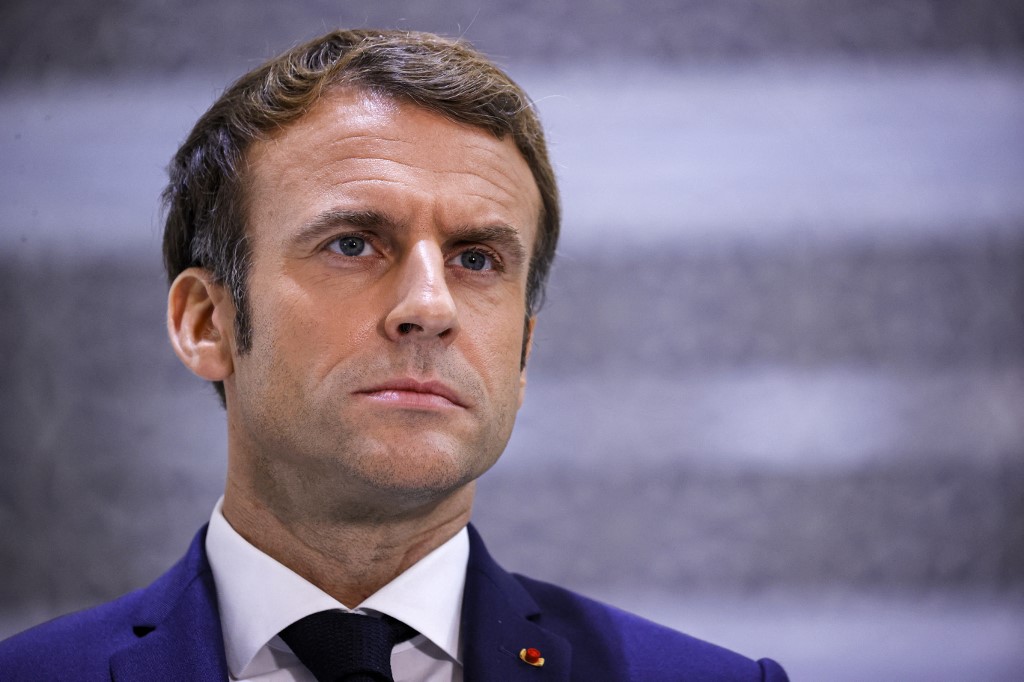
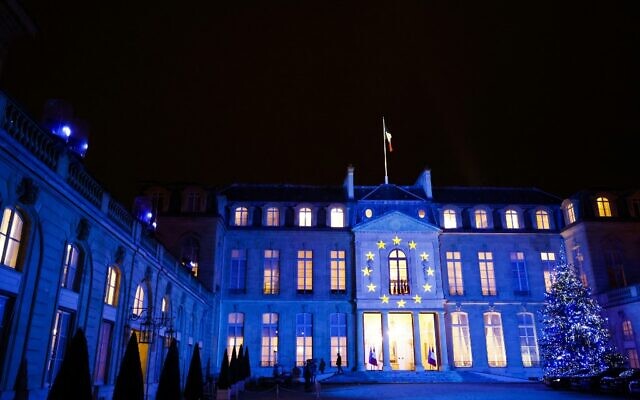
PARIS (AP) — In a country long on edge over questions of identity and belonging, flying the European Union flag over France’s tomb of the unknown soldier at the Arc de Triomphe was almost guaranteed to trigger fierce opposition.
Bristling reactions to the New Year gesture, meant by pro-EU President Emmanuel Macron to mark Paris taking over the bloc’s rotating presidency, rained down from the right of the political spectrum.
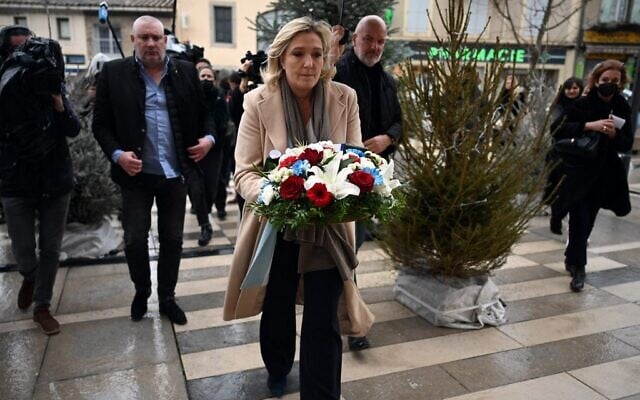
It was an “attack on the identity of our fatherland,” fumed far-right presidential candidate Marine Le Pen, echoed both by her rival, the far-right pundit Eric Zemmour and left-wing firebrand Jean-Luc Melenchon.
Macron’s best-placed opponent, Republican candidate Valerie Pecresse, went further, suggesting the president “has a problem with French history.”
While the row blew over with the removal of the outsize banner, it was symptomatic of a countdown to the April presidential vote marked by repeated clashes over the national narrative.
History “is a question that obsesses the right of the French political spectrum, matching an anxiety of French society,” historian and political scientist Jean Garrigues told AFP.
Two-thirds of French people agree that “France’s identity is disappearing,” a survey by pollsters Ifop published in early January found, while more than four in five believe “some political personalities co-opt questions related to identity.”
Rather than EU integration or immigration, though, respondents identified the top threats to their identity as a weaker economy, deindustrialization and unemployment.
Colonial past
Incumbent Macron has not shied away from sparking controversy over history and identity.
His call in April to “deconstruct our history, in a certain way,” so as to better understand its modern echoes including racism, was also met with howls from the right.
“French political actors understand that you have to keep updating history, especially when there are parts of it that won’t go away, like the Algerian war,” said political scientist Pascal Perrineau.
“That was a civil war that left extremely deep traces in our collective life, which created divisions, even if those are gradually vanishing,” he added.
Although Macron is “very keen on all these historical references, he ought to be careful, they’re inflammatory,” Perrineau said.
That was clear in October, when Macron claimed Algerian leaders had “totally rewritten” the country’s history to stir up hatred of former colonial master France.
The comments — which triggered a months-long row with Algiers — overshadowed his past efforts to acknowledge imperial-era crimes.
In December, Melenchon visited French Caribbean territory Guadeloupe, racked by anti-vaccination protests fueled by discontent over social inequality and low trust in government health advice, thanks to a 1990s-era scandal over the pesticide chlordecone.
Melenchon praised Guadeloupe’s “people who won’t let themselves be crushed” — and savaged government officials’ “colonial mindset.”
‘Return to the past’
On the far right, Zemmour has made the past the central pillar of his campaign.
In a video announcing his presidential candidacy, he read a speech into a microphone standing on a desk, the imagery recalling Charles de Gaulle’s 1940 radio appeal for the French to resist Nazi occupiers.
The lament for the state of modern France was intercut with montages of past French glories — from singer Barbara to supersonic airliner Concorde — contrasting with modern scenes of demonstrators clashing with police or Muslims praying.
Former French president Nicolas Sarkozy had already made immigration and Islam a political battleground, creating a controversial ministry responsible for immigration, integration and national identity.
Zemmour has also made provocative historical claims, including that Marshal Philippe Petain, the collaborationist ruler of Nazi-occupied France, helped save Jews from the Holocaust — an idea rejected by historians.
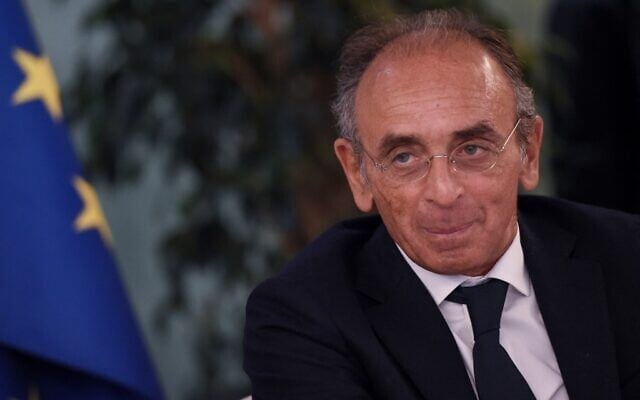
The candidate even called into question the innocence of Alfred Dreyfus, a Jewish officer wrongly convicted of spying for Germany in the late 19th century whose case drew battle lines through French society that resonate to this day.
Zemmour’s “program is reactionary, it idealizes a past it wants to get back. It’s reminiscent of the far-right programs of the early 20th century,” historian Garrigues said.
“His project is anchored in history, in a return to the past, when the fundamental point of a political project is to be anchored in the future.”









The Times of Israel Community.