

Bras, bees, and ‘oil for peace’ at Israeli agricultural event
The Agromoshav show brings together products, technology, and customers interested in the latest Israeli breakthroughs
 Add ToI as a Preferred Source on Google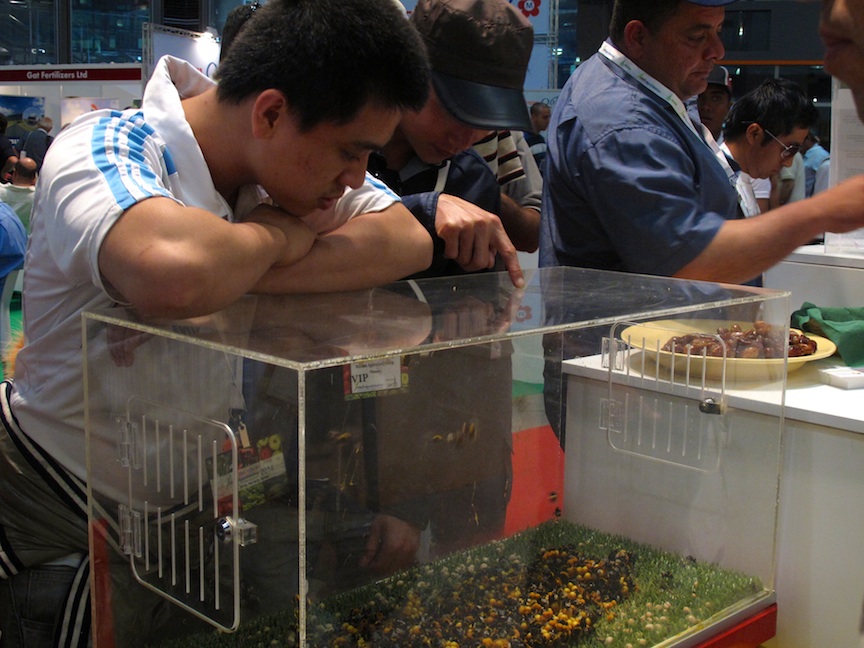
Two women dressed in bikinis tower over a pair of marketers snacking on nuts and pouring glasses of scotch; the models are sporting “body art” with pictures of fruit and the words be fresh scrawled on their midsections. Meanwhile, just a few feet away, onlookers cautiously peer into cases full of hundreds of “bio-flies” and bumblebees imported from Chile.
It’s a diverse scene, but then again, Fresh AgroMashav 2013 — an exhibition held on June 11 and 12 in the Israel Trade Fairs and Convention Center in Tel Aviv — drew a diverse crowd, regaling thousands of visitors from Israel and abroad with this strange mix of “bees and busts.”
This is the 23rd edition of the Fresh AgroMashav agricultural exhibition, dedicated to bringing the buyers and growers of fresh produce together. The exhibition, organized by the Mashov group (which publishes specialty magazines and organizes events for agriculture and other industries), included over a hundred delegates from Israel, Europe, America, and Asia, all interested in some aspect of buying, selling, and marketing produce. According to Mashov, representatives of some 90% of Israeli farms and agricultural companies visit the show each year.
The bikini models promoted Be Fresh, a Tel Aviv company that produces, imports, and exports fresh vegetables and fruits. Be Fresh was only one of dozens of companies represented at the show; other companies showed off products and technologies from fruit slicers and tractor wheels to environmental fruit packaging that uses less cardboard, along with hot water heaters running on biomass. One company, Origene Seeds, has created a watermelon seed that can grow to specific sizes, from the one kg “Nano”-sized watermelon, to the 11 kg “Maxima” melon.
The bee display was run by an Israeli company — which is now a part of Monsanto — called Bio-Bee, located in Kibbutz Sde Eliyahu. Established 25 years ago, the company provides farmers with bumblebees, flies, and beetles to help pollinate crops and control for pests. Among their “creatures” is a beetle called “crypro,” which is used to combat the citrus mealy bug known as Planococcus Citr, which sucks the sap out of plants and damages produce. “Crypro” preys on the mealy bug itself, allowing farmers to fight the pests without use of pesticides.
A spokesperson for the company, Nadov Mishov, said that Bio-Been has established a new subsidiary, called Bio-Fly, which uses Sterile Insect Technique (SIT) control to fight another common pest, the fruit fly. Bio-Fly operates by releasing male fruit flies that have been sterilized with gamma radiation into a target area. When the female fruit flies mate with the males, their eggs do not produce hatchlings. The Bio-Bee Company sells these “good bugs” to farmers in Israel as well as to companies around the globe; the company has subsidiaries in Chile and India.
Ambassador Yitzhak Eldan, former Chief of Protocol in the Foreign Ministry and now President of The Ambassador’s Club of Israel, was instrumental in bringing foreign representatives to the Agromoshav. Speaking at the event, Eldan emphasized the importance of fostering cooperation between Israel and other countries to help meet the challenge of food scarcity and poverty. “Israel has much to show and to share, both with our immediate neighbors and certainly with other countries of the world,” he told show attendees.
International cooperation and advances in food production and agriculture not only have the potential to solve food shortages, they also have the potential to foster peace. Among the products available at the event was one called “Olives for Peace,” an organic olive oil package being marketed jointly by an Israeli farmer and a Palestinian farmer. Doron Akiva, an olive oil producer in Ezuz in southern Israel, has teamed up with Palestinian farmer Mohammad Joudeh of the village of Azzun, near Kalkilyeh in central Samaria.
The product consists of one package containing two separate bottles of olive oil produced by each farmer. “We don’t want to talk peace,” Doron said, “we want to make peace.” Olives for Peace may or may not achieve that goal, but if the show’s many attendees taking samples are any indication, the company has definitely mastered olive oil.









The Times of Israel Community.