

Persian women stage bittersweet memories in new play
Jewish Iranian-American authors give insight into their past and present in a NY performance of ‘Saffron & Rosewater’
 Add ToI as a Preferred Source on Google
Mark Schulman has been a copy editor at The Times of Israel since 2014. With a BA in Anthropology from the University of Michigan and an MA in International Relations from Columbia University in New York, he has spent the past 25 years following his diplomatic wife around the world, with stints in Africa, Australia, Switzerland, the US, and, of course, Israel. He has written and edited for numerous publications from all these postings and beyond.
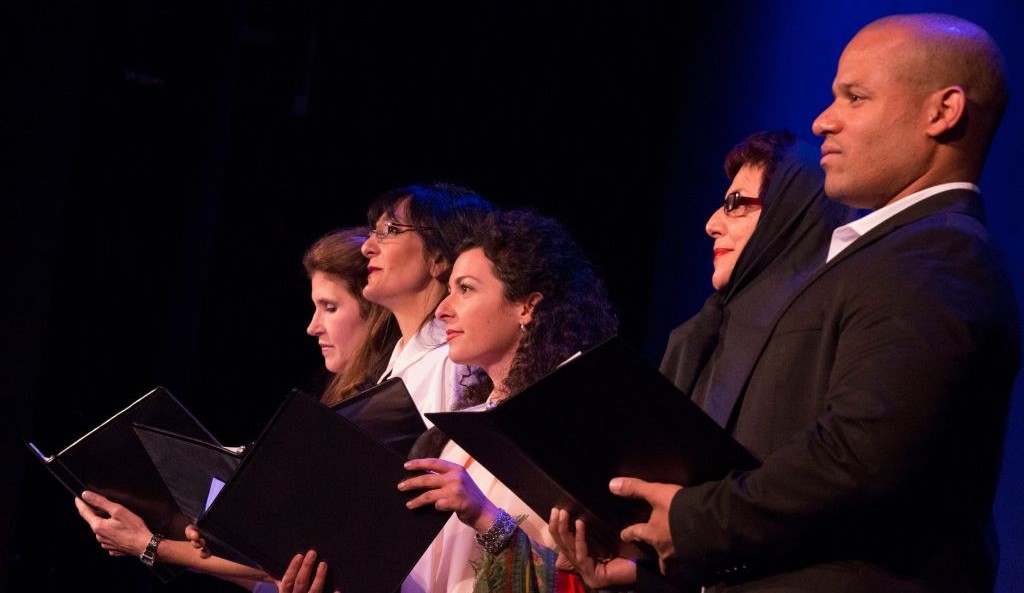
NEW YORK — As world leaders knocked out a deal with Iran to temporarily freeze its nuclear program at the end of November, theatergoers negotiated frigid temperatures on New York’s Upper East Side to listen to different Persian voices, those of Jewish women.
Politics did not dominate the New York premier of “Saffron & Rosewater: Songs and Stories from Persian Jewish Women” at the 92nd Street Y in Manhattan. Rather, this Jewish Women’s Theatre production offered a night of insight into the Jewish experience in Iran before the 1979 Islamic revolution and its aftermath.
A woman and a Muslim mullah seduce each other on a flight out of Iran. A young girl rebels against the family tradition of being married off at 13. A young woman’s determination to attend university in America nearly kills her traditional Jewish-Iranian father. A Jewish-Iranian grandmother celebrates Thanksgiving in America as if it were the High Holy Days.
“Each of these stories carries an important message about the American-Iranian women and their struggle with alienation, discrimination and the difficult process of adjusting to a foreign home and culture,” said best-selling writer Dora Levy Mossanen, author of one of the vignettes, “Soraya and the Mullah.”
Like many, Levy Mossanen fled Iran with her family at the onset of the revolution and settled in Los Angeles. Often referred to as Tehrangeles, LA is home to roughly 30,000-50,000 Persian Jews (out of some 300,000 Persian Americans), where they have set up their own organizations, synagogues and other cultural centers. Great Neck, New York, on Long Island is also known for its large community, and, of course, Israel, with its 50,000 Iranian-born Jews and 90,000 second-generation Iranian-Israelis.
“We are all raised with stereotypes of immigrant groups, and one way we can pierce through such stereotypes is to hear and understand the experiences of others,” said author Angella Nazarian who writes about her family’s harrowing escape from revolution-rocked Iran to the US in her story “What Mattered.”
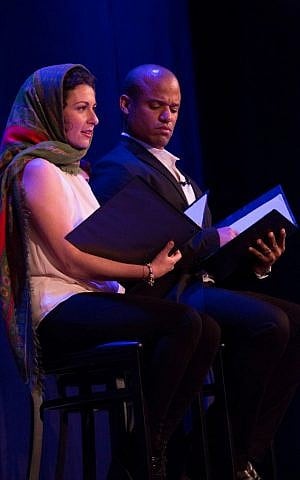
“Even now, whenever I see scenes of immigrants being pushed around like cargo in the movies, it brings me back. Whenever I see people crammed into small spaces, whenever I see panicked scenes at the border, a feeling of urgency and dread washes over me, and I travel a thousand miles deep into myself.”
Many in the audience sang along to “Gole Sangam” (“My Flower of Stone”), a popular Persian song about yearning for a missing loved one, recently recorded by Iranian-born Israeli pop star Rita. Rita has stayed close to her Persian roots, often singing the song in Farsi and even her fans in Iran have been impressed, buying up her CDs on the black market.
“Gole Sangam” is about a flower that blossoms on stones, a metaphor for the ability to overcome any difficulties and grow from them. This is the underlying theme found in all the stories in “Saffron & Rosewater.”
In “The Jewish Queen – A Fairy Tale”, Farideh Goldin, Director of Jewish Studies and Interfaith Understanding at Old Dominion University, takes Queen Esther’s legacy of saving the Jews of ancient Persia to heart, while journalist and psychotherapist Esther Amini describes her experience as a second-generation Iranian-American in the humorous, but poignant “Barnard College.”
“These performances honor the courage and resilience of women who lived epic, sometimes heroic lives who would have quickly faded into anonymity,” said Gina Nahai, a creative writing professor at University of Southern California and author of the play’s “Becoming American.” “They capture the truth and tell it in a way that will be heard and remembered.”
“Saffron & Rosewater,” directed by Eve Brandstein and produced and adapted by Ronda Spinak, is a collection of contemporary stories of Persian Jewish women, whose tales describe Iran – the country they once called home – and America, the country they now call home. They are a far cry from the consumer-driven and shallowness of the “Shahs of Sunset” an American reality TV show that follows a group of Iranian-American friends, including a Persian Jew, in Beverly Hills.
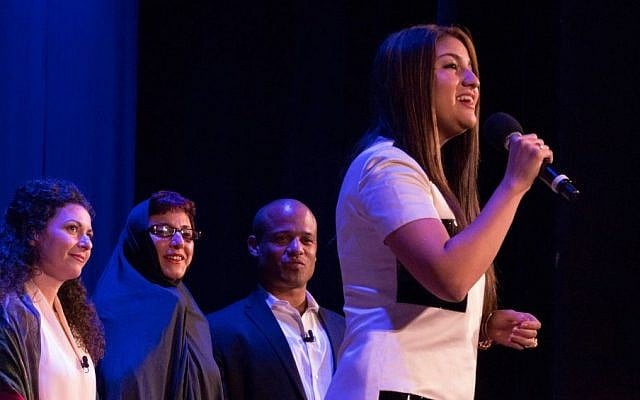
“Saffron & Rosewater” is produced by the LA-based Jewish Women’s Theatre, which was established in 2007 to bring the voice of Jewish women to the stage.
“We wanted to establish a creative home for Jewish women writers and artists inclusive of all backgrounds and denominations, so that their contemporary American stories would be written, shared and preserved for posterity,” said Jewish Women’s Theatre Co-Founder and Artistic Director Spinak. “‘Saffron & Rosewater’ was a perfect fit for our mission.”
The next performance of Saffron & Rosewater will take place on 14 December at Congregation Kehillat Ma’arav in Santa Monica, California. For more information about the Jewish Women’s Theatre, visit http://jewishwomenstheater.









The Times of Israel Community.