

Void vote on migrants deals blow to Hungary’s anti-EU revolt
Though 98% of participants reject Brussels’ refugee quota plan, low turnout nullifies the referendum
 Add ToI as a Preferred Source on Google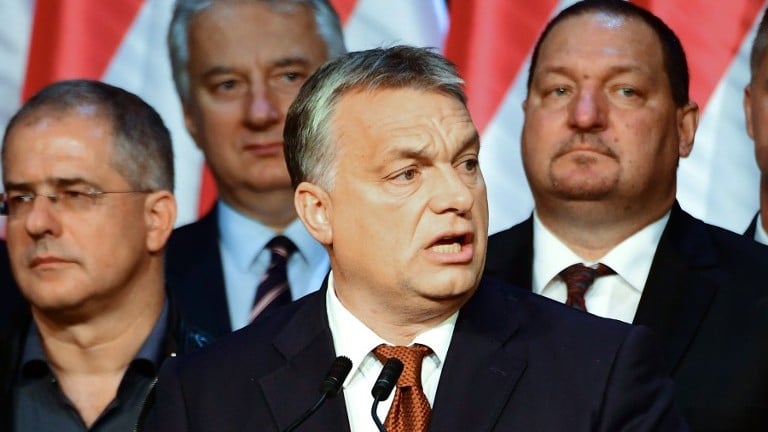
BUDAPEST, Hungary (AFP) — Hungary’s populist Prime Minister Viktor Orban suffered a blow Sunday in his revolt against the European Union after low voter turnout voided his referendum aimed at rejecting a contested migrant quota plan.
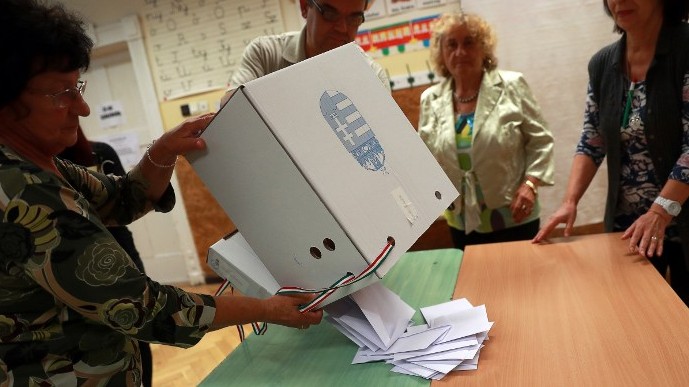
Although a whopping 98 percent of those who voted supported his bid to reject the plan, turnout reached just 43 percent of the eight-million-strong electorate, falling short of a 50% threshold, the National Election Committee said after nearly all the ballots had been counted.
Opposition figures swiftly called on Orban to step down over the vote, after rights groups had accused him of whipping up anti-migrant fears despite there being only a few hundred asylum seekers in Hungary.
But the firebrand leader had earlier vowed there would be “legal consequences” regardless of the outcome, as he downplayed the significance of the low turnout.
Orban’s right-wing government led an expensive media offensive urging voters to spurn the EU’s plan, which seeks to share migrants around the 28 member states via mandatory quotas without the consent of national parliaments.
“A valid referendum is always better than an invalid one, but the legal consequences will be the same,” Orban said earlier on Sunday.
“There is only one condition for this: that there are more ‘No’ votes than ‘Yes’ votes.”
The firebrand leader has emerged as the standard-bearer of those opposed to German Chancellor Angela Merkel’s “open-door” policy, in the wake of the bloc’s worst migration crisis since World War II.
Polling stations opened at 0400 GMT and closed at 1700 GMT, with final results expected later in the evening.
Opposition parties and rights groups had called on Hungarians to boycott the referendum or spoil their ballot.
The EU proposal — spearheaded by Germany and approved by most EU governments last year after antagonistic debates — seeks to ease pressure on frontline countries Italy and Greece, the first port of arrival for most migrants.
But implementation has been slow.
Eastern and central European nations vehemently oppose the plan aimed at relocating 160,000 people, many of who fled war in Syria.
Even as Hungarians voted, neighboring Austria’s Foreign Minister Sebastian Kurz said the EU should stop clinging to its troubled plan.
“The target is totally unrealistic,” he told the German daily Welt am Sonntag, warning that disagreements over the plan could threaten “the cohesion of the entire European Union.”
Hungary has not accepted a single one of the 1,294 refugees allocated to it under the scheme and instead joined Slovakia in filing a legal challenge against it.
Top EU officials had warned the referendum threatened to further split the quarreling bloc, already weakened by Britain’s vote in June to leave the union — a decision Orban has blamed on the EU’s handling of the migrant crisis.
European Parliament President Martin Schulz said Sunday that Orban was playing “a dangerous game” that could affect the entire bloc, merely to cement his power at home.
The referendum asked voters: “Do you want the EU to be able to mandate the obligatory resettlement of non-Hungarian citizens into Hungary even without the approval of the National Assembly?”
In an editorial, Orban warned on Saturday that Hungarians had “a duty” to fight the failed “liberal methods” of the “Brussels elite.”
“It’s true that the campaign was exaggerated but no-one can tell me if these migrants really are refugees of war,” Zoltan, a 38-year-old lawyer and voter for the “No” camp, told AFP.
More than 400,000 refugees trekked through Hungary toward northern Europe in 2015 before Hungary sealed off its southern borders with razor wire in the autumn and brought in tough anti-migrant laws, reducing the flow to a trickle.
Other countries on the so-called Balkan migrant trail followed suit, leaving some 60,000 migrants stranded in Greece.
Many of those migrants live in grim conditions in camps dotted around the Aegean islands and the mainland, desperate to continue their onward journey.
The EU said last week it hoped to relocate half of them by the end of 2017.
A deal struck in March with Ankara to halt the influx looks shaky in the wake of a coup attempt in Turkey in July.
German Interior Minister Thomas de Maiziere meanwhile said Sunday that Berlin wants to reinstate an EU rule, suspended in 2015, which obliges asylum seekers to return to the first country within the bloc that they reached.
“We will take up discussions on this in a meeting with (EU) interior ministers” later in October, he told the Greek daily Kathimerini.










The Times of Israel Community.