

Netanyahu calls for early elections at Likud convention, without specifying a date
Prime minister says the political system has become ‘unstable’ and talks of the benefits of a short, four-month election campaign
 Add ToI as a Preferred Source on Google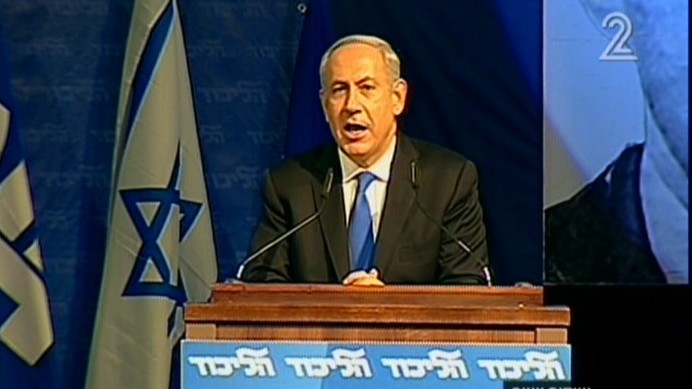
Prime Minister Benjamin Netanyahu called Sunday night for new elections, saying the political system had, three and half a years after the last elections, become unstable.
Speaking at his Likud party’s central committee meeting in Tel Aviv — which kicked off a 90-day party convention — Netanyahu said he prefered to hold elections soon, but stopped short of naming a specific date. September 4 had previously been floated as the likely date for early elections.
“I will not support an election period of a year and a half,” Netanyahu said. “It’s better to have a short election period of four months that will speedily restore political stability to this country,” he added, seemingly endorsing the September date without explicitly saying so. Likud parliamentary group chairman Zeev Elkin told The Times of Israel that legislation would be brought forth in the Knesset Monday dissolving the current government and calling for elections on September 4.
After a week of waiting in the wings while in mourning for his father’s death, Netanyahu assumed center stage at the meeting and appeared to take a jab at his political adversaries: “I respect all the other heads of parties that are running for the next Knesset, and they have a lot to contribute, but the State of Israel cannot allow itself a prime minister without political, security and economic experience,” Netanyahu said to the applause of the packed event hall.
“With the start of the fourth year of this government, the stability of the government started to erode, and this lack of political stability leads to blackmail and populism,” he said.
The Likud gathering gave Netanyahu the opportunity to make changes to the structure and makeup of the Knesset list. Likud is set to hold its primaries in June.
The convention was also expected to elect Netanyahu as temporary party president, adding to his control over proceedings. However, party activists gathered signatures ahead of the meeting in support of a secret ballot for the coveted position, which is being contested by MKs Danny Danon and Michael Eitan, as well as the prime minister. It was unclear as of Sunday night when a vote would take place.
Danon and Eitan favor secret balloting because they fear that an open vote would keep party members from voting against party chairman Netanyahu.
In his speech, Netanyahu also pledged to replace the now-expired Tal Law, which for years virtually exempted ultra-Orthodox yeshiva students from military service, “with a more just and fairer” alternative and to keep on advancing peace talks with Israel’s neighbors.
After the speech, the crowed chanted “secret, secret,” demanding that the vote for the president of the Likud convention be held in a secret ballot. Besides Netanyahu, MKs Michael Eitan and MK Danny Danon are running for the position. Eitan and Danon favor secret ballots because they fear that open votes would keep members from votings against party chairman Netanyahu.
The presidency of the Likud Convention is a powerful office, as its holder basically controls the way in which the party determines who stands where on its Knesset list for the upcoming elections. The party’s final list will be determined through democratic elections through democratic elections but the convention process can initiate changes to the way in which these elections are held.
In a television interview before the convention started, Danon, currently one of several deputy Knessset speakers, invoked the example of the biblical Yitro, who advised Moses to share some of the responsibility of leading the nation and appoint advisors under him.
In the run-up to the convention, Danon also made it clear that the key point of his candidature centered on the fight to keep Defense Minister Ehud Barak out of the government. “I will work to prevent any chance of Barak joining Likud and I intend to lead this conference in a moral and ideological way,” he posted on his Facebook page hours before the convention. “We will not accept direct or indirect appointment of Barak. We will not allow an attempt to unite Likud and the Independence Party or any other clever attempt at enabling Barak to join the Likud list!”
Barak split from the Labor party last year to create Independence, or Atzma’ut, but most polls predict that the party will pass the Knesset’s two-percent threshold.
A recent Maariv poll had the Likud winning 31 out of the 120 available Knesset seats, giving Netanyahu the likely first shot at forming a new coalition.
Labor is on track to become the second-largest party, with 18 seats, according to the survey.
Led by its new chairwoman Shelly Yachimovich, Labor would like to revive its glory days as the country’s ruling party. Yachimovich said, in a Saturday interview to Channel 2, that people must stop being fixated with the notion that only Netanyahu can be prime minister. But in the same interview, she said that she would not rule out participating in a coalition led by him. “Politics is a means to an end,” she said. “Not an end in itself.” Her first goal was indeed to oust Netanyahu, but if she could not, in the interim she might have to work with him toward her wider agenda, she said.
Foreign Minister Avigdor Liberman’s Yisrael Beytenu party is predicted to win 12 seats. Kadima, under the new leadership of Shaul Mofaz, and the recently founded Yesh Atid party, led by political newcomer Yair Lapid, are each set to win 11 seats, according to the survey — which would mean a remarkable debut for Lapid and a disaster for Kadima, which holds 28 seats in the outgoing parliament.
There has been much discussion over the reasons for holding elections nearly a year before their scheduled date. Some of those suggested include: potential inability to pass a budget, strife over legislation ordering the enlistment to military or national service for ultra-Orthodox Jews, and anticipation of social upheaval as the result of citizen unrest over cost of living issues.
But on Friday, Channel 2’s senior analyst Amnon Abramovich said Netanyahu is calling early elections so that he and his transition government will be free to deal with Iran’s nuclear program this fall, with a fresh mandate from the public, before the election of a US president, and with Defense Minister Ehud Barak — who may be a political casualty of the elections — still at his side.
In response, the left-wing Meretz party chairwoman Zahava Gal-On said Saturday that the notion that Israel could attack Iran while the US president is engaged in election campaigning and the Knesset is in recess was illegitimate and “childish.”
“The idea of taking advantage of the fact that the parents are away from home is childish because the parents will return and the punishment will be severe,” said Gal-On. “An interim government lacks the moral authority and public legitimacy to take such action.”









The Times of Israel Community.