

Argentine immigrants fuel Jewish revival in Spain
Arriving before the new Sephardic vogue, Spain’s Argentine Jewish community has opened doors to passionate Liberal Judaism
 Add ToI as a Preferred Source on Google
Cnaan Liphshiz was a Jewish World reporter at The Times of Israel
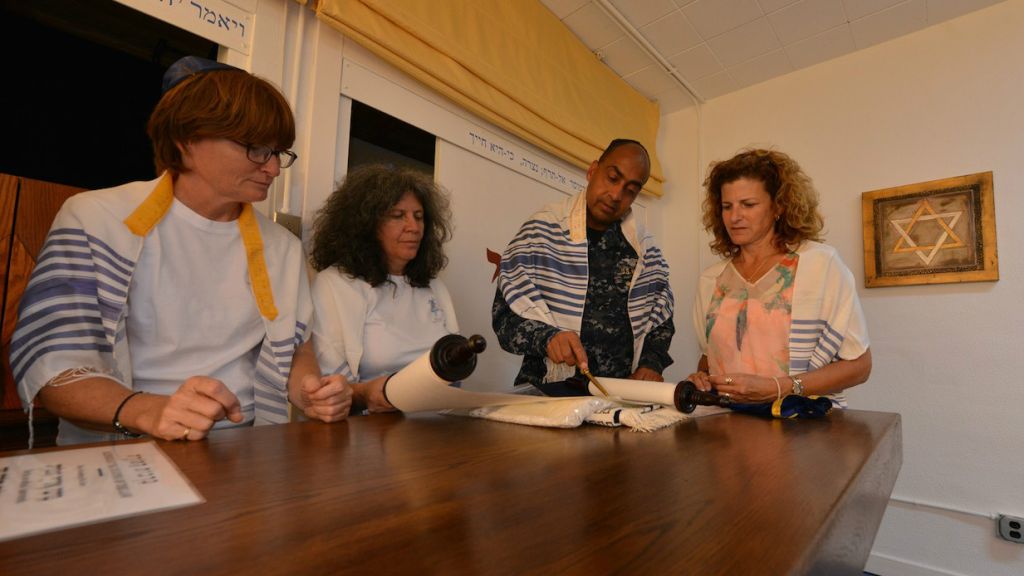
ROTA, Spain (JTA) — While setting up a synagogue at the American naval base where she works, Ahuvah (Amanda) Gipson made something of a bitter-sweet discovery.
Rifling through a storage area at the sprawling American-Spanish military complex Naval Station Rota in 2012, Gipson, a former naval outreach professional who now teaches off base, found three dusty Torah scrolls and a dismantled 4-foot Hanukkah menorah.
The objects were all that remained from a community that American Jews serving at Rota established many years ago, but which fell apart after they shipped out.
Setting up a durable congregation on a military base is difficult because of frequent turnover, but nearly three years later, Gipson’s 15-member Bet Januka community — a name referencing the found menorah — is still going strong, largely because many congregants now are local Jews.
“We’re small, but we’re here to stay,” Gipson said. “It’s kind of like the bigger story, but on slightly smaller scale.”
The bigger story is the rapid growth of Jewish life in Spain, once home to one of the world’s largest and most accomplished Jewish communities but which has had only a modest Jewish presence since the expulsion in the 15th and 16th centuries.
Nowhere is the growth felt more strongly than in Madrid, home to Spain’s largest Jewish community of some 12,000 members, where six of the capital’s seven synagogues have opened in the last decade. Bet Januka is one of six Reform communities founded across the country since 2007.
‘[It’s] a phenomenal regeneration not only in interest in Judaism, but also in the level of encouragement from the government’
“[It’s] a phenomenal regeneration not only in interest in Judaism, but also in the level of encouragement from the government,” said Leslie Bergman, president of the European Union for Progressive Judaism.
Locals say the process is being driven by a number of factors, including a supportive government and the arrival of thousands of Argentine Jews who were driven to Spain by the financial crisis of the 2000s and earlier by the Dirty War, the reign of political terror in the 1970s. Prior to their arrival, the Jewish community was constituted overwhelmingly by a small group of Orthodox Jews of Moroccan descent.
“The small community of Moroccan Jews that lives here and runs the Orthodox synagogue is pretty low-profile,” said David Pozo Perez, president of the Reform congregation Beit Rambam in Seville, who was born in Spain and is married to an Argentine. “They aren’t very big on the cultural activities that Argentinian Jews are used to from home. And so the Argentinians’ desire to re-create such an environment gave a big push to setting up social frameworks, activities and also Reform synagogues.”
But Spain’s so-called Jewish revival is also being fueled by processes outside the Jewish community.
‘When rural municipalities with hardly any Jews celebrate Sukkot and Hanukkah in festivals, it encourages Jews’
Following Portugal’s lead, Spain this year introduced legislation that may make many Jews of Sephardic descent eligible for citizenship, a measure officials described as a form of atonement for the expulsion of Jews during the Inquisition. Along with a host of public initiatives to celebrate Spain’s rich Jewish heritage, the law has helped foster the growth of local Jewish communities.
“It isn’t affecting the growth of communities directly, [but] it certainly helps generate a climate that is more positive to Judaism and conducive to strengthening communities,” said David Hatchwell, president of the Jewish Community of Madrid. “When rural municipalities with hardly any Jews celebrate Sukkot and Hanukkah in festivals, it encourages Jews to also celebrate their tradition more proudly than before.”
In addition to encouraging Jews to celebrate their faith, the initiatives to highlight Spain’s Sephardic heritage is drawing out the anusim, the descendants of Jews forced to convert to Christianity during the Inquisition. While only some of them formally convert, many more attend and even organize Jewish-themed events in the Spanish and Portuguese countryside.
The rural festivals have also made it easier for small Jewish communities like Rota’s to access municipal resources that facilitate community-building. Rota’s municipality, for example, allows Bet Januka to make use of a community center in the city’s center, which is more convenient than dealing with security procedures at the base.
All the processes reshaping Jewish life in Spain were on display during a recent Havdalah ceremony at the center.
“This scene probably wouldn’t have been possible 15 years ago,” said Jose Manuel Fernandez, a retired police officer who converted to Judaism with his wife after learning he was descended from anusim.
“The Argentinians were not here yet,” he said, “and I’m not sure the municipality would’ve necessarily let us be here.”





The Times of Israel Community.