Netanyahu could be first world leader to get vaccinated, later this week
PM says he’ll be 1st Israeli to be inoculated, expects ‘everyone’ to follow; Health Ministry official said to urge ending bid to develop Israeli vaccine, saying there’s ‘no point’
Michael Bachner is a news editor at The Times of Israel
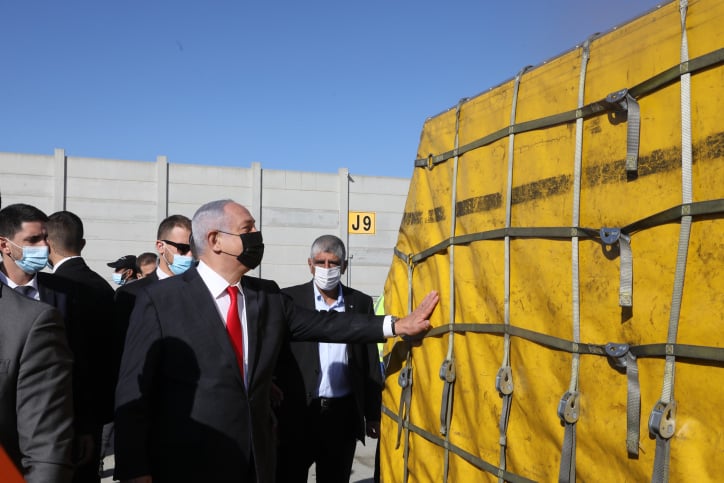
Prime Minister Benjamin Netanyahu touches the first batch of Pfizer vaccines to arrive in Israel at Ben Gurion Airport near Tel Aviv, December 9, 2020. (Marc Israel Sellem/Pool)
The Times of Israel liveblogged Sunday’s events as they unfolded.
After months of promises, the mandatory quarantine period will be shortened to 10 days this week, the Health Ministry announces.
Health Minister Yuli Edelstein has adopted the recommendation of professionals, a ministry statement says, and has decided that starting Tuesday at 6 a.m., anyone who needs to isolate will only have to do so for 10 days rather than the current 12.
As part of the new rules, people will have to test negative in two coronavirus tests, one taken at the beginning of the quarantine period and the second taken nine days after the initial possible exposure to the virus. There must be at least 24 hours between the two tests.
As thousands of Israelis flood Ben-Gurion Airport while much of the country is shuttered, a senior Health Ministry official warns that the mass pilgrimage to Israel’s new friend, the United Arab Emirates, could be a coronavirus “ticking time bomb.”
“Dubai is our new Turkey,” the unnamed official is quoted as saying by the Ynet news site, referring to the large number of Israelis who returned from Turkey while carrying the virus, contributing to its spread in the country.
The official is referring to Israel’s decision to keep the UAE on its list of “green” countries with low infection rates, reportedly to avoid a diplomatic rift just months after establishing formal ties, while morbidity is in fact on the rise there.
The Health Ministry expects that 224 COVID-19 patients will return from the UAE to Israel in December, Ynet reports, more than any other country (next are Turkey with an estimated 86 and the United States with 66).
Some 10,000 Israelis are currently in Dubai, the report says.
Anger is brewing meanwhile on social media, where footage was published today of long lines and people not observing social distancing at the airport, while businesses across the country with far less infection potential remain closed.
Israeli soldiers drove back four suspects who approached the border from Lebanon earlier today by firing their guns in the air, the military says.
The four people were spotted walking toward the security fence by soldiers monitoring surveillance cameras. Ground troops were called to the scene to prevent an infiltration.
During this effort, the soldiers called for the suspects to halt and fired their weapons into the air, “after which the suspects fled the scene,” the Israel Defense Forces says.
It is not immediately clear if the suspects represented a security threat or if they were migrants attempting to enter Israel for work.
“The IDF will not allow any attempt to violate the sovereignty of the State of Israel,” the military says.
Britain and the European Union say talks will continue on a free trade agreement — a deal that if sealed would avert New Year’s chaos for cross-border traders and bring a measure of certainty for businesses after years of Brexit turmoil.
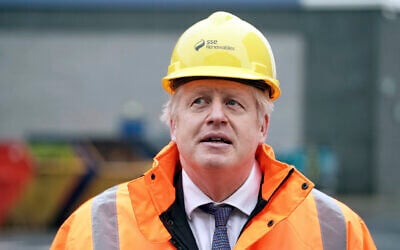
Britain’s Prime Minister Boris Johnson looks on during a visit to the National Renewable Energy Centre in Blyth, England, December 11, 2020. (Owen Humphreys/PA via AP)
British Prime Minister Boris Johnson and European Commission President Ursula von der Leyen had set today as the deadline for a breakthrough or breakdown in negotiations.
But they step back from the brink, saying it is “responsible at this point in time to go the extra mile” and that they have told their negotiators to continue talking.
With less than three weeks until the UK’s final split from the EU, key aspects of the future relationship between the 27-nation bloc and its former member remain unresolved.
Israeli gymnast Artem Dolgopyat wins the European Championships in the floor exercise.
Dolgopyat takes the gold with a score of 15 in the contest, taking place in Turkey.
Artem Dolgopyat of Israel performs in the floor exercise during the men’s artistic gymnastics finals at the European Championships in Glasgow, Scotland, August 12, 2018. (AP Photo/Darko Bandic)
Dr. Miri Mizrahi-Reuveni, the director of the Maccabi HMO’s health division, tells Army Radio that Maccabi clinics will be ready to go ahead with vaccinating 25,000 people starting December 20, when Israel could potentially start a mass inoculation effort. The official start date in December 27, but reports and officials have said it could be pushed forward.
Mizrahi-Reuveni contradicts a Channel 12 report from several days ago that alleged that there is a significant shortage of syringes to administer the coronavirus vaccine.
“We don’t know of any shortage of syringes, we are getting prepared,” she says.
The Knesset plenum vote on dissolving the government and calling elections for Marcxh 16, 2021, has been pushed off to Tuesday, Hebrew-language media reports.
After the Knesset okayed the bill in a preliminary reading and a committee approved it, the bill needs to pass three additional plenum readings.
Normally, first readings of law bills are held on Mondays. However, Knesset Speaker Yariv Levin of Prime Minister Benjamin Netanyahu’s Likud party — who sets the schedule — is believed to be interested in hindering the legislation, since Likud wants elections to be held at a later date and doesn’t want key amendments included in the bill regarding election funding to take effect.
If the bill isn’t passed by December 23 (and Likud and Blue and White don’t reach an unlikely last-minute compromise on the state budget), elections will be automatically called for March 23 with no further amendments.
British Prime Minister Boris Johnson says he still hopes for a post-Brexit trade deal with the European Union but that failure remains the “most likely” outcome.
“I’m afraid we’re still very far apart on some key things but where there’s life there’s hope,” he tells reporters. “The most likely thing now is of course we have to get ready for WTO terms.”
Prime Minister Benjamin Netanyahu’s lawyers in his corruption trial ask the Jerusalem District Court to force prosecutors to hand over the attorney general’s authorizations to initiate each of the three criminal investigations against him, arguing that existing investigation material indicates discrimination against the premier.
Boaz Ben-Tzur and Amit Hadad claim that “police investigators worked to conduct a general, amorphous and limitless investigation into the prime minister. They operated as if they had an ‘blank check’ enabling them to collect any shred of gossip as long as it’s related to the prime minister, which is illegal,” rather than getting approval to probe a specific suspicion.
They make the claim based on the 2016 police testimony of former national security adviser Uzi Arad, who “was asked to give incriminating information regarding the prime minister, no matter the nature of the information.”
“This is a personal investigation, rather than an investigation that focuses on a concrete suspicion,” they conclude.
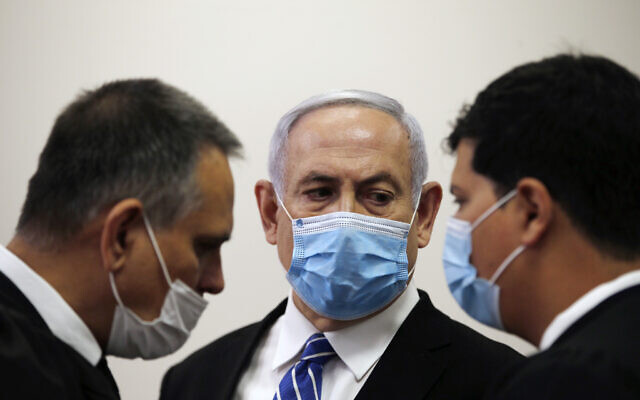
Prime Minister Benjamin Netanyahu, with his lawyers in the courtroom, as his corruption trial opens at the Jerusalem District Court, May 24, 2020. (Ronen Zvulun/ Pool Photo via AP)
Prime Minister Benjamin Netanyahu meets in Jerusalem with the visiting US National Security Adviser Robert O’Brien, the US Embassy says.
The statement says O’Brien “held a series of meetings with Israeli officials to discuss regional issues, shared security concerns and the Abraham Accords,” referring to the normalization deals with several Arab states.
O’Brien awards his Israeli counterpart, National Security Adviser Meir Ben-Shabbat, the Department of Defense Medal for Distinguished Public Service, the highest honor given to foreign officials.
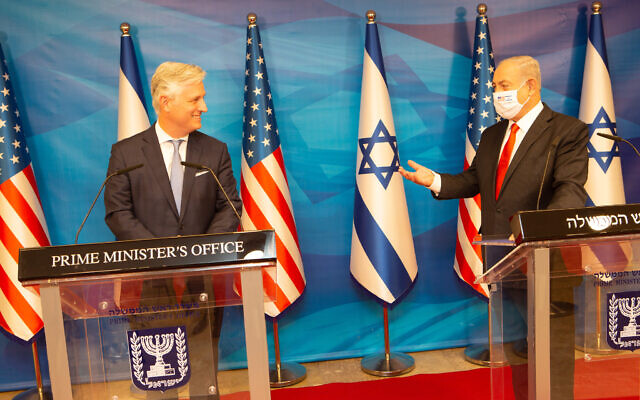
US National Security Adviser Robert O’Brien, left, meets Prime Minister Benjamin Netanyahu at the Prime Minister’s Office in Jerusalem, December 13, 2020. (courtesy US Embassy)
In a tweet, Dmytro Kuleba says there is “no place for anti-Semitism in Ukraine.”
I condemn in strongest terms Thursday’s brutal attack on a Jewish Menorah in Kyiv. I welcome the swift reaction by law enforcement agencies identifying the perpetrator. He now faces criminal charges & I‘m convinced justice will be served. No place for Anti-Semitism in Ukraine.
After his gold medal in the floor exercise, Israeli gymnast Arten Dolgopyat also takes bronze in the vault exercise at the European Championships after finishing third with a score of 14.483.
He becomes the first Israeli gymnast to snag two medals at the championship.
Prime Minister Benjamin Netanyahu says it would be a mistake “to go back to business as usual with Iran,” signaling Israeli resistance to an expected push by US President-elect Joe Biden to revive the international nuclear deal with Iran.
Netanyahu speaks at a press conference with Robert O’Brien, US President Donald Trump’s national security adviser.
But his comments appear to be aimed at Biden, who has said the US will rejoin the nuclear deal if Iran agrees to strict adherence. The deal, which lifted sanctions on Iran in exchange for curbs on its nuclear program, has unraveled since Trump withdrew from it in 2018.
“Today, the Islamic Republic of Iran is still a nasty neighborhood bully,” Netanyahu says. “But, if unchecked, tomorrow Iran will arm itself with nuclear-tipped intercontinental ballistic missiles that can target Europe and America and it will become a global bully, which will endanger everyone.”
“As long as Iran continues to subjugate and threaten its neighbors, as long as Iran continues calling for Israel’s destruction, as long as Iran continues to bankroll, equip and train terrorist organizations throughout the region and the world, and as long as Iran persists in its dangerous quest for nuclear weapons and the means to deliver them, we shouldn’t go back to business as usual with Iran,” he says. “We should all unite to prevent this major threat to world peace.”
US National Security Adviser Robert O’Brien, left, meets Prime Minister Benjamin Netanyahu at the Prime Minister’s Office in Jerusalem, December 13, 2020. (courtesy US Embassy)
Netanyahu led an unsuccessful fight against the deal when it was negotiated by then-President Barack Obama in 2015 and welcomed Trump’s withdrawal three years later. Netanyahu says the deal will not prevent Iran from developing a nuclear weapon and fails to address other belligerent Iranian behavior, such as its support for proxies across the region and its development of a long-range missile program.
O’Brien says the Trump administration’s pressure campaign against Iran has been successful and says the string of agreements between Israel and Arab countries will cement what he calls “the legacies of peacemakers” Trump and Netanyahu.
Following footage of hundreds of people crowding together at Ben Gurion Airport, raising fears of the coronavirus spreading among travelers, the government announces a team to recommend steps to prevent that.
Transportation Minister Miri Regev and Health Minister Yuli Edelstein announce the inter-ministerial team, which will be headed by the director-general of the Transportation Ministry, Ofer Malka, and the deputy director-general of the Health Ministry, Itamar Grotto.
The Prime Minister’s Office says the cabinet meeting has been delayed for the second time, from tomorrow to Wednesday.
The meeting has previously been pushed off from today to tomorrow to allow the Likud and Blue and White parties to reach agreements regarding the nomination of a new police commissioner and Justice Ministry director-general, among other disagreements.
The government is very likely in its last days, with early elections called automatically if no compromise is reached regarding the state budget, and Blue and White pushing to dissolve the Knesset even earlier.
Palestinian Authority President Mahmoud Abbas arrives in Qatar for a state visit. He is scheduled to meet with Emir Thani bin Hamad Al Thani to discuss “issues of mutual concern” tomorrow in Doha.
The trip is Abbas’s third official international visit since the beginning of the pandemic: at the end of November, he traveled to Amman and Cairo for a quick two-day trip to meet with Jordanian monarch Abdullah II and Egyptian President Abdel-Fattah El-Sissi.
Effi Eitam, a far-right former minister who has been nominated as the next head of the Yad Vashem Holocaust museum, responds to widespread criticism leveled against his selection.
“People say that when the allegations are baseless and unfounded, there is no point in responding. But I am here to respond,” Eitam tells the Kan public broadcaster in an interview, saying he has a deep connection with the Holocaust and its memory.
Earlier this month, in the latest protest against Eitam, a broad coalition of 750 Jewish studies scholars and directors of Jewish and Holocaust museums signed a petition opposing the proposed appointment.
His critics say he is unfit to lead Israel’s Holocaust memorial because he is accused of calling for most Palestinians in the West Bank to be expelled and for Arab Israelis to be excluded from the country’s political system.
Chairman of the Afek oil drilling company Effi Eitam, seen at the Supreme Court during a hearing on oil searching in the Golan Heights, on December 23, 2014, in Jerusalem. (Flash90)
“I have always opposed any talk of a transfer,” Eitam argues, referring to the expulsion of Palestinians from the West Bank. “Anyone with an ounce of integrity can look through my interviews and see that.
“But I did say one thing, and I stand behind it: If a war is declared upon us by people, communities, or groups that want to turn Israel into a terror arena, we shall fight with all our might, decisively.
“Expelling the Arabs of Judea and Samaria is not a goal, it’s a consequence,” he says, referring to Palestinians in the West Bank. “There may come a situation — a tragic one — as part of violent fighting, in which a civilian population will be harmed.”
Regarding his comments that Arab MKs should be expelled from the Knesset, he says: “I think Arab Israelis should make a clear choice whether they are partners — with full rights — in building the State of Israel, which is the state of the Jewish nation, or they are actively undermining its existence as such.”
He says that when Arab lawmakers meet people like Syrian dictator Bashar Assad during a war, “that’s a situation that no democracy can accept.” He estimates that most Arab Israelis do want to be part of Israel.
Tens of thousands of vaccines scheduled to reach Israel this week will take more time, Channel 12 reports, raising fears that the beginning of the country’s mass inoculation against the coronavirus will be delayed.
The report cites unnamed officials involved in the storage and distribution of the vaccines saying that a shipment set to come from Belgium on Tuesday has been postponed to an unknown date.
The Health Ministry says 1,291 new COVID-19 cases were diagnosed yesterday and another 917 have been confirmed thus far today.
The number of serious patients leaps from 321 this morning to 349, underscoring the rise in infections. Of them, 102 are on ventilators.
The total number of cases since the start of the pandemic rises to 356,823, of which 16,801 are active cases.
The death toll grows by 13 since this morning and reaches 2,996, just short of the 3,000 mark.
The ministry says 2.9 percent of the 44,853 tests conducted yesterday came back positive. Non-final data for today says 3.8% of 24,073 tests have been positive.
Testing rates tend to drop on weekends (last week there were around 70,000 daily tests), with the positivity rate temporarily rising (last week the rate was around 2.5%).
Prime Minister Benjamin Netanyahu says he will be the first Israeli to get the coronavirus vaccine.
Speaking to Channel 20, Netanyahu says: “The risks in not taking the vaccine are far greater than the risks in taking it, and that’s why I’ll get vaccinated first and I expect everyone to get vaccinated.”
Meanwhile, the Kan public broadcaster reports that Netanyahu and Health Minister Yuli Edelstein intend to get vaccinated in a filmed event this Saturday or even earlier. That could make Netanyahu the first world leader to get vaccinated.
Health Ministry Director-General Chezy Levy confirms widespread reports that Israel will issue a “green passport” for Israelis who get two doses of the coronavirus vaccine.
Speaking with Channel 12, Levy says the document will allow its carriers not to be quarantined and to enter restaurants, culture events and other public gatherings.
Levy adds that this will lead to a form of international card that would presumably allow global travel for those who are vaccinated.
The Health Ministry will this week launch an initiative to perform coronavirus antibody tests to identify people who have had COVID-19 and recovered without being diagnosed, Channel 12 reports.
Right now, the initiative is limited to relatives of confirmed patients.
People who have antibodies detected in their blood will be eligible to receive a document exempting them from quarantine and gathering restrictions once a vaccination campaign begins, the report says.
The Health Ministry is gathering Israeli celebrities who agree to get a coronavirus vaccine in front of cameras as part of an effort to encourage people to get inoculated and battle online disinformation about the vaccine, Channel 13 says.
The celebs include artists, journalists and others, the report says.
The report adds that the first to get the vaccine will be Prime Minister Benjamin Netanyahu, President Reuven Rivlin, Health Minister Yuli Edelstein, and managers of hospitals and HMOs.
It also says that senior Health Ministry officials have called for a halt to efforts to develop an Israeli-made vaccine, since “there’s no point in it if we vaccinate several millions in a few months.”
The network cites officials in the Defense Ministry — whose Biological Institute is developing the vaccine — as being surprised to hear the development through media reports, arguing that there is no reason to scrap all the work that has been done.
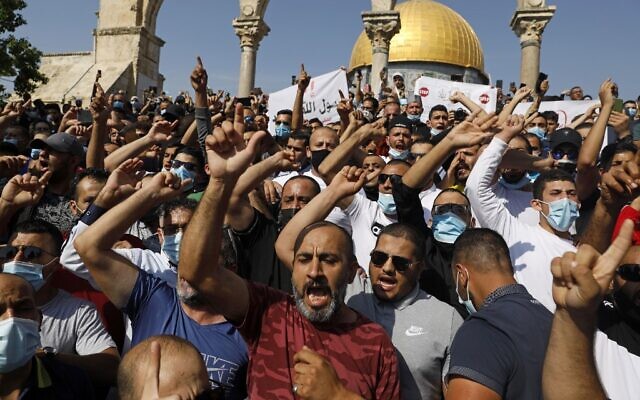
The top government official tasked with battling the coronavirus pandemic has admitted that Israel has given up enforcing the coronavirus restrictions at the Temple Mount in Jerusalem, even though mass prayers are being held there every Friday, the Kan public broadcaster reports.
The Temple Mount is an ultra-sensitive compound in the Old City, the holiest site in Judaism and the third-holiest for Muslims, who refer to it as the Al-Aqsa Mosque compound or the Noble Sanctuary. It is administered by the Jordanian-controlled Waqf, and any attempt by Israel to demonstrate sovereignty there risks a diplomatic crisis with Amman.
Kan broadcasts a recording of a conversation Ash had over the weekend with a senior IDF Home Front Command officer in charge of overseeing the virus response in East Jerusalem. The conversation focused on a Muslim prayer held Friday with some 18,000 worshipers.
“We have no solution, we have nothing to do with it,” Ash is heard saying. “We have holes in our net that are impossible to patch.”
Another unsolvable “hole” mentioned by Ash is the continued entry of Israeli citizens to West Bank areas under the Palestinian Authority’s control. Such entry was banned more than a month ago, but is proving hard to enforce.
Palestinians gesture during a protest against comments by French President Emmanuel Macron defending cartoons of the Prophet Muhammad, at the Temple Mount in the Old City of Jerusalem, on October 30, 2020. (Ahmad GHARABLI / AFP)
Prime Minister Benjamin Netanyahu has postponed his planned visit to the United Arab Emirates, which was planned for next week, the Ynet news site reports.
The delay comes due to the political crisis, which is very likely to send Israel to early elections by next week.
The visit, the first since the countries established diplomatic ties in September, was previously pushed off by the Emiratis.
As a multimedia journalist, my job is to take the quality, fact-based journalism produced by The Times of Israel newsroom and make it accessible across every platform — from Instagram posts to podcasts to short-form videos.
This is how many, especially young people, consume news these days. But misinformation is rampant on social media. Our team at ToI produces accurate, responsible short-form reporting on Israel and the Jewish world.
If you believe in the importance of factual social media journalism, please consider joining our reader support group, The Times of Israel Community. Your financial support is essential to sustain responsible multimedia reporting.
We’re really pleased that you’ve read X Times of Israel articles in the past month.
That’s why we started the Times of Israel - to provide discerning readers like you with must-read coverage of Israel and the Jewish world.
So now we have a request. Unlike other news outlets, we haven’t put up a paywall. But as the journalism we do is costly, we invite readers for whom The Times of Israel has become important to help support our work by joining The Times of Israel Community.
For as little as $6 a month you can help support our quality journalism while enjoying The Times of Israel AD-FREE, as well as accessing exclusive content available only to Times of Israel Community members.
Thank you, David Horovitz, Founding Editor of The Times of Israel


 Add ToI as a Preferred Source on Google