

Why we may not know who’s won Israel’s election even after the votes are counted
Imagine they held an election and nobody won. Or lots of people said they won, but nobody was quite sure. And it wasn’t imaginary…

 Add ToI as a Preferred Source on Google
David Horovitz is the founding editor of The Times of Israel. He is the author of "Still Life with Bombers" (2004) and "A Little Too Close to God" (2000), and co-author of "Shalom Friend: The Life and Legacy of Yitzhak Rabin" (1996). He previously edited The Jerusalem Post (2004-2011) and The Jerusalem Report (1998-2004).

Imagine you held an election, and lots of people claimed they’d won. But nobody really did. Or lots of people claimed they’d won and nobody really did.
Confused? You should be. Welcome to Israel’s spectacularly unpredictable election reality, one month before we go to the polls.
Here’s a really complicated take on how things look right now — at time of writing, late in the morning of March 7. I take no responsibility for how different things might look a few hours from now, or whenever you happen to be reading this.
And don’t blame me for the complicated stuff either, which I’ve tried to present in three bite-sized complicated pieces; it’s not my system; we just live with it.
1. You simply can’t rely on the polls.
I realize that by writing the sub-headline above, I’m essentially saying you can stop reading right now. Still with me, nonetheless? Then let me elaborate. I’m not impugning the skills, fairness and forensic ambition of Israel’s pollsters. I am saying that with 47 parties having registered for the April 9 elections, predicting how they’ll fare is, if not a fool’s errand, then a masochist’s one.
Of the 47, about a dozen parties are actually in play — safely or possibly clearing the threshold for Knesset representation (more on this in a second). Aah, but which dozen or so? (Spoiler: The Pirates Party, which wants to see “The Internet” become prime minister, is not among them. Shame. They even dressed up as pirates when they registered at the Knesset two weeks ago.)

Our doughty pollsters think that the Benny Gantz-Yair Lapid Blue and White alliance is leading the field at around 35 seats in the 120-member Knesset, followed by Benjamin Netanyahu’s Likud at around 30.
After that, consensus evaporates, but Labor, the Hadash-Ta’al Arab alliance, the ultra-Orthodox United Torah Judaism, the URWP Union of Right Wing Parties, and The New Right of Naftali Bennett and Ayelet Shaked are generally seen as safely clearing that threshold — that is, winning in excess of 3.25% of eligible votes nationwide (about 135,000 votes, we think).
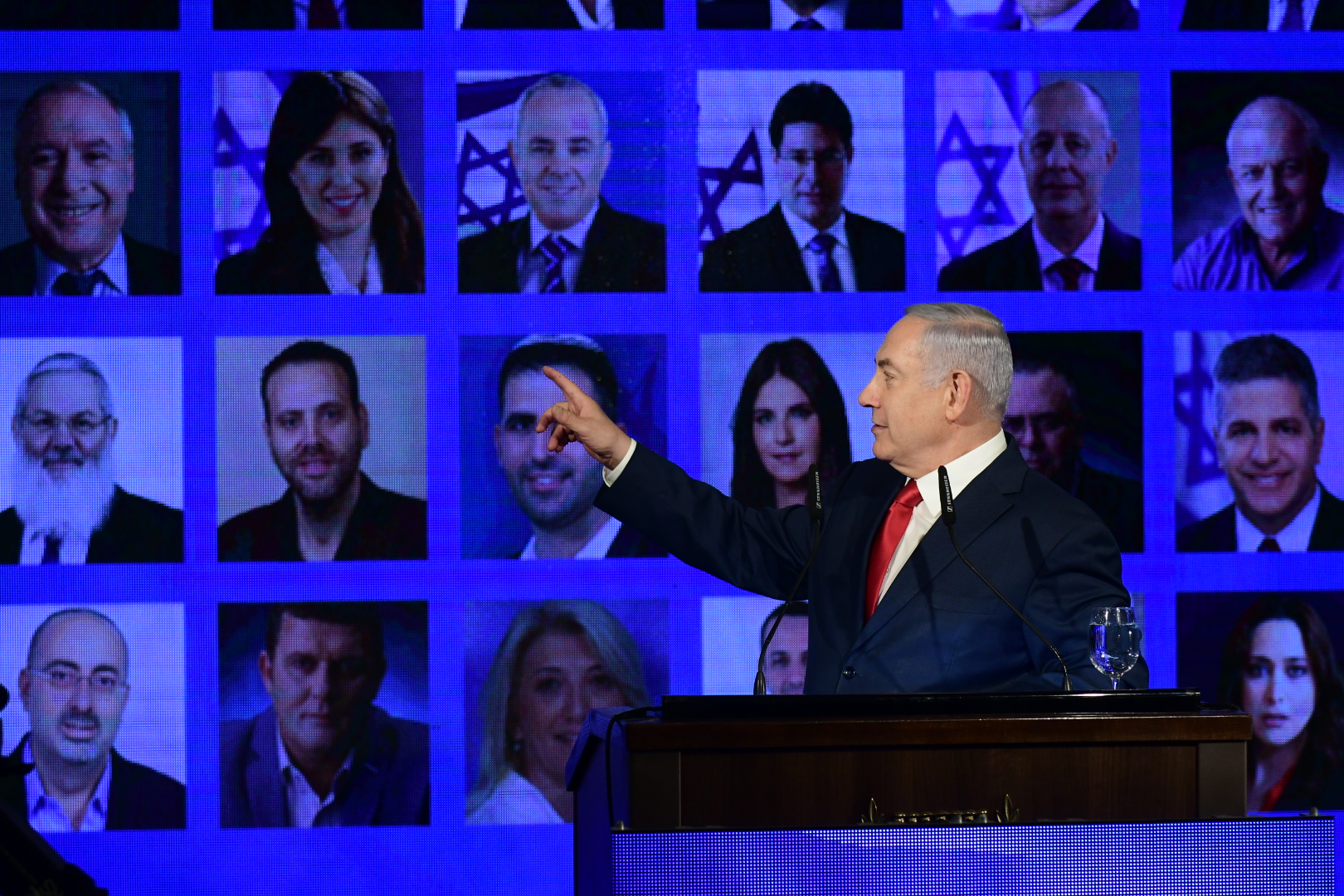
Wobbling around the threshold in some polls are Shas (ultra-Orthodox Sephardi); Meretz (left); Kulanu (right-center); Ra’am-Balad (Arab alliance, banned by the Central Elections Committee but likely to be allowed to run by the Supreme Court); Yisrael Beytenu (right, led by Avidgor Liberman); Gesher (Orly Levy-Abekasis’s centrist-ish party) and, as of this week, Zehut (led by ex-would-be Likud MK Moshe Feiglin).
That’s seven parties — seven! — that could get zero seats if they wind up below the threshold, with all their votes (* all-but) going to waste. Or they could get four or more seats, if they clear the threshold.
Given that our redoubtable pollsters are working with relatively small samples, that polls are not generally conducted face-to-face, that not all voters always tell pollsters the truth, that not all pollsters always survey the Arab community in Arabic, and — especially — that many, many Israelis simply haven’t decided who they’re going to vote for, there’s absolutely no way at this stage to credibly predict the composition of the next Knesset.
(Our political correspondent, Raoul Wootliff writes: “You might want to add that the entire process of predicting seat distribution is highly dubious in the first place, given that the performance of the small parties can have an outsized effect on the final numbers. And, that the seat distribution in polls is much less telling than the percentage of votes received by each party — which most pollsters do not release because it reveals various weightings that they do. ToI’s own poll last week is a very good example. In the scenario before an indictment announcement against Netanyahu, Likud got 19% and Blue and White got 23%. In the scenario after an indictment announcement, Likud went down to 15% and B&W up to 26%. But the seat numbers differed hugely — 29 dropping to 25 for Likud, vs 36 soaring to 44 for B&W — because three parties slipped below the threshold and changed the distribution for all the other parties.” All clear now? I know you’ll want to join me in saying “Thanks Raoul!”)
By extension, there’s absolutely no way at this stage to credibly predict the composition of the two opposing blocs in the next Knesset.
Conventional wisdom has it that the specifics of which right-wing party gets how many seats, and which center-left party gets how many seats, can be set aside, and that the real question is how many seats each bloc has. Is it Netanyahu who’ll be able to muster the 61 seats from various parties that would give a Likud-led coalition a majority, or can Gantz reach that magic 61? As of this writing, the polling consensus is that a Likud-led bloc is hovering around the 59-61 seat level, but that consensus just isn’t credible, in part because of all those parties hovering around the threshold. If Shas, Kulanu, Yisrael Beytenu and Zehut all make it, and the others don’t, for instance, things could look far rosier for Netanyahu than in many other scenarios. But the bloc question is more complex than it looks (as I’ll try to explain in a sec).
Bottom line, early in the afternoon on March 7: To the question of who is likely to win Israel’s elections, the only responsible answer is: We don’t know.
2. But Blue and White is clearly winning
I realize that this sub-headline negates the sentence that preceded it. But hear me out. It’s less complicated than the section above, I promise.
Every poll since Gantz and Lapid announced that Lapid was putting aside his ego and would serve as No. 2 to a prime minister Gantz for the first two and a half years after their merged Israel Resilience and Yesh Atid parties win the elections — if they win elections — has shown them beating Likud, and often in recent days by about five seats.

I interviewed Lapid at an English-language event in Tel Aviv on Wednesday night and, in his emphatic telling, a result like that on election day would mean Blue and White has won, and Gantz will be prime minister.
How so? Because, according to Lapid, the biggest party wins the elections, period. And all the “bloc” talk is a red herring.
When I put it to Lapid that, actually, in 2009, Tzipi Livni’s Kadima won 28 seats to Likud’s 27 but, last time I checked, Tzipi Livni had not been Israel’s prime minister, he explained that this was the exception that proved the rule. Livni had only one seat more than Netanyahu and, true, she’d proved unable to muster a coalition. But a more substantial advantage, such as the one Blue and White currently holds over Likud in the polls, he asserted, would guarantee its victory.

In other words, I pressed, parties that, on the campaign trail, are insisting that they wouldn’t partner with Blue and White, will in fact partner with Blue and White if it handily outscores Likud? Lapid gave quite a lengthy answer, in the course of which he refused to name the names of any such parties, but his ultimate assertion was: Yes.
3. Except, I don’t get it
Here’s the thing. I don’t think it’s impossible for politicians to (shock) change their minds. I don’t think it’s impossible for politicians to (shock) say one thing before the elections, when they’re trying to win over voters, and the opposite thing the day after, when the voters have had their say. So far, so healthily cynical.

I’m not even saying Lapid is flat wrong. If Blue and White does win several more seats than Likud, and the other, smaller-party arithmetic works in Blue and White’s favor, then plenty of the seemingly impossible could become possible. Could Kulanu incline toward an alliance with Blue and White? Well, maybe. What about Yisrael Beytenu. Who knows? (If these parties clear the threshold, of course.) Bennett seems unlikely, but he has partnered Lapid before. The ultra-Orthodox parties? They jointly restated on Thursday that it’s only Netanyahu for them, but history suggests Shas, if not both of them, could conceivably swing around.
And if Likud really, really tanks — which it shows absolutely no sign of doing — it could even turn on its leader, and then we could be talking about a Blue and White-Likud unity coalition.
But, it seems to me, when all the votes are in, and all the seats distributed, we could also plausibly find ourselves in a situation wherein Likud and its so-called natural allies can’t quite muster a 61-seat coalition, but neither can Blue and White. A situation, that is, in which the center, left and Arab parties have enough seats to deprive Netanyahu of a majority, but in which Blue and White, which has indicated it would not include Arab parties in a coalition, can’t muster a majority either. Blue and White would have won the election, for sure, except it wouldn’t necessarily have won the election. (That sentence is not a typo.)
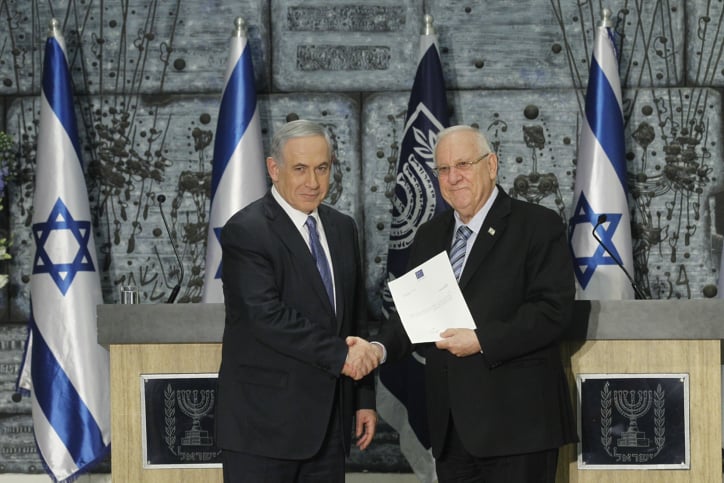
Under another joyous aspect of our glorious electoral system — the worst form of choosing a government, except for all the others we’ve discussed and/or tried — party big brass troop off to see the president when the votes are in, and tell him who they think he should charge with forming a government. Whom will who recommend (again, not a typo) if the election results produce the scenario I set out in the paragraph above? Whom will Rivlin choose? And will that someone be able to form a viable coalition?
I think I mentioned this: We don’t know.
And we have strayed into this territory before. In 1984, when all else failed, Shimon Peres (Labor Alignment) and Yitzhak Shamir (Likud) reluctantly agreed to “rotate” the prime ministership, with Peres taking the first two years and Shamir the second. Just imagine, we could be looking at a rotating prime ministership, in which one of the constituent parties is also rotating its leader. Quite the dizzying spectacle. How fortunate that the job of prime minister is so simple and straightforward.
And finally
The irritating conclusion, as of March 7 slightly later in the afternoon: Not only are the results of these elections anybody’s guess — as of this writing, a month before polling day — but that also might remain the case after we’ve voted.
Or not.
Sorry.
—
(* Knesset seats are distributed proportionately on the basis of votes cast for parties that clear the threshold. Votes cast for parties that do not clear the threshold do not figure in this distribution.)
A shout out to Jeremy Saltan, who compiles Israeli opinion polls here.








The Times of Israel Community.