

Reaching new depths: 9 things to know for February 27
A Likud ad with soldiers’ graves sparks anger, a rabbi recounts an attack on him that may or may not be anti-Semitic, and ire over Kahanists continues to rage
 Add ToI as a Preferred Source on Google
Joshua Davidovich is The Times of Israel's Deputy Editor
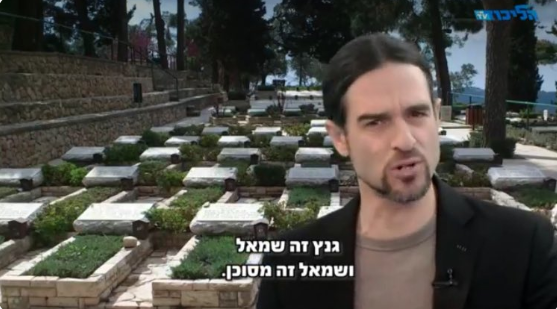
1. Grave miscalculation: The newest scandal surrounding Prime Minister Benjamin Netanyahu surrounds a clip on his Likud TV in which a party activists appears before soldiers’ graves to warn that the left is dangerous, and will lead to hundreds of deaths.
- It’s not the baseless claim against a whole segment of the political map that people are up in arms about, but rather the use of a picture of the Mount Herzl military cemetery in the background.
- “Crossing all lines,” reads a headline on the front of Yedioth Ahronoth.
- “This is shocking, I don’t know who the psychopath is who thought of the idea to incorporate the fallen [soldiers] in politics,” Eli Ben Shem, head of the Yad Labanim soldiers memorial organization, tells the Ynet news website. “I received dozens of messages from families hurt by that video. People don’t understand that it opens wounds.”
- Netanyahu quickly tried to stamp out the fire by ordering the clip taken down and those responsible suspended, and even right-wing Channel 20, which rarely criticizes the party, includes harsh criticism from the widow of a fallen soldier.
- “Truly, there are no words for the garbage this election is calling up,” Michal Kasten-Keidar is quoted saying.
- For the cultural anthropologists out there, it’s worth noting that while in the US it’s illegal to use military cemeteries for campaign ads, it’s often done anyway, and rarely kicks up much of a storm beyond a story or two, in contrast to Israel, where it seems the whole country was up in arms.
- Even cast-off Likud bad boy Oren Hazan is shaking his head: “Mr. prime minister, this time you’ve gone too far,” he tweets.
2. From ‘48 to ‘19: Unlike Netanyahu, Avishai Ivri, the former journalist and right-wing pundit who was in the segment, didn’t back down, but rather doubled down.
- He told journalist Haim Har-Zahav, who criticized the clip, “My friends are lying under those gravestones because of you, I would shut up if I were you.”
- That would be an impressive feat, given that, as pointed out by Channel 13 journalist Akiva Novick, the section of the cemetery pictured is the resting place of 35 pre-state soldiers killed in an ambush while trying to rescue Jews trapped in the Etzion Bloc in 1948, known in Israeli lore as the Lamed Heh.
- Yedioth quotes Uri Kushner, brother of Tuvia Kushner, who is buried in the section, who says he felt a “small punch in the gut” upon seeing the ad.
- “To see the section in a political campaign is a disgrace. This is a serious blow to the memory of my brother and the rest of the fallen.”
3. From Russia with high-stakes: The scandal was blamed for Netanyahu pushing off his departure to Russia by an hour, and his trip was shortened on the other end too, amid widespread speculation that Attorney General Avichai Mandelblit could announce a decision to charge the prime minister as early as Thursday, according to Channel 12 news.
- Netanyahu had to cancel an appearance with the Moscow Jewish community, which Channel 13 reports has led to “great anger” among local Jews.
- Netanyahu already delayed the trip once to broker a deal to bring Kahanists into the Knesset, which led to unprecedented anger among many American Jews.
- Amir Bohbot writes in the Walla news site that the trip is full of pitfalls for Netanyahu, who will try to tighten the Israel-Russia relationship regarding Syria following the downing of a spy plane in October: “Among other things, they will discuss areas where the Russians want to change the ground rules. If they don’t take Israeli interests into account, the situation could leader to a wider conflagration.”
4. Pandora’s Box: One person who has apparently stood by his side is US jurist Alan Dershowitz, who is on the cover of Israel Hayom warning Mandelblit that he could endanger Israeli democracy.
- An open letter sent by Dershowitz to Mandelblit claims that prosecuting Netanyahu in Case 2000, in which he is accused of trying to reach a deal with Yedioth publisher Arnon Mozes to hobble Israel Hayom in exchange for positive media coverage, would open a “Pandora’s Box” in which any official seeking positive media coverage would have to be prosecuted.
- The media consensus appears to be that Netanyahu will be charged with bribery in case 4000, the lesser breach of trust in case 1000, and case 2000 remains up in the air.
- In the Calcalist financial daily, Moshe Gorali recommends that Mandelblit only go with the strongest cases he has, for his own well-being: “This has a double advantage: He will both stick to his professional conscience, and make it easier to take on the ringing criticism he will get in any case, which will at least come while he is on a path he can trust. If you are going to live or die by the sword, it’s better that it should be your own sword and not someone else’s.”
5. Right fight: Ahead of the move, Netanyahu appears to be at least trying to make political hay, asking Justice Minister Ayelet Shaked for help obtaining documents his legal team claims can help exonerate him. Shaked had no choice but to pass the request to Mandelblit, as she is legally required to do, allowing Likud to open another front of attack on her.
- The infighting on the right has become the newest feature of the elections, with Shaked’s partner Naftali Bennett seemingly trying to push Netanyahu and the Trump administration into a corner over its peace plan.
Up until now, Bennett's criticism of the US peace plan has been in order to claim Netanyahu will allow a Palestinian state – & siphon off right-wing voters. He now appears to be trying to goad the US into saying the plan won't include a Palestinian state – so he can claim victory https://t.co/tx6Ma4h55H
— Raoul Wootliff (@RaoulWootliff) February 27, 2019
- Haaretz’s Anshel Pfeffer notes that the whole Israeli political spectrum is shifting rightward, which is actually bad news for Netanyahu.
- “The center of gravity of the opposition shifting from center-left Zionist Union to centrist Kahol Lavan has made a vote for an opposition party easier for soft-right voters. Netanyahu is trying to brand Gantz as ‘weak left,’ but it will be a much tougher sell than with [Isaac] Herzog and [Tzipi] Livni four years ago,” he writes.
6. Questions over Argentina attack: Two days after an attack on Argentina rabbi Gabriel Davidovich, there seems to remain a split over whether the assault was anti-Semitic or just a robbery.
- Yedioth reports the rabbi himself doesn’t seem sure that the attack was anti-Semitic, though he is not ruling it out. He tells the paper that the attackers forced him to the ground and beat him until he passed out.
- After that, according to the paper, they tied up his wife and told her “we know he’s the chief rabbi and you have a jewelry store. Where’s the money?”
- “Though they cursed her out, the curses were not of an anti-Semitic nature,” the paper reports.
- Argentine Environment Minister Rabbi Sergio Bergman tells Haaretz that “as of now, there are no clear indications that this is an anti-Semitic act.”
- Argentina’s La Nacion reports that police think Davidovich was specifically targeted, and it may have been part of a personal vendetta over a man refusing to grant a Jewish divorce.
- According to the paper, police have not yet been able to take testimony from Davidovich and his wife, who remain hospitalized.
7. Anti-Semitic-ish, at least: Nonetheless, many are viewing the attack through the lens of anti-Semitism, and using it as a springboard to speak out against the scourge.
- AMIA president Jorge Knoblovits tells AFP the robbery was merely a pretext for “an anti-Semitic act.”
- “In the world, there is a lot of room for ignorance, and where there is ignorance, there is space for anti-Semites,” he says.
- In Israel Hayom, Ariel Shmidberg cites the attack, other incidents, and the country’s inability to bring the AMIA and embassy bombers to justice as a reason for Jews to leave and move to Israel.
- “In Israel, no account isn’t settled: terrorists know that security agents will get to them, sooner or later, and they have no escape,” he writes. “In Argentina … community members are continuing to demand justice. It’s safe to assume it won’t come. Rabbi Davidovich also knows the chances his attackers will be caught are slim. Thus, there is one answer: moving to Israel.”
8. Not just politics: A survey released by the Ruderman Family Foundation shows that 95 percent of Jewish Israelis think Israel has a moral obligation to maintain its relationship with Diaspora communities, especially the US Jewish community.
- However, only 57% of Israelis believe the relationship is currently in a good place.
- That relationship is being tested, yet again, by Netanyahu’s support for the Otzma Yehudit party.
- Days after the Orthodox Young Israel group came out in defense of Netanyahu by saying the move is just politics, breaking with almost all other groups, historian Deborah Lipstadt, considered a voice of moral authority, says she is breaking with her congregation over it.
- “This is a party that has racist views,” she tells JTA. “This is a party that condones murder. This is a party that condones the man who committed the largest mass murder in Israel by a Jew. Those are all things that I find despicable, and to say it’s just politics is really bad.”
9. Terror is as terror does: In The Nation, Meirav Zonszein goes through the various ways American Jews have continued funneling money to groups associated with Meir Kahane and Otzma Yehudit candidates, despite it being labeled a terror group by the US.
- “If in the past, they relied on political mechanisms for fundraising and recruiting activists, today we are talking about a network of organizations disguised as charity groups and social causes that are raising money from the State of Israel and abroad in order to continue inciting and undermining the foundations of democracy,” says Ran Cohen, whose Democratic Bloc group has been instrumental in following the money.
- Haaretz’s Gidi Weiss also digs deep to recount a secret 1980 meeting between then prime minister Menachem Begin and US Ambassador Sam Lewis, in which the Israeli leader spoke out against Kahane (while also wringing his hands over his decision to crack down on him.)
- “He could have brought disaster – not on our people but on Arabs,” Begin told Lewis, according to the report. “We had no choice. He is a crazy man. He could have brought on us disaster. He is a dangerous man.”






The Times of Israel Community.