

Resisting call by Labor, Lapid says no plans to nix PM rotation deal with Gantz
Blue and White No. 2 dismisses claim that party would do better if it cancels agreement, tries to woo Labor voters
 Add ToI as a Preferred Source on Google
Raoul Wootliff is a former Times of Israel political correspondent and Daily Briefing podcast producer.
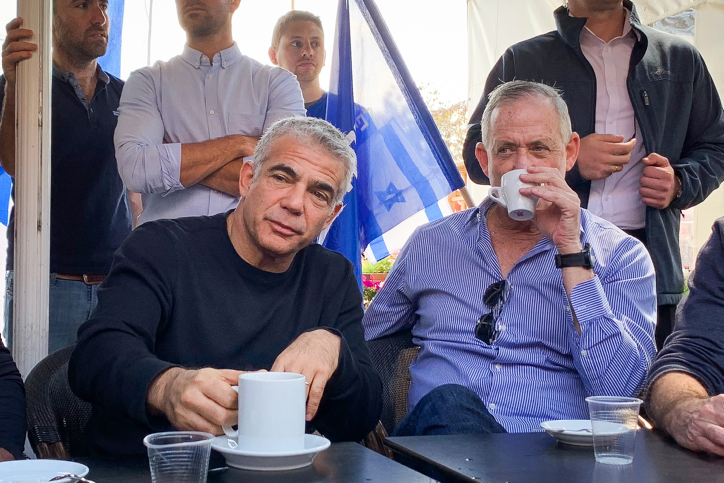
Yair Lapid, No. 2 on the Blue and White party slate challenging Prime Minister Benjamin Netanyahu’s Likud in next week’s Knesset election, on Sunday insisted he would not give up a rotation deal with party leader Benny Gantz despite calls from the Labor opposition party to nix it.
A leading Labor member on Saturday urged Blue and White to cancel the agreement between its two leaders to rotate the premiership between them, saying the party could win several more Knesset seats if it stuck solely with Gantz as its prime ministerial candidate.
The agreement — which would see Gantz take the post for the first two and a half years if the party forms the next government, and Lapid taking over for the next year and a half — was key to the unity deal between Gantz’s Israel Resilience and Lapid’s Yesh Atid when the two factions merged to form Blue and White.
But on Sunday morning, Lapid told Army Radio: “The rotation does not disturb a single voter in Israel. They appreciate the fact that we have a common path and are not preoccupied with ourselves. Of course I’m not giving up the rotation.”
Continuing a scramble between the two parties for center-left votes, Lapid addressed Labor voters and said that while he “respects” the party, “Labor supporters should vote Blue and White. Today a Labor vote ensures Netanyahu will remain in power.”
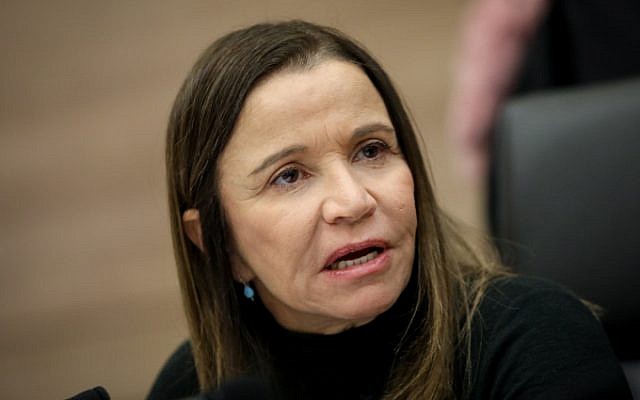
Speaking at a cultural event in the city of Ramat Hasharon in central Israel a day earlier, Labor’s MK Shelly Yachimovich said: “I believe — and I don’t just believe but know — that the moment they announce they’re canceling the rotation and Gantz is the candidate for prime minister without rotation, they’ll win an additional two-three seats from more moderate right-wing voters.
“So if every seat is as important as they are saying, I think they had better give up on the rotation and take those two-three more seats from the right, instead of from the center-left,” she said. “I think they’ll see an immediate result in the polling. I don’t think, I know.”
The rotation agreement was a demand set by Lapid for the formation of the joint slate. Though Gantz was said to have resisted it at first, he eventually relented, paving the way for the formation of Blue and White.
However, Gantz, with his security credentials as former chief of staff of the IDF, is seen as more popular with moderate-right voters than Lapid. Some have said the notion of Lapid as prime minister has turned them off voting for the Gantz-led party.
After its formation in February, Blue and White initially polled with a significant 5-6 seat lead over Prime Minister Benjamin Netanyahu’s Likud, but has recently fallen to a 2-3 seat lead, and in some polls the two parties are neck and neck.
Conversely, Netanyahu has consistently been seen as having a better shot at forming a government following the April 9 vote, as the right-wing bloc of parties that support him has an edge over the center-left bloc that could prop up Gantz and Lapid’s party.
If Blue and White is able to glean votes from the moderate right, it could upset that balance.
Labor, meanwhile has been polling at around 8-10 seats under the leadership of Avi Gabbay, a steep drop from its current 19. The vast majority of those lost votes are believed to have gone to Blue and White, due to its perceived potential to unseat Netanyahu.
While horse-race polls are an almost daily occurrence in Israel in the weeks leading up to elections and are not seen as overly reliable, taken together, the surveys can often serve as a general gauge of the political climate and where the vote may be headed.
Times of Israel staff contributed to this report.






The Times of Israel Community.