

Was Khamenei behind the barring of moderate presidential candidates in Iran?
After conservative council paves way for hardliner to win, determining the supreme leader’s stance may hold key to anticipating Iran’s next moves in Vienna nuke talks
 Add ToI as a Preferred Source on Google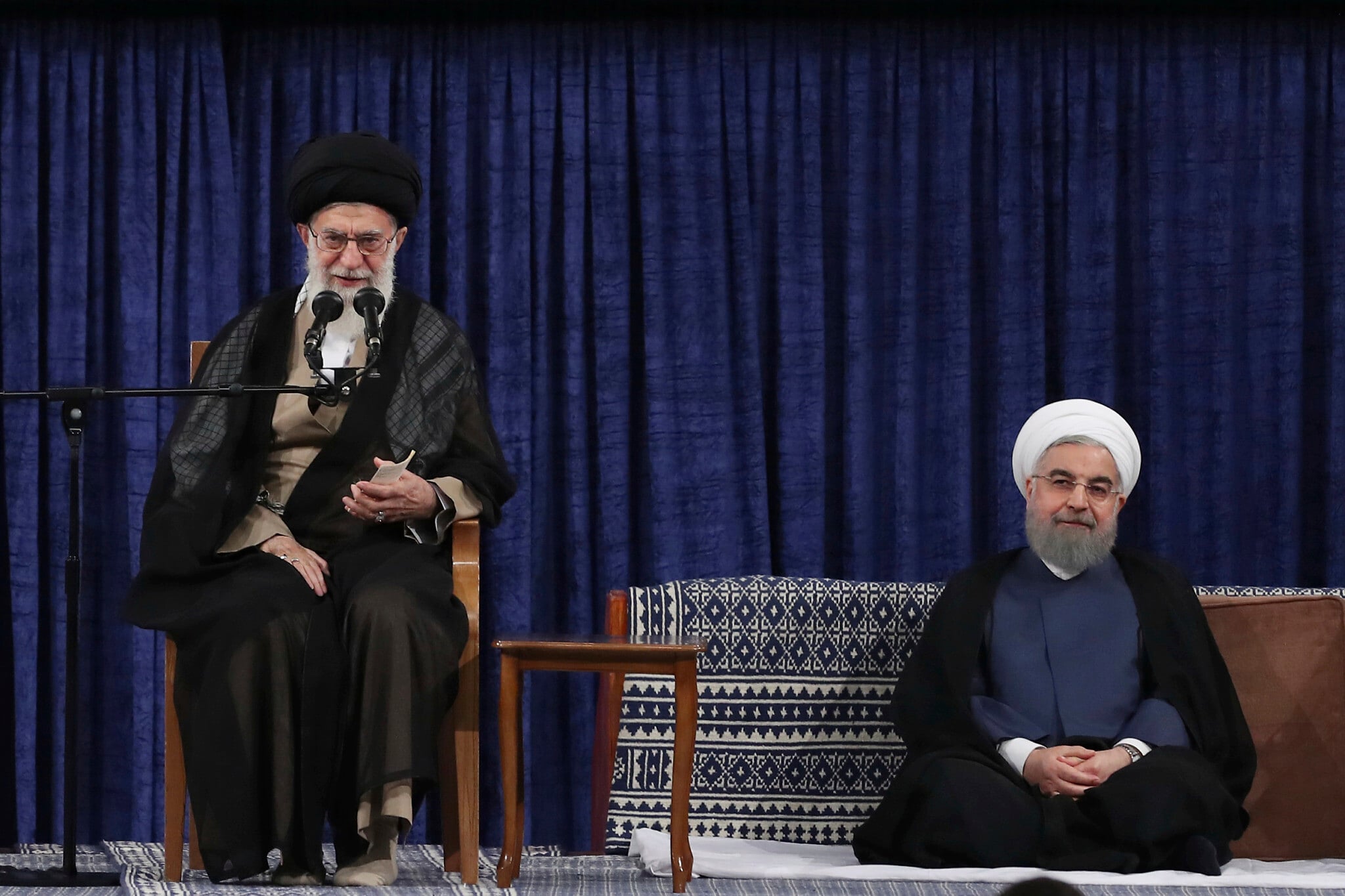
While Israeli attention was focused on the latest round of fighting in Gaza and its diplomatic aftermath, the Iranian regime took a drastic step in the lead-up to June’s presidential elections, one that could be an indication of how Supreme Leader Ali Khamenei will approach the ongoing nuclear talks in Vienna in coming weeks.
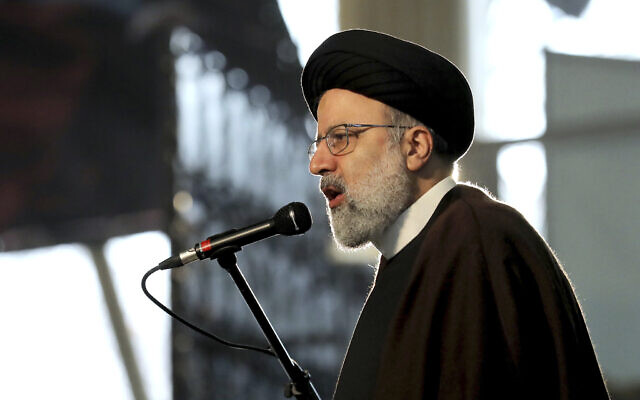
On Tuesday, Iran’s Guardian Council barred the leading reformist candidates from running for the presidency, removing the key obstacles for Ebrahim Raisi, a conservative cleric running Iran’s judiciary, to replace President Hassan Rouhani in August.
But to understand the implications of the move, one must first assess whether Khamenei was behind it, or whether it was an attempt by the revolutionary clerics of the Guardian Council to flex their muscles and decide the election on their own.
Revolutionaries and republicans
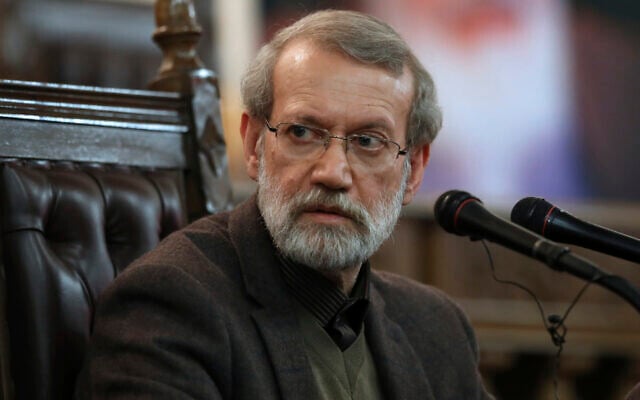
The Guardian Council, which rejected the candidacies of the vast majority of the 590 individuals who registered to run, most notably banned former parliament speaker Ali Larijani, a conservative who allied with Rouhani in recent years. Larijani, a member of one of the Islamic Republic’s most illustrious families, had been positioning himself as a pragmatic candidate who would back Rouhani’s signature 2015 nuclear deal with world powers. That accord is now in tatters as diplomats in Vienna try to negotiate a return of both Iran and the US to the agreement.
Another moderate candidate, Rouhani’s senior vice president Eshaq Jahangiri, was also disqualified. Jahangiri served as the liaison between Rouhani and Khamenei.
Ori Goldberg, of the Interdisciplinary Center Herzliya’s Lauder School of Government, stressed that the oft-used framing of Iran being split between “hardliner” and “reformist” camps is unhelpful.
“The much more apt description is revolutionaries and republicans,” he said.
“Revolutionaries are the ones who feel that the Islamic Republic’s resilience is linked automatically to a contrarian, hostile attitude towards the world. They want Iran to be involved in all sorts of projects outside its borders. They feel that Iran’s lasting power depends on its ability to maintain a revolutionary stance. ”
“Their rivals are not reformists,” argued Goldberg. “You don’t have Gorbachev, certainly not a Vaclav Havel in the ranks of the Iranian leadership today. What you have are people who call themselves republicans. They feel that if the Islamic Republic wants to continue living, it has to leverage its strength at home. It has to make its citizens’ lives easier. It has to get a little more moderate. It has to grow the stable, functional, neoliberal economy, and it has to have a good relationship with the world. It needs the world in order to grow.”
An earthquake
Some see the Guardian Council’s decision to ban the republican candidates as a reflection of the wishes of Khamenei.
“It’s an earthquake,” said Raz Zimmt, Iran expert at the Institute for National Security Studies in Tel Aviv. “If the decision remains, it is a very blatant step by the regime that appears to be meant to pave the way for Raisi.”
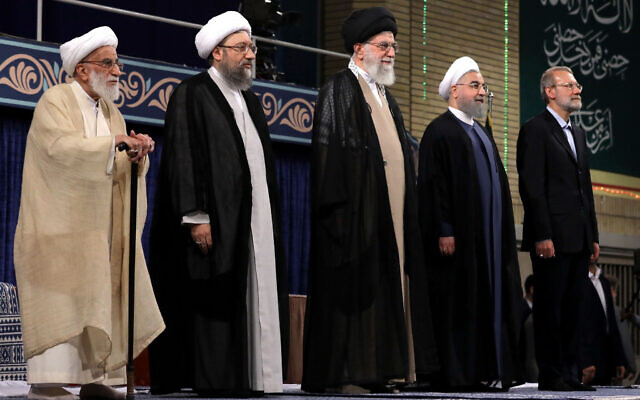
Raisi, who is linked to mass executions by the regime in the aftermath of the Iran-Iraq War, is the best-known candidate of the seven remaining hopefuls, with opinion polling previously showing his anti-corruption campaign drawing support.
But he is a poor campaigner who is not popular today, and the Guardian Council – and perhaps Khamenei – seems to have little faith in his ability to triumph in anything resembling a fair fight.
“They are fielding a candidate who has no public support,” said Goldberg. “Their guy Raisi was resoundingly defeated by Rouhani in 2017. They know they have no public support, so what they’re doing is using the executive power at their disposal.”
“This will be the first time that there isn’t even the appearance of competition” in Iranian presidential elections, Zimmt pointed out.
If Khamenei was behind the decision, it can offer insight into Iran’s next moves at the nuclear talks.
“It means that Khamenei does not want the moderates, who want better relations with the West, to be the ones who seal a new deal with the Americans,” said Meir Javedanfar, Iran lecturer at IDC Herzliya.
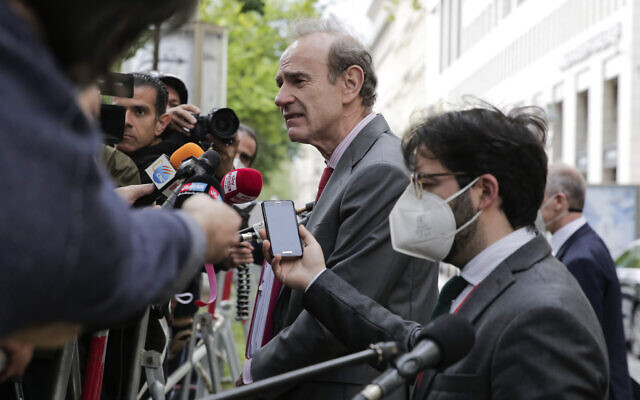
“He wants to give his hardline allies that win. He wants his hardline allies to be able to say that ‘we are the ones who reached a deal with the United States, because only by negotiating through strength can we get a new nuclear deal with America, not negotiating through compromise, which was Rouhani’s way.”
The practical effect on the talks, he argued, is that Khamenei will seek to draw out the talks until Rouhani steps down in August, then will try to close a deal.
“I think the Iranians are biding their time,” said Javedanfar. “It seems that Khamenei wants first and foremost to see if he can push the Americans to agree to a better deal where they cancel the sanctions. While he waits, he wants the clock to run out on the presidency of Rouhani.”
The fifth round of indirect talks between Iran and the US over both sides returning to some iteration of the Joint Comprehensive Plan of Action resumed in Vienna on Tuesday.
The nuclear negotiations have been plagued by contradictory, anonymously leaked information coming from Iran. It’s likely a sign of the conflict between the administration of the outgoing Rouhani, the relatively moderate cleric who clinched the 2015 deal, and those now seeking to replace him.
Khamenei, the reluctant republican
Others believe that the Guardian Council, the senior members of the revolutionary faction, acted on their own.
“I don’t understand Khamenei to be behind this move,” said Goldberg.
“The supreme leader is most likely a revolutionary at heart, but in his rational mind, he knows two things. First, that the public does not support the revolutionaries, and in Iran, dictatorship it might be, you ignore the public will at your own peril.”
“And the second thing he knows,” Goldberg said, “the people that have kept Iran up and running, the people who have been able to sell Iranian oil, the people who have kept up the relationship with China and India that has kept Iran afloat economically, that’s Rouhani and his people. He knows that these are the only people to whom he can entrust the country and assume they will keep the Islamic Republic up and running.”
Goldberg sees evidence for this in the fact that Khamenei has in the past gotten in the way of presidents who have been overly open to the world, but has not disrupted Rouhani’s diplomatic outreach.
The supreme leader can still overturn the Guardian Council decision, and if he does so, “that’s a real sign he understands that the future of the country is in the hands of the republicans and not the revolutionaries.”
Rouhani’s reaction to the decision seems to indicate that he also believes this to be a move by the Guardian Council against the will of the Supreme Leader. Speaking out against the decision on Wednesday, Rouhani said he had appealed to Khamenei to intervene, and warned that “the heart of elections is competition. If you take that away it becomes a corpse.”
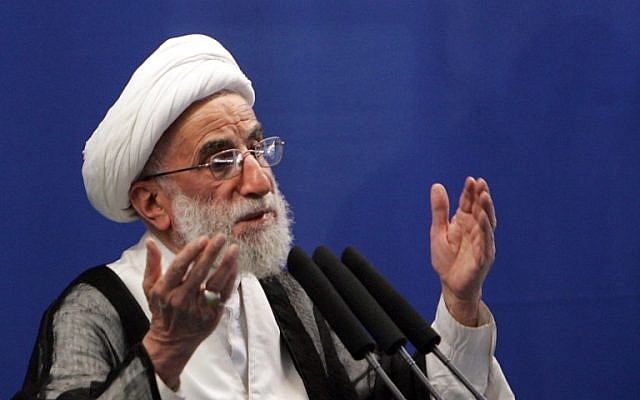
There is precedent for Khamenei’s intervention, pointed out Henry Rome, senior analyst at the Eurasia Group. In 2005, Khamenei stepped in to ask the Guardian Council to reinstate two moderate candidates.
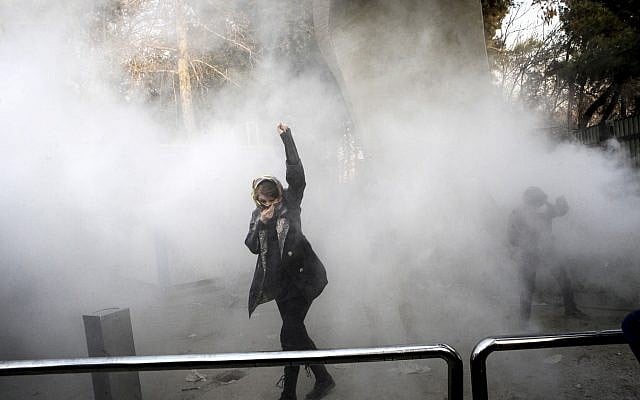
If Khamenei lets the Guardian Council have its way, Goldberg predicted that Iranians would take to the streets if another republican candidate was not found.
Rome argued that the more likely scenario is that voters will express their exasperation by staying away from the polls.
“The Islamic Republic is on pace to record the lowest turnout for a presidential election in its history,” he said.
AFP and AP contributed to this report.


The Times of Israel Community.