

East Jerusalem fury resounds in (some of) Israel’s press
Most papers play up the drama of the US criticism over building plans amid a Netanyahu-Obama meeting, but don’t go looking for it in Israel Hayom
 Add ToI as a Preferred Source on Google
Joshua Davidovich is The Times of Israel's Deputy Editor
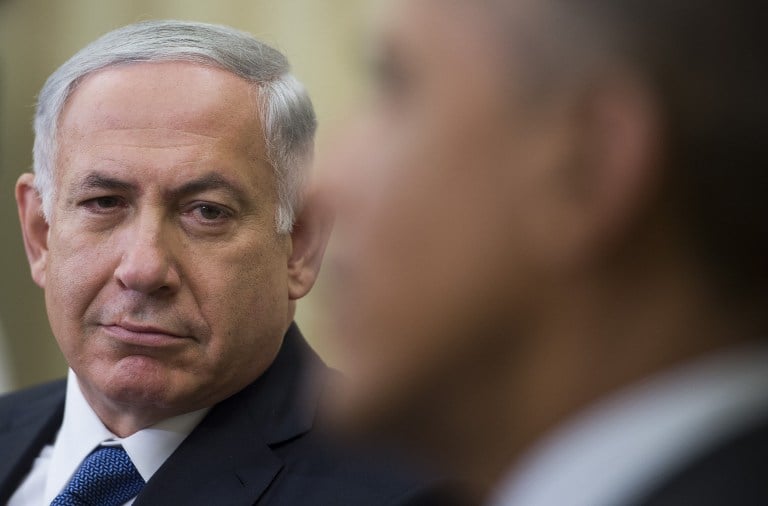
Wednesday promised to be a day of great political and diplomatic importance. Prime Minister Benjamin Netanyahu was scheduled to meet with US President Barack Obama for the first time since Israeli-Palestinian peace talks fell apart followed by the summer Gaza war, which sparked some nasty back and forth between Jerusalem and Washington.
In the end, the day delivered on its promise, though the fireworks came not from the Oval Office but from Washington briefing rooms, where spokespeople tore Israel a new one over the approval of 2,610 new housing units in the East Jerusalem neighborhood of Givat Hamatos. The development easily overshadowed the tired platitudes repeated by Netanyahu and Obama in front of flashbulbs in the White House.
While both Yedioth Ahronoth and Haaretz led with the actual news, Israel Hayom, a paper that has come under renewed criticism for its seeming insistence on acting as Netanyahu’s mouthpiece, ignores the firestorm and leads its front page with the most milquetoast quote it could pick out from the Oval Office press conference: “Thinking outside the box.” That’s not always a good thing.
In Yedioth, the drama plays out like a bad Aaron Sorkin script, with the paper offering supposed quotes from the closed-door Obama Netanyahu meeting, albeit without a hint of sourcing:
“As the prime minister of Israel made his way to the White House, the president of the United States found out that the Jerusalem municipality had given final approval for construction of 2,610 homes over the Green Line. Obama received Netanyahu smilingly in front of the cameras, but after the doors were closed came the rebuke that kicked off what may be the harshest crisis in US-Israel relations. ‘What’s your vision for peace,’ Obama shot at Netanyahu. ‘Moves like these only raise doubts about Israel’s willingness for peace.’ Sources in Washington said that in the eyes of Obama, this was a loogie in his face, and not for the first time.”
Haaretz reports, however — quoting an actual source, albeit an unnamed one — that Obama did not even specifically bring up the new building plans.
“A source familiar with the meeting between Obama and Netanyahu said that the US president raised the issue of settlement construction during their talks, but that he did not specifically mention the Silwan or Givat Hamatos neighborhoods. Obama emphasized that the settlement construction feeds a cycle of provocations, and added that amid the ongoing efforts to stop and soften Palestinian steps at the United Nations, settlement construction would be even more damaging,” writes correspondent Barak Ravid.
The paper’s Ari Shavit, writing in the op-ed page, contends that Obama and Netanyahu, despite all the bad blood, can still be the Churchill and Roosevelt they aim to emulate.
“The man who wanted to be Roosevelt knows by now that he won’t be Roosevelt. The US economy may be reviving, but the social injustice is deepening and the limp performance internationally is onerous. And the man who wanted to be Churchill knows by now that he won’t be Churchill. After deriding the Israeli political shtetl, he has become an inseparable part of it. But it’s not too late. Iran is vulnerable. There’s still a chance to form an American-Sunni-Israeli alliance to stand up against Tehran. With the right vision and management, it’s still possible to combine a suspension of settlement construction, a strategic partnership with the Arab states and an economic-diplomatic alliance against the ayatollahs,” he writes. “But to do the right thing Obama must show a little of the leadership that John Kennedy showed, and Netanyahu must show a little of the wisdom that Levi Eshkol showed. Only if they rise above themselves and stand up to the challenge of their times will the two save their legacy.”
That’s certainly an idea Israel Hayom can cotton to. The paper offers essentially a transcript of the press appearance between the two, and almost completely ignores the tempest over the East Jerusalem building plans (save for a Liechtenstein-sized graf buried at the end of the news item).
Regarding the Oval Office sit-down, the paper quotes an Israeli source who describes the meeting as “good and intense. Among the subjects discussed by the two were Iran, American efforts against the Islamic State and the influence changes in the Middle East can have on the process with the Palestinians.”
As comment man Dan Margalit sees it, things are as hunky dory as can be between the two leaders, who see eye to eye on the dangers of the Middle East. If only, Margalit ponders in Israel Hayom, the gadfly ministers on Netanyahu’s right would just shut their big yappers.
“In these circumstances there was no room for the statements of Uri Ariel, and right after, Naftali Bennett. There is no democracy in the world where the leader makes a statement abroad and his ministers attack even before he returns home. Even more so now, when Netanyahu reiterated a statement he has been making for five years. What was so urgent that they had to present his words as meaningless? This is a battle over Jewish Home that is causing unneeded damage to the Jewish state,” he writes.
The gantze geshichta
While the war in Gaza is but a fresh memory, two separate interviews by IDF Chief of Staff Benny Gantz, to Haaretz and Yedioth, highlight how the summer of carnage could fade into just a blip in Israelis’ imaginations, for good or for bad. While the full interviews will run on Friday, both papers preview their “gets” a day early.
For the good, Gantz tells Haaretz that a long-term peace deal with the enclave is possible, if only Israel finds a mechanism to safely ease economic restrictions. “There’s the potential for many years of quiet, if we act intelligently,” he tells the broadsheet. “Hamas, in its current state, won’t hurry to ramp up tensions with us again. The sense of its capabilities have been damaged. It lost assets, tunnels, rockets.”
On the flip side, though, Gantz tells Yedioth that the threat of a war against Hezbollah in the north will make this summer’s conflict look like a pleasant summer stroll. “The active threat against Israeli citizens from Lebanon is much wider than that of Gaza,” he says, in what seems to have been meant as a throwaway comment defending the army’s handling of the Hamas tunnel threat. “So I need to run to Jerusalem and recommend attacking Lebanon? We need to know how to deal with dangers.”







The Times of Israel Community.