Charity provides West Bank shelter for unsold and abandoned donkeys
Safe Haven For Donkeys rescues the animals that can’t attract buyers at market because they are young and not yet at full strength; also offers free drop-in treatment
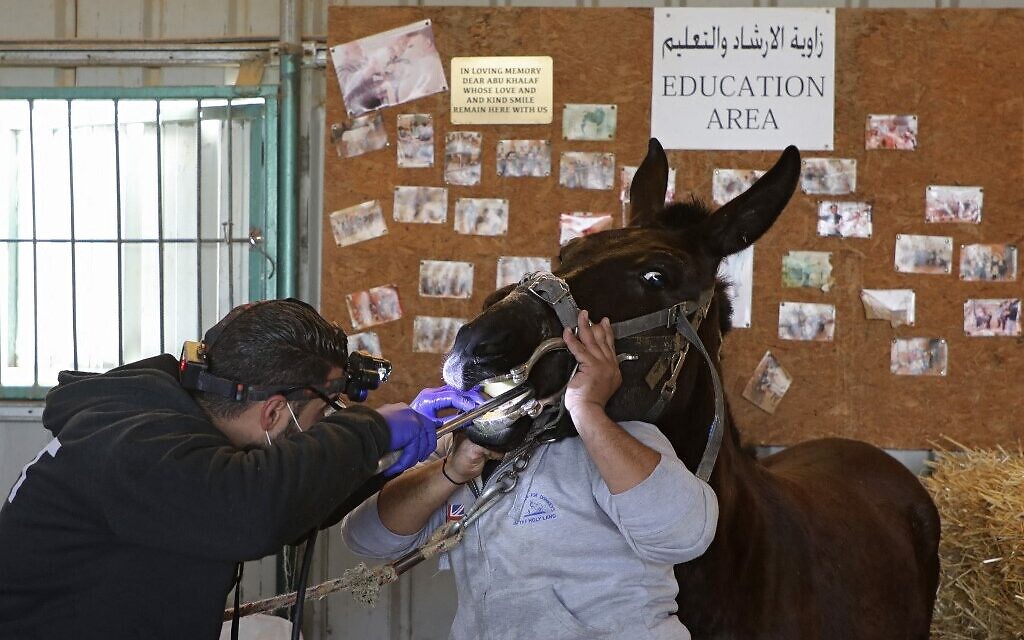
A doctor inspects a donkey at the Safe Haven for Donkeys sanctuary in the town of Rujayb, east of the city of Nablus in the West Bank, on February 25, 2021 (Jaafar ASHTIYEH / AFP)
AFP — Rakan Silos rises early every Thursday and heads to a West Bank donkey shelter where he helps care for animals that still play an important role in daily Palestinian life.
Donkeys that did not attract a buyer at a weekly market in Nablus are brought to the shelter in nearby Rujayb, where Silos, a veterinarian, examines them “completely and free of charge.”
The shelter is run by the British charity Safe Haven For Donkeys, established in 2000 to care for working donkeys in Israel and the West Bank.
Donkeys “work so hard for so little,” but are often plagued by easily treatable conditions like overgrown hooves and bad teeth, the charity says.
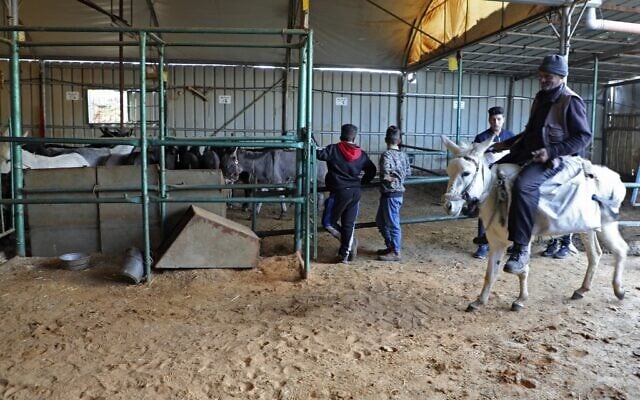
A man rides a donkey into the Safe Haven for Donkeys sanctuary in the town of Rujayb, east of the city of Nablus in the West Bank, on February 25, 2021 (Jaafar ASHTIYEH / AFP)
Some Palestinians still rely on donkeys for transport and in agricultural work.
Get The Times of Israel's Daily Editionby email and never miss our top stories
Silos, who trained at Al-Najah University in the West Bank, said donkeys in Nablus are brushed and coddled, the way some in other cultures might treat a cherished horse.
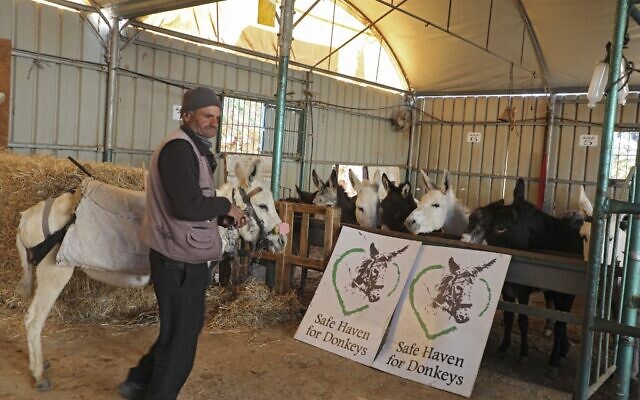
A man leads a donkey at the Safe Haven for Donkeys sanctuary in the town of Rujayb, east of the city of Nablus in the West Bank, on February 25, 2021 (Jaafar ASHTIYEH / AFP)
On Thursdays, market day in Nablus, fully grown donkeys are popular sellers, but younger ones often go unsold and abandoned because buyers want animals at full strength rather than one that will take time and money to raise.
“We take care of them until they are adults,” said Wael Salama, who also works at the shelter.
Advertisement
He explained that adoption is free but on the condition that the donkey not then be sold.
The refuge, the only one in the West Bank, has capacity to care for up to 200 donkeys, but also offers free treatment for farmers who bring their donkeys to the site.
Help us report truthfully on social media
As a multimedia journalist, my job is to take the quality, fact-based journalism produced by The Times of Israel newsroom and make it accessible across every platform — from Instagram posts to podcasts to short-form videos.
This is how many, especially young people, consume news these days. But misinformation is rampant on social media. Our team at ToI produces accurate, responsible short-form reporting on Israel and the Jewish world.
If you believe in the importance of factual social media journalism, please consider joining our reader support group, The Times of Israel Community. Your financial support is essential to sustain responsible multimedia reporting.
We’re really pleased that you’ve read X Times of Israel articles in the past month.
That’s why we started the Times of Israel - to provide discerning readers like you with must-read coverage of Israel and the Jewish world.
So now we have a request. Unlike other news outlets, we haven’t put up a paywall. But as the journalism we do is costly, we invite readers for whom The Times of Israel has become important to help support our work by joining The Times of Israel Community.
For as little as $6 a month you can help support our quality journalism while enjoying The Times of Israel AD-FREE, as well as accessing exclusive content available only to Times of Israel Community members.
Thank you, David Horovitz, Founding Editor of The Times of Israel


 Add ToI as a Preferred Source on Google