

It’s the most wonderful time of the year? 9 things to know for December 25
The timing of new elections, as possible charges are readied, leaves little doubt as to why Netanyahu called a snap poll; it’s unlikely Mandelblit will have a very jolly time
 Add ToI as a Preferred Source on Google
Joshua Davidovich is The Times of Israel's Deputy Editor
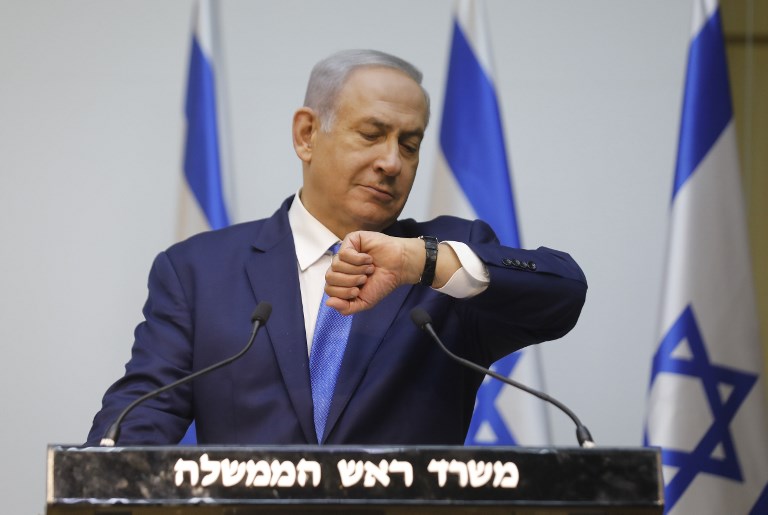
1. Let it slow: The least unexpected development in Israel’s political arena still managed to come as somewhat of a surprise. After months of rumors and reports of new elections, the government agreed Monday to bring itself down, heralding new elections.
- Ostensibly, the reason for the snap poll was the government’s inability to come together on a law regulating military draft deferments for members of the ultra-Orthodox community, but pundits near and far are pretty much in agreement that the real reason is the possibility of indictments coming down against the prime minister.
- By the scheduling of elections for April 9, the thinking goes, Attorney General Avichai Mandelblit may be blocked from charging the prime minister beforehand for fear of intervening on the election.
- Netanyahu “made a decision last week and knew that he was going to go ahead with it now,” a senior Kulanu source tells ToI’s Raoul Wootliff — last week being when Mandelblit was handed the 800-page case file to review.
- “All the considerations that prevailed until now, like the intention of holding the election in May or June, after Independence Day celebrations and the Eurovision Song Contest, or even later, in September, went out the window. The supreme and only priority that has dictated Netanyahu’s steps from that evening until now is his complicated legal situation. In the end it’s the investigations, dummy,” Haaretz’s Yossi Verter writes (employing the classic James Carville line that long ago jumped the stupid shark).
2. You’re a mean one, Mr. Mandelblit: It’s not only about avoiding the charges, but about proving a point to Mandelblit about how popular the man he may charge is.
- “Netanyahu is going to elections in which he will ask the public’s trust in continuing in his job, even under indictment and court criticism,” Mati Tuchfeld writes in Israel Hayom. “The left will try to improve its terrible position in the coming months, but from everything that’s been seen so far, it seems it will miss out this time as well.”
- “He wants to preempt this, he wants to win, he wants to turn around to the attorney general and say, ‘Before you decide to prosecute me, pay attention, the people of Israel have reelected me for a fourth time. … You can’t overturn the results of a democratic election,’” Hebrew University Prof. Reuven Hazan tells Foreign Policy.
- (Hazan is also quoted in the Washington Post, New York Times, AP, and Financial Times, showing just how far one call arranged by The Israel Project can go.)
- Noting that Mandelblit will be criticized no matter what he does, Yedioth Ahronoth’s Nahum Barnea calls on him to keep the process as sterile as possible: “You can’t take the indictments out of the elections, but you can take the elections out of the indictment.”
- “If Mandelblit decides to indict, Netanyahu’s prospects of losing increase dramatically, but if he wins nonetheless, the potential ramifications and impact would be radical, if not revolutionary,” Chemi Shalev writes in Haaretz. “If the public reelects him despite a Mandelblit indictment, it will not only repudiate the rule of law, it will hand Netanyahu a mandate to purge the legal apparatus in a way that would let him go scot-free nonetheless. If all of this reminds Americans of Trump, Whitaker, Rosenstein and Mueller et al, they are not alone.”
3. On Mandelblitzen! It’s still unclear whether Mandelblit can or will publish anything ahead of the election, making him the biggest wildcard — and target — of the campaign season.
- After reports emerged Monday that Mandelblit would likely hold off on indicting, the Justice Ministry issued a statement saying it would continue the investigation apace regardless of political impact, and pointed journalists to its vague guidelines, which advise keeping things business as usual but being careful not to intervene in the democratic process.
- Hours later, the same places that reported Mandelblit would hold off were reporting he could charge Netanyahu by next month, seemingly enough time before the vote to avoid accusations of meddling, citing unnamed judicial sources as Mandelblit’s office likely kept up its offensive against those initial reports.
- Mandelblit has smartly not let himself get pinned down to any date (though had he set himself a public deadline before elections were called he could have avoided any accusations of impropriety no matter when he announced his decision.)
- “Mandelblit doesn’t have the luxury of making a decision at a pace he considers proper. The pressure that will come down on him to make a decision soon could lead him to gird himself and his aides in coming week and to work around the clock to make a decision and publish it before the end of January,” Tova Zimuki writes in Yedioth.
4. Run, Benny run: Mandelblit is the biggest wildcard in the election, but not the only one. Former IDF chief Benny Gantz, who has yet to officially announce he is running and in what form, is the other big unknown.
- Luckily for Netanyahu, a poll published early Tuesday by the Maariv daily shows him easily cruising past Gantz, getting 30 seats whether or not the former army chief runs. Gantz, according to the poll, which was conducted online and should be taken with many, many grains of salt, would only get 13 seats.
- Previous polls had shown Gantz only seriously challenging Netanyahu if he joins up with other left-centrists, like Yesh Atid.
- Speaking to the New York Times, Orit Galili-Zucker, a former strategic communications adviser to Netanyahu and a political branding expert, says Netanyahu should not be so quick to assume victory, pointing to the unreliability of polls. (Indeed, in 2015, even exit polls showed a dead heat between Likud and Zionist Union, while actual results had Likud winning handily, leading to much soul-searching that has apparently been quickly forgotten.)
- “He could find himself out of the prime minister’s office and out of history,” Galili-Zucker says, “having been defeated not on ideological grounds, but on personal grounds.”
5. Come all ye faithless: Yedioth notes that given that Gantz hasn’t announced if and how he’ll run, and many of his positions, he’s more an “enigma” than a juggernaut.
Fun fact: The most recent application for the establishment of a new party in Israel took place on December 2. The new party is called "Straight" (Yashar in Hebrew).
On November 22, a party called "Simply Love" (Pashut Ahava) was registered.
Which one is Benny Gantz?
— Raphael Ahren (@RaphaelAhren) December 25, 2018
- A center-left bloc could give Netanyahu a run for his money, though, if one can coalesce. Even former prime minister Ehud Barak hinted in an interview with Hadashot news Monday that he could enter the fray if such an amalgamation forms, which apparently got Likud in enough a huff to shoot back that he was Israel’s most failed leader ever.
- “Whether the centrist and left-wing party leaders will be able to iron out their differences and come together could prove decisive for the election — and for Netanyahu,” ToI’s Marissa Newman notes, listing several of the unknowns heading into the election.
- Haaretz’s Aluf Benn, in his own polisticle, notes that “Netanyahu wants the opposition camp to be made up of as many small parties as possible, which will compete for the attention of his fans after the elections and not pose a palpable threat.”
6. Silent fight: The formation of a center-left bloc would mean that like last time around, it seems the elections will be once again a battle of the blocs, and the ruling coalition has not been shy about wanting to get back together after the campaign, with Netanyahu saying as much during a Likud meeting Monday.
- “Despite the arguments between the Likud and ultra-Orthodox, the blow-ups between Bennett and Netanyahu and Moshe Kahlon’s very unflattering opinion of the prime minister, the core coalition is a coalition that works, leads, and has brought the best achievements,” Yehuda Shlezinger writes in Israel Hayom, comparing Netanyahu to a family.
7. Baby, it’s dangerous outside: The elections were called just a few weeks after Netanyahu chided other lawmakers for trying to force elections with a security situation brewing in the north, and journalists don’t let him off the hook, with his public statement on the matter getting heavy rotation on news channels Monday.
- “It’s so cynical it literally hurts me in my bones,” Yedioth Ahronoth’s Sima Kadmon writes, figuratively.
- Haaretz’s Amir Tibon writes that Netanyahu tried to justify the move by saying that the security threat was gone, with the northern operation running swimmingly. But then US President Donald Trump came along.
- “Netanyahu’s developing narrative regarding security and the elections could perhaps enjoy the benefit of the doubt if it weren’t for Trump’s surprising announcement last week that he is withdrawing all American forces from Syria,” he writes. “Yet despite this real and concerning security deterioration that happened just last week, Netanyahu’s concerns for the security situation have somehow dissipated. Suddenly, even a serious situation like the one Israel is about to face by itself in Syria was not important enough to overcome Netanyahu’s own political (and legal) calculations.”
8. Peace plan got run over: What’s likely good news for Netanyahu are reports that Trump will delay the rollout of his peace plan until well after the election, likely the summer, according to experts.
- “The US would like to see Bibi [Netanyahu] reelected and understands that the plan, which calls for the division of Jerusalem, would be ammunition for [Jewish Home party chair and Netanyahu rival] Naftali Bennett to attack the PM,” Dana Weiss of Channel 2 tweets.
- “I cannot imagine that anyone in the White House would think about releasing the plan at this volatile time,” said Marc Zell, the head of the Israeli branch of the Republican party, tells ToI’s Raphael Ahren.
- Deal or no deal, a Netanyahu re-election will mean more years of no peace, Palestinian lawmaker Mustafa Barghouti tells the Associated Press from a less-than-jolly Bethlehem: “He failed in Gaza, he failed in the North, he failed in the West Bank and he has become, he and his government, an obstruction to any possibility of progress towards real peace.”
9. Netanyahu is coming to town: The April 9 timing also means that Netanyahu will have a chance to travel to the US for the AIPAC conference and get some photo ops of him hobnobbing with Trump and other US politicos and cementing his image as a world leader.
- But with Democrats increasingly estranged from the Israel of Netanyahu, Brookings fellow Shlomo Lipner notes that the meeting can also backfire if Congressional Dems decide to flex their muscles and blackball him.
Expectation in #Israel that @netanyahu will visit Washington in March for @AIPAC policy conference. Hopes to score royal @WhiteHouse treatment and maybe address to joint session of Congress – just weeks before #IsraElex19.
Will be test drive for new @HouseDemocrats on Israel.
— Shalom Lipner (@ShalomLipner) December 24, 2018
- Globes correspondent Tal Schneider, who won the soothsayer lottery by predicting elections on April 9 back in September, reveals it was all about the confab.
some ppl asked me today how did I know the presumed date #israElex19? (attached screenshot) back in Sept.
It's simple: I checked when is @AIPAC conference as I assume that @realDonaldTrump will be recruited by @netanyahu to assist in sliding into his 5th term. > pic.twitter.com/GfJE1SButb— Tal Schneider טל שניידר تال شنايدر (@talschneider) December 24, 2018


The Times of Israel Community.