

Jewish ballplayers go to bat for charities in ‘team portrait’
500 signed prints a triple threat of sports fandom, a for-profit venture and charitable giving
 Add ToI as a Preferred Source on Google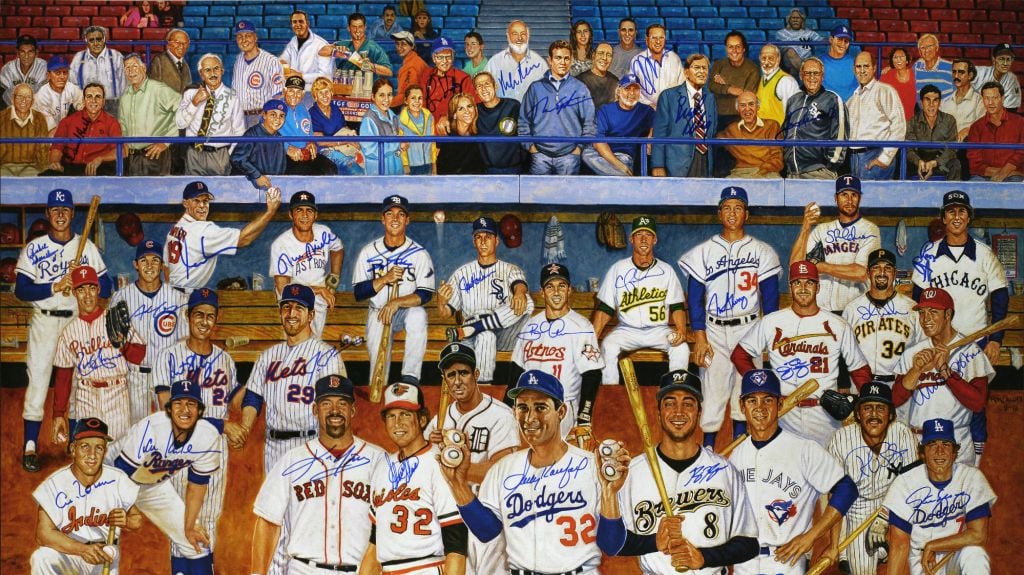
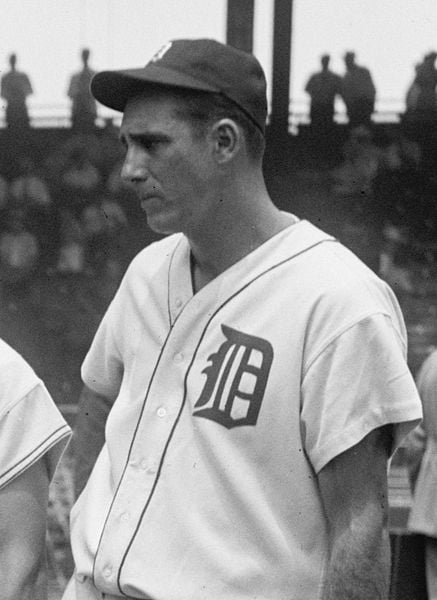
JTA – At the first Detroit Tigers game he attended, in 1940, Bob Matthews saw slugging first baseman Hank Greenberg play.
Now a retired orthodontist living in Farmington Hills, Michigan, Matthews can gaze each day at his hero’s image on visits to the Jewish Community Center of Metropolitan Detroit in nearby West Bloomfield.
On a wall by the facility’s fitness room hangs a framed print showing a baseball field’s dugout and a “team” of uniformed Jewish players surrounding a bat-gripping Greenberg.
The print and 499 just like it – each signed by the 26 living major leaguers past and present who are depicted (Greenberg, a National Baseball Hall of Fame member, died in 1986) – is the brainchild of Greg Harris, a Chicago-area attorney who in 2011 hit upon the idea of merging sports fandom, a for-profit venture and charitable giving.
About 100 of the 500 signed prints have been sold for $6,500 each and higher. Harris hopes that sales, along with portions of the players’ fees, will help raise $500,000 for Jewish and general charities. So far, he said, about $120,000 has gone to charity.
About 100 of the 500 signed prints have been sold for $6,500 each and higher
Matthews, for example, said he chose to divert $500 of what he paid to benefit the JCC.
Harris’ approach “is making a contribution” to the work charities can do, especially those still trying to recover from a drop in donations resulting from the 2008 recession,” said Rick Cohen, communications director for the National Council of Nonprofits.
“We applaud efforts like that. Anytime that happens, especially as nonprofits continue to struggle with depleted resources, it’s a wonderful thing.”
The venture also comes during a period of heightened interest in the exploits of Jews in baseball that includes the 2013 publication of a 491-page oral-history book by retired lawyer Larry Ruttman, this year’s update to a popular baseball card set, an Israeli team competing in the World Baseball Classic qualifiers and a major museum exhibition on baseball’s role in the enculturation of Jewish immigrants.
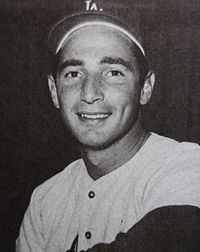
The original painting, executed in 2012 by artist Ron Lewis of Pocatello, Idaho, includes legends like Greenberg and fellow Hall of Famer Sandy Koufax. The American League’s 1953 Most Valuable Player, Al Rosen, and 2011 National League MVP Ryan Braun are shown, too.
Joining Braun, current major leaguers on the painting’s roster are Ian Kinsler, Craig Breslow, Scott Feldman, Ike Davis and Sam Fuld. Kinsler’s manager with the Tigers, Brad Ausmus, is shown in his playing days.
The rest of those in uniform features a hodgepodge of eras and ability levels: Ruben Amaro Jr., Ross Baumgarten, Ron Blomberg, Craig Breslow, Mike Epstein, John Grabow, Adam Greenberg, Shawn Green, Joel Horlen, Jason Marquis, Norm Miller, Richie Scheinblum, Art Shamsky, Norm Sherry, Steve Stone, Steve Yeager and Kevin Youkilis.
Many more past and present Jewish players do not appear in the work, either for reasons of space or because, as in the case of Ken Holtzman, a deal could not be reached. Holtzman certainly is worthy of inclusion – his 174 wins remains the record for a Jewish pitcher.
Some prominent Jewish nonplayers are depicted in the grandstand and also autographed the prints: Major League Baseball commissioner Bud Selig; Chicago White Sox owner Jerry Reinsdorf; Chicago Cubs general manager Theo Epstein; Arizona Diamondbacks president Derrick Hall; two late former heads of the MLB Players Association, Marvin Miller and Michael Weiner. Also, talk show host Larry King, Los Angeles Dodgers broadcaster Charlie Steiner and actor-director Rob Reiner.
Jewish symbols are sprinkled throughout the piece: a Star of David scratched into the dirt, a tallit hanging in the dugout, a chai carved into the dugout’s bench, Israel’s flag on the lineup card, a box of matzah.
Shamsky, an outfielder who batted .300 for the New York Mets’ World Series championship team in 1969, said the “subtle touches” hold appeal to him. They include Shamsky shaking hands with Davis to symbolize the linking of Jewish members of the Mets across generations.
“It’s a coming together, a celebration, of Jewish baseball players,” Shamsky said.
Blomberg, a contemporary of Shamsky’s who also played in New York, spoke in similar terms.
“Being a proud Jew like I am and to be able to be on a portrait of great ballplayers and to be up on a lot of Jewish walls – these portraits are going to be passed down from one generation to another,” said Blomberg, who reached the majors with the Yankees in 1969 and four years later became the game’s first designated hitter.
Blomberg and Shamsky have made several appearances with Harris to promote the artwork. At an event during last summer’s All-Star Game festivities in Minneapolis, Blomberg said, he was gratified by the interest shown by many non-Jewish passers-by, several of whom purchased the print.

For his charitable contribution, Blomberg selected the ALS Foundation for Life because Jim “Catfish” Hunter, a Hall of Fame pitcher who was Blomberg’s teammate for two seasons in New York and died in 1999 of amyotrophic lateral sclerosis, or Lou Gehrig’s disease, “was one of my best friends,” he said.
As for Matthews, the game he attended as a 5-year-old would be the only time he watched Greenberg play. Over the years he’s purchased a Greenberg bat, a Koufax-autographed Dodgers uniform, baseballs signed by Rosen and Green – even a 1934 tax form signed by Moe Berg, a longtime catcher who spied for the Office of Strategic Services, a precursor to the CIA.
Those and other items can be seen at the Bloomfield facility in a display called “Jewish Heroes and Other Legends.” But the painting is the main draw.
“It’s almost like a magnet. It pulls people down the hall,” Matthews said. “I thought this would be the most graphic way to tie all the baseball players together.”









The Times of Israel Community.