

Pro-Israel hopefuls line up to fill power vacuum in US House
Retiring Speaker John Boehner leaves strong track record on Israel, and legacy likely to continue to successor
 Add ToI as a Preferred Source on Google
Rebecca Shimoni Stoil is the Times of Israel's Washington correspondent.
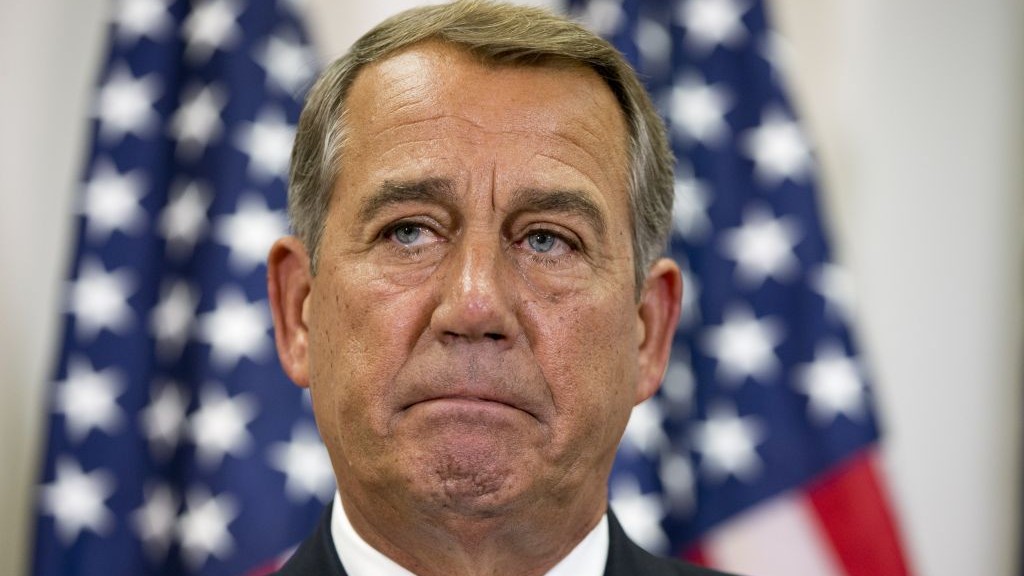
WASHINGTON — Speaker of the House John Boehner announced his retirement Friday after weeks of increasingly acrimonious infighting among Congressional Republicans, launching a contest for key leadership roles that will pit House moderates against Tea Party-oriented members of the House Freedom Caucus. Boehner leaves a legacy of strong support for Israel in the Speaker’s Balcony, and most of the Republican hopefuls are poised to fill Boehner’s shoes – at least where foreign policy is concerned.
The departing Boehner was heralded after his announcement as a staunch supporter of Israel, but in the weeks preceding his announcement, the Ohio legislator’s opponents had criticized him for an insufficiently combative approach to the nuclear deal reached with Iran earlier this year.
Earlier this month, as Congress prepared to vote on matching resolutions of disapproval of the nuclear deal, some of the agreement’s most ardent critics turned their ire toward Boehner and Senate Majority Leader Mitch McConnell, arguing that even allowing the resolution to come to a vote constituted a concession to the Obama administration.
Speaking at a demonstration outside the Capitol as the House debated the resolution, speakers called on McConnell and Boehner to support claims that the administration had failed to provide the documents necessary to launch the Congressional review period for the deal. If the review period had yet to begin, they argued, Congress should not agree to hold the vote on the resolution – which was supposed to come within 60 days after the review period commenced.
The anti-deal protesters, representing a number of conservative organizations, carried signs condemning Boehner, including one labeling him a “Repugnicant Traitor.”
Senator Ted Cruz, a staunch supporter of the Congressional Freedom Caucus and GOP presidential hopeful, rallied conservatives against Boehner, telling them during the protest that “Mitch McConnell and John Boehner can stop this deal if they simply enforce federal law.”
If the vote went ahead, he argued, it would signify that “Republican leadership decide[d] that a show vote is more important than stopping this deal.”
Boehner assuaged that uprising, less than two weeks ago, only to find himself enmeshed in a second battle – the one that proved to be his final one with his internal rebels – over the federal budget. Battling for a continuing resolution to avoid a government shutdown and political brinksmanship over the proposed defunding of the Planned Parenthood organization due to its purported sale of fetal tissue, Boehner is widely believed to have announced his retirement in order to take the threat of a leadership coup by conservatives off the bargaining table.

The Jewish Federation of North America’s William Daroff, who leads the group’s Washington office and has known Boehner since the early eighties, believes that the fight over the Iran deal “didn’t play a role” in the speaker’s resignation.
“I think the key factors were issues having to do with the size and scope of government and governmental spending, like the continuing resolution to keep government funded and the Planned Parenthood issue,” he explained. “John Boehner is someone who believes – he has a strong conservative record as a member of Congress.”
Boehner, Daroff said, has always been a strong supporter of Israel – and of causes close to the Jewish community. Although the Speaker of the House doesn’t cast votes, Boehner could – and did – use his influence in other ways to support Israel.
“His ability to steer leadership roles to people who are strong pro-Israel voices, ensuring that the chair and ranking leadership of committees are people who believe in a strong US-Israel relationship is important and something he had a big role in,” Daroff elaborated.
“Clearly he and Prime Minister Netanyahu had a close relationship for years. He’s been a key ally of Netanyahu’s and a key ally of AIPAC’s and he’s clearly someone that the Jewish community has been able to turn to as we’ve been looking for help with issues like preserving the charitable tax deduction so that non-profit organizations are able to continue to do the work that we do.”
Despite what may become a rancorous fight within the Republican conference over who will fill a series of leadership positions following Boehner’s departure, Daroff believed that the “vacuum” left by Boehner’s departure will not remain empty for long.
“The good news is that there is a strong bipartisan majority in both houses of Congress that is supportive of a strong US-Israel relationship and the names being mentioned to replace Speaker Boehner — particularly House Majority Leader Kevin McCarthy — are people who also have in their ‘kishkes’ strong recognition of Israel’s prime role as a key ally of the United States, so I think that clearly there will be a vacuum and he will be missed, but I think that nature abhors a vacuum and the pro-Israel community will have other champions who will rise to the occasion.”
McCarthy, who replaced Jewish Majority Leader Eric Cantor when Cantor lost his seat in a surprise primary upset, is considered by many to be the clear front-runner to replace Boehner. He reportedly has worked in recent weeks to garner the support of the Freedom Caucus, and has a record of making strong statements in support of Israel – and expressing his staunch opposition to the Iran nuclear deal.
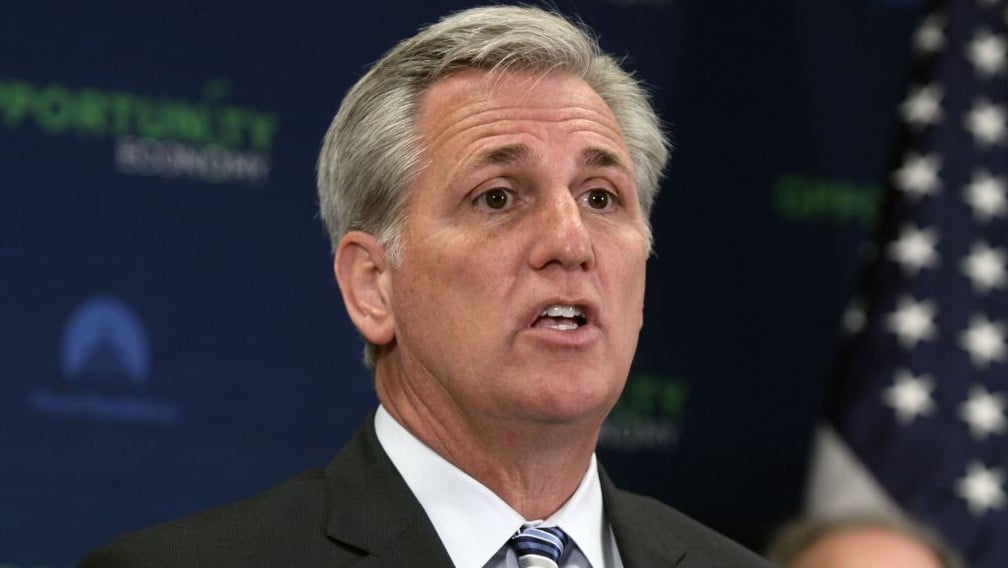
While he does not share Boehner’s longtime relationship with Prime Minister Netanyahu, McCarthy has worked to demonstrate his support a pro-Israel agenda that has become a sort of measuring-stick for House Republicans. Six weeks ago, the majority leader, together with Minority Whip Steny Hoyer, led parallel trips to Israel, sponsored by AIPAC’s charitable arm, during which 22 Democrats and 36 Republicans heard from Israeli officials about their opposition to the Iran deal, among other topics.
McCarthy will likely face some contest from other Republicans, most likely from Rep. Jeb Hensarling, the chairman of the House Financial Services Committee. Hensarling is in no hurry to declare his candidacy, as no date has been set yet for the Speaker’s race. Another possible candidate is the conservative Floridian Daniel Webster, who won a largely symbolic 12 votes against Boehner during the last House leadership race which was held in January.
If McCarthy gets the top spot, it would leave the number two spot in the GOP leadership wide open, spurring a race that is much more complex. The next two House Republicans down the line in the leadership ladder — Majority Whip Steve Scalise and Republican Conference Committee Chairwoman Cathy McMorris Rodgers — are expected to throw their hats in the race, as are Rules Committee Chairman Pete Sessions and Budget Committee Chairman Tom Price.
Scalise was a vocal hawk on the Iran deal, featuring his opposition to the agreement in his constituent mailings and speaking against it not just in Washington, but in local town hall meetings in his Louisiana district. He has visited Israel – once as one of seven Congressional conservatives who traveled with family members for a week-long visit in Fall, 2013. His support, however, was not without bumps in the road.
In 2014, liberal groups castigated Scalise for speaking in 2002 at a white supremacist gathering in his home state when he served as a state representative. Under pressure, one of Scalise’s advisers acknowledged that Scalise spoke at the meeting of the European-American Unite and Rights Organization, but said that at the time, Scalise did not know that the group’s close ties with the white supremacist and neo-Nazi movements.
The Southern Poverty Law Center has described the organization, which was founded by former Ku Klux Klan Grand Wizard David Duke, as a hate group. In early 2015, Scalise successfully defended himself against calls to step down from his position as a result of the revelation – a defense aided by staunch support from both Boehner and McCarthy.
Running against Scalise will likely be Cathy McMorris Rodgers, the fourth-ranked Republican in the House. Like Scalise, she comes from a district with few Jewish voters, but has also been a vocal supporter of the Jewish community and of Israel.
Earlier this month, she sent out a new year’s greeting to Jewish constituents and supporters in which she compared the deadly attack at the Hyper Cacher Supermarket to the US promise of sanctions relief for Iran as “dark episodes” in what she described as a “dangerous and trying year.”
An evangelical Christian, McMorris Rodgers has participated in organized privately-funded trips to Israel twice since being elected to Congress in 2005, and was one of the first members of Congress to offer congratulations to Prime Minister Netanyahu following his successful campaign for re-election in March.
A victory by either Scalise or McMorris Rodgers would open up another leadership race – to fill either the position of majority whip – Scalise’s job – or McMorris Rodgers’. A likely challenger in that race – although he hasn’t ruled out trying for an even higher position – is Peter Roskam. Roskam lost to Scalise in the contest for GOP whip last year, and is one of the most active and prolific pro-Israel legislators in the Republican caucus.
It was, in fact, Roskam, who, working together with the Freedom Caucus, set off the last-minute fight to block the vote of disapproval before additional documentation was provided about the Iran deal by the administration. Roskam also authored the legislation added to a must-pass trade bill this spring that sought to disincentivize European companies and countries from engaging in boycotts, divestments or sanctions against Israel, including against products of West Bank settlements.
The Congressional agenda for this week already indicates that Boehner’s departure will have little – if any – change on the Republican-dominated House’s orientation toward Israel – or Iran.
On the same day as Boehner’s headline-grabbing resignation, McCarthy announced that the House would take up legislation in the coming week that seeks to undermine the Iran nuclear deal by suspending sanctions relief until Iran pays damages ordered by US courts for Iranian-sponsored terror attacks. According to the legislation, President Barack Obama would not be able to waive sanctions until he certifies that Iran has paid some $43 billion in damages, a sum that would eliminate a large portion of Iran’s windfall from sanctions relief.
Although the bill is unlikely to go far due to the certainty of a presidential veto, it is a sign that the House – with or without Boehner – will continue to try to hammer away at the nuclear deal, and a signal that while other issues may change with the leadership, the House’s orientation toward Israel – and Iran – is unlikely to shift any time soon.
UPDATE: On Monday night, Rep. McMorris Rodgers announced that she would not be a contender for the position of Majority Leader, leaving Scalise and Georgia’s Tom Price as the only contenders.









The Times of Israel Community.