

‘Passion project’ about Rabin assassination up for top prize in Venice
Amos Gitai’s ‘Rabin, the Last Day’ will premiere and compete for the Golden Lion at the Venice Film Festival
 Add ToI as a Preferred Source on Google
Jessica Steinberg, The Times of Israel's culture and lifestyles editor, covers the Sabra scene from south to north and back to the center
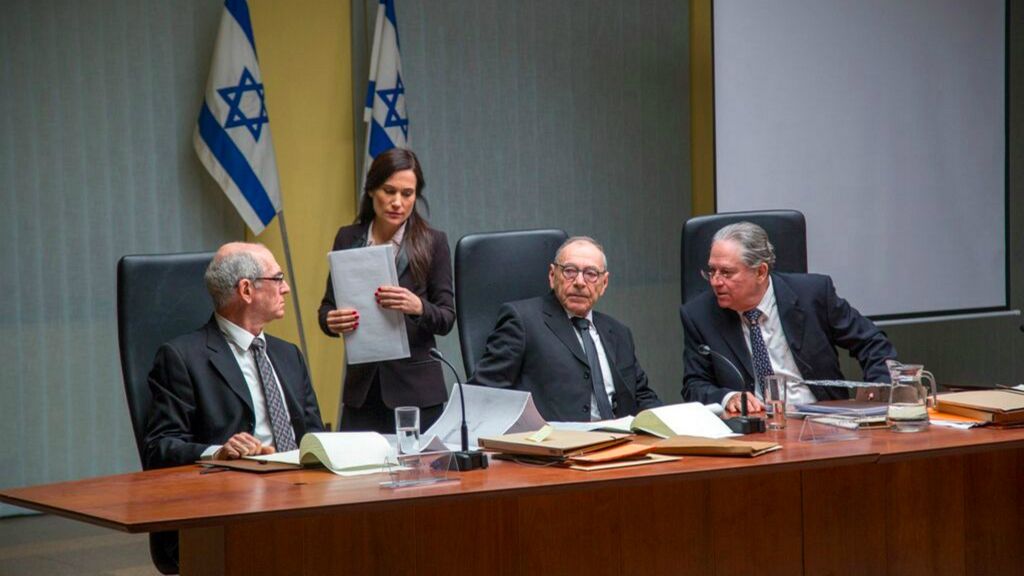
Director Amos Gitai has become the latest Israel filmmaker to closely consider the traumatic events leading to the 1995 assassination of prime minister Yitzhak Rabin with his “Rabin, the Last Day,” now up for the prestigious Golden Lion, the top prize at the upcoming 72nd Venice Film Festival.
Gitai will compete against Russia’s Aleksandr Sokurov – a previous Golden Lion winner – who tells the story of the Louvre museum in “Francofonia,” and Italy’s Marco Bellocchio with his vampire-themed “Blood of My Blood.”
Winning films from the festival, held September 2-12, often score nominations for the American Oscars.
“Rabin” is Gitai’s newest film, following last year’s work, the difficult Holocaust drama “Tsili,” which also showed at Venice.
Using a large, local cast of actors with some 70 speaking roles, “Rabin” tells the story of that last night, including real-life footage, both professional and amateur from the assassination, leading up to the rally during which the prime minister was murdered. It also examines the Shamgar Commission of Inquiry that followed the assassination.
https://youtu.be/NaokiG9iU3U
“It’s a portrait of Israeli society at that time and a lot of the figures are still active today,” Gitai told Screen Daily. He said that while assassin Yigal Amir is in the film, he didn’t want to “fetishize him” and is more interested in the incitement to kill Rabin.
The film is a “passion project” for the director, reported Variety, and represents the flip side to “Beyond the Fear,” a documentary about Larissa Trimbobler, who married Amir after his conviction. That film, screened just prior to this summer’s Jerusalem Film Festival, came from the late Herz Frank and Maria Kravchenko, and caused such a stir that a decision was made to show it before the festival, and not during.
Gitai’s showpiece brings the audience back to the final moments of Rabin’s life and examines how Israeli society reacted to the assassination. Filmed at various sites around Israel, including Tel Aviv’s Rabin Square where the murder took place during a peace movement rally, it’s a work of historical fiction that also includes archival and amateur footage.

During this summer’s Jerusalem Film Festival, Gitai told Screen Daily that he discovered through the making of the film how much Rabin meant to “so many people in many different countries.”
“Israeli society is still feeling the shockwaves of his killing even if it’s already 20 years ago,” he told the film industry publication. “It’s an open wound and looking at the current situation in the Middle East, there is a big longing, even if it’s under the surface, for somebody like him who had a very open-minded way of talking to the other side. In order to make peace, there cannot be real acrimony.”
Rabin also served as a personal touchstone for Gitai, who returned to Israel, like many Israeli intellectuals living abroad, following the prime minister’s 1992 election and the Oslo Accords. Rabin promised to change the course of the country and lead the nation to a peace agreement with the Palestinians.
Gitai had left Israel in his twenties to study architecture in California — following his Bauhaus-trained father — and then returned to serve in the 1973 Yom Kippur War. While serving as part of a helicopter rescue crew, he shot 8mm footage of the fighting. His helicopter was shot down by a Syrian missile, and Gitai and five others of the seven crew members survived. He always says that those momentous minutes — his filming and his survival — changed the course of his career.
The budding filmmaker first made documentaries focusing on the Middle East and Jewish-Arab conflicts. His first feature, “Home” (1979), was banned in Israel and later presented at international film festivals in Berlin and Rotterdam. Gitai moved to France in the 1980s to pursue his filmmaking career, and his 1989 film, “Berlin-Jerusalem,” represented Israel in the Venice Film Festival that year.
After returning to Israel in the early 1990s, Gitai made his city trilogy, “Devarim,” “Yom Yom” and “Kadosh,” with each film dedicated to a different city in Israel. The later fiction trilogy of “Kippur,” “Eden” and “Kedma” dealt with significant historical events in Israel.
“Rabin, the Last Day” was co-produced by LGM and Les Films du Worso, two top productions companies in France, reported Variety. The film’s Israeli distributor United King is planning an October or early November release for the film, tying it to the 20th anniversary of Rabin¹s murder on November 4, 1995.
Other Israel-related films appearing at the Venice Film Festival include “Mountain,” by Sam Spiegel graduate Yaelle Kayam. It’s the premiere of Kayam’s first full-length feature film about a religious Jewish woman living with her family on a desolate section of Jerusalem’s Mount of Olives.





The Times of Israel Community.