

Hemming and hawing on the way to disaster
The country is maybe in a terror wave, a Palestinian detainee is sort of released and Iran is kind of going to be under inspections. The only certainty? Things don’t look good
 Add ToI as a Preferred Source on Google
Joshua Davidovich is The Times of Israel's Deputy Editor
Israeli front pages look like a sick topical version of the classic game rock paper scissors Thursday morning, with a rock hurled at a windshield, Iran papering over its commitment to accept international inspection, and a hunger striking Palestinian possibly being cut out of jail with judicial scissors.
The winner? Certainly not Israel. Best two out of three?
While other paper focus on the IED thrown at a soldier, which is a different kind of attack than seen recently, Yedioth takes a longer view, describing Wednesday’s series of attacks on soldiers and civilians in the West Bank as “nonstop terror” on its front page, and chronologically detailing the three incidents that took place around Jerusalem in the course of just a few hours.
With a map showing not just the “night of attacks” but also three other assaults over the last week, also in and around Jerusalem, the paper describes what it calls “worries surrounding the wave of terror.”
Right-winger Hanoch Daum, known mostly for his tongue-in-cheek commentary, takes a serious turn, though he can’t resist the cliché of comparing Jerusalem to New York — (“Imagine if those stopping for gas in New Jersey were stabbed” and truly, a Google search for such incidents only returns 891,000 hits) — in explaining why Israel can’t stand idly by.
Making like Bob Dylan, though, he seems to say that everybody must get stoned, and that may be a good thing.
“The one solace I can take from the two incidents last night – and the several that have occurred recently – is that those who choose to ignore the violence against settlers will now need to deal with the bitter reality and recognize the lack of personal security for everyone, leftist and rightists, settlers and those from the center of Israel,” he writes (apparently filing before the third attack). “It is forbidden to get used to a reality in which people in Israel will fear getting out of their car to fill up gas.”
Judge Ziggy and the Allaan key
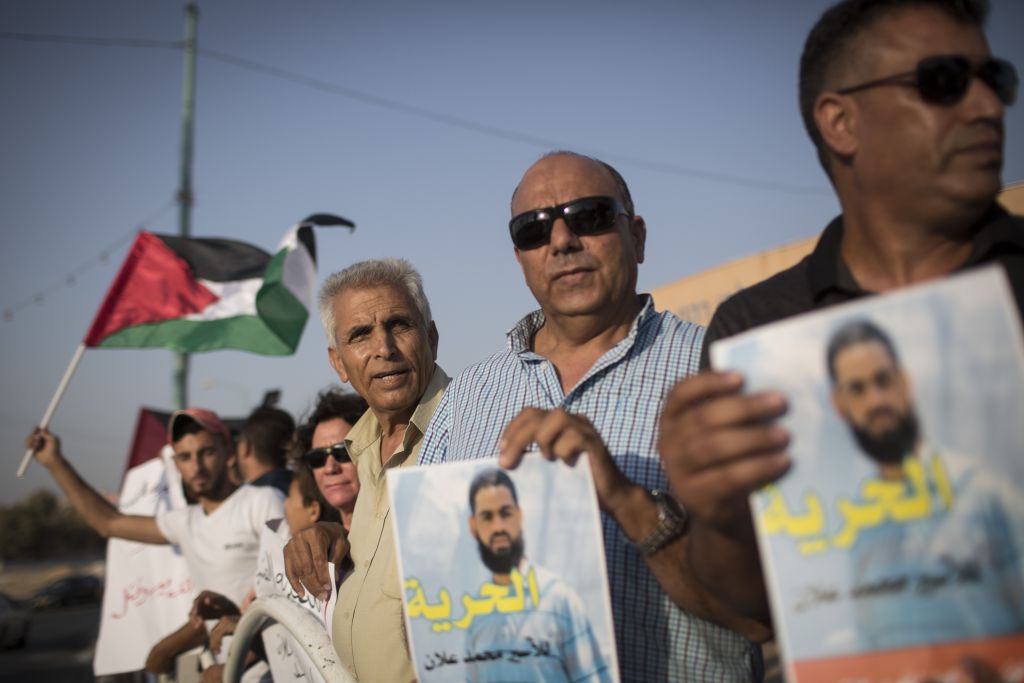
The attacks may have been a preview for what officials fear will happen should hunger striking Palestinian detainee Mohammed Allaan die.
A court decision to release him should he have suffered permanent brain damage is described by Haaretz as a salve intended to calm the street and little else.
“The court’s order does not release [Mohammed] Allaan from administrative detention – it simply freezes the order for the period of his treatment. When his condition stabilizes, Allaan may petition authorities to be transferred to another hospital. The response to that will be at the discretion of the court,” the paper notes. “On the one hand, the judges froze the order, fearing criticism against the Israeli judicial system should Allaan die while under administrative detention. On the other hand, the judges haven’t revoked the order completely so as not to signal a surrender to the hunger strike.”
In Israel Hayom, Dan Margalit is critical of the decision, saying it’s confusing by being neither here nor there and saying it is the court’s Ziggy Stardust moment.
“If he’s not in administrative detention, what’s stopping his family from ordering an ambulance and having him transported from Barzilai hospital to one in Nablus? And if they can’t do that, how can he be thought of as out of administrative detention? The decision last night was a form of judicial androgyny. He’s held but he’s free, he’s sick but he’s almost healthy. A type of language has evolved in Israel in the last several years, and it goes far beyond what is being discussed over the fate of Allaan now, in the near future or at all.”
No matter, says Haaretz columnist Gideon Levy, who contends that the damage from Allaan’s hunger strike has already been done, largely reprising a column published earlier in the week.
“What happened? What always happens in these cases: Israel can never resist the opportunity to prove that you can only talk to it with force. Even a firm hunger striker, weak and alone, can only talk to it with force. That is the only language, the official tongue,” he writes. “The fate of Allaan – if he recovers after a long period of suffering, will need permanent care or will heaven forfend die – will follow Israel for a long time yet. Rightly.”
Allaan’s health may be a problem for Israel, but the country is a tad more concerned with the long-term effects of Iran’s nuclear ambitions. An agreement that Iran will be allowed to inspect its own nuclear sites as part of oversight of its enrichment program as part of the deal reached with world powers last month is called “absurd” by Israel Hayom.
The tabloid matches the news with a little sarcasm in its straight report:
“Here’s a diplomatic problem: How do you oversee the Parchin military base, which has apparently been used for nuclear tests, if Iran refuses to allows inspectors in? The amazing answer supplied by Western diplomats: Iran will oversee it itself,” the paper writes.
If that’s not enough, commentator Boaz Bismuth compares the agreement to the “(Persian) cat guarding the (nuclear) cream,” but like an unfunny John Oliver, doesn’t stop there with his wacky comparisons.
“The date yesterday was August 19. No, we are not talking about an April Fool’s joke. According to the same ‘healthy’ logic of the powers, Israel is consider allowing Hamas members to work the Iron Dome anti-missile battery in the next war, and the Interior Ministry is thinking about transferring visa control to the infiltrators,” he writes, using the government term for migrants. “We need to coordinate ourselves with the rest of the planet. Truly, we live in a strange world.”








The Times of Israel Community.