

Israel said to upgrade David’s Sling system to counter wider range of ballistic threats
Bloomberg reports improvements come after Iranian missile barrages exposed gaps in air defenses; cheaper interceptors could help conserve expensive Arrow 3 stockpiles
 Add ToI as a Preferred Source on Google
Emanuel (Mannie) Fabian is The Times of Israel's military correspondent
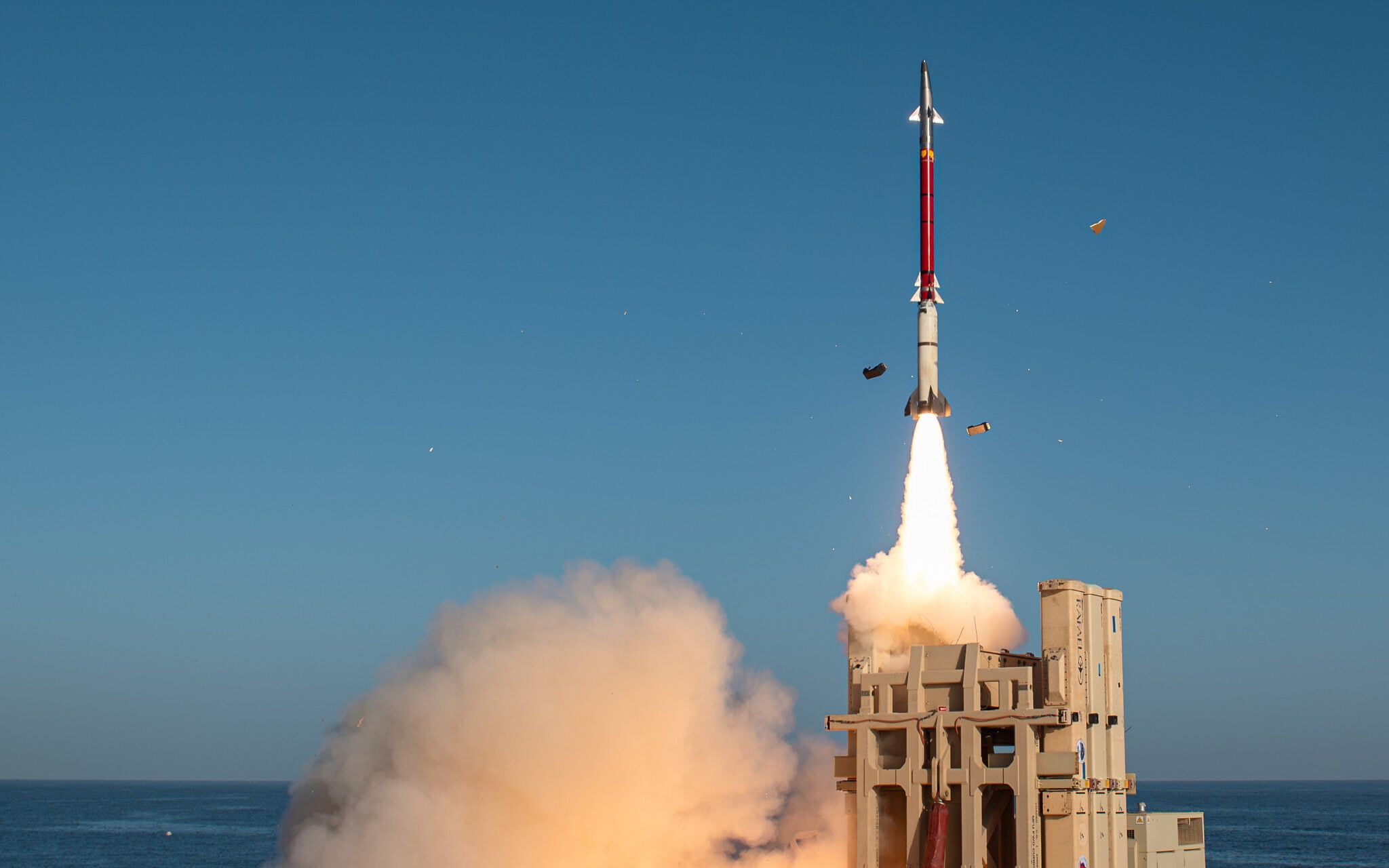
Israel has made upgrades to its David’s Sling medium-range air defense system, expanding its ability to intercept a broader range of ballistic threats and withstand prolonged attacks, Bloomberg reported on Friday, citing the Israeli Air Force’s chief air defense investigator.
The upgrades come after missile barrages from Iran earlier this year exposed gaps in Israel’s air defenses, but also provided extensive data that was used to improve its systems, the report said.
David’s Sling, operational in Israel since 2017, forms the middle tier of Israel’s multi-layered air defense capabilities, which also include the short-range Iron Beam and Iron Dome, and a top tier of Arrow systems to engage long-range ballistic missiles.
Produced by defense firm Rafael, David’s Sling was initially designed to intercept rockets, missiles, cruise missiles, aircraft, and UAVs at ranges of 40 to 300 kilometers.
While not initially designed to intercept long-range ballistic missiles, David’s Sling was first used against Iranian missiles during the 12-day war in June 2025, successfully shooting down several projectiles launched from 1,500 kilometers (932 miles) away.
The system was also used extensively during the following war earlier this year, downing numerous Iranian missiles, though the system was not always successful.

In March, the IDF confirmed that David’s Sling interceptors failed to down two Iranian ballistic missiles that struck the southern cities of Dimona and Arad, injuring nearly 200 people and causing extensive damage.
The military said the system engaged both projectiles, but its interceptors failed to knock them down due to separate and unrelated errors.
The extensive use of the system during the war with Iran earlier this year came after the Defense Ministry announced in early February that it had completed a series of “complex” tests with David’s Sling, aimed at “upgrading readiness for future threats.”
The use of the medium-range system instead of the long-range Arrow 3 to shoot down Iranian ballistic missiles was part of the military’s efforts to conserve Israel’s stockpile of expensive long-range interceptors.
While each David’s Sling missile costs roughly $1 million to use, the Arrow 3 system can cost over $2.5 million per use. Military officials have previously claimed that the upgrades to David’s Sling were not necessarily to save costs, but rather to give the IAF more options when it comes to shooting down missiles.
Israel is trying to solve a growing problem among US allies – precision strikes are getting cheaper and easier for enemies while prolonged wars in Ukraine and the Middle East have depleted stockpiles of expensive interceptors, Bloomberg noted.
In Europe, both Finland and Greece have ordered David’s Sling systems, and Germany has received a delivery of an Arrow 3.

Bloomberg recently reported that Iran may have 1,700 ballistic missiles and is producing about 50 a month, citing a Western intelligence estimate.
The new upgrades come amid reports that Prime Minister Benjamin Netanyahu is pushing for renewed joint US-Israeli strikes on Iran, with Israeli officials awaiting a decision by US President Donald Trump.
Trump said Thursday that he was “not rushing” into a decision on whether to strike Iran again.
Times of Israel staff contributed to this report.










The Times of Israel Community.