

Laughter at Trump joins a long line of jaw-dropping UN moments
From Khrushchev’s shoe-banging, to Arafat’s olive branch and gun, to Ahmadinejad’s 9/11 conspiracy theories, General Assembly has seen leaders pull more than a few shocking stunts
 Add ToI as a Preferred Source on Google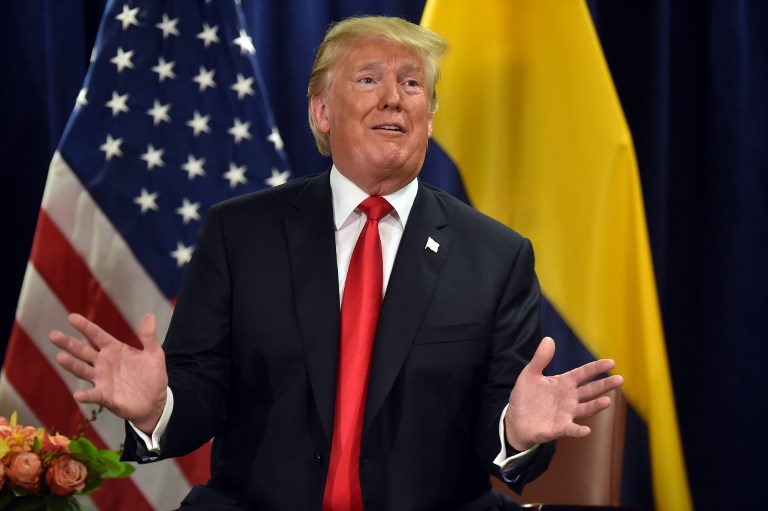
The laughter was sudden, loud and unexpected.
It came at the expense of the US president as he addressed global leaders at the United Nations, and it was witnessed by an audience of tens of millions viewing immediate clips online of an awkward moment for Donald Trump.
The laughter followed Trump’s boasts that “in less than two years, my administration has accomplished more than almost any administration in the history of our country.”
Clearly startled by the laughter, he joked that it wasn’t the reaction he expected.
Later, as he left the UN grounds, he told reporters that he had meant to be funny.
“Oh it was great, well, that was meant to get some laughter, so it was great,” he said.
Nonetheless, it was a jaw-dropping moment in the hallowed hall where war and peace, prosperity and poverty, famine and plenty have been passionately discussed over the decades.
A look at some other moments that shocked at the General Assembly.
KHRUSHCHEV’S SHOE
Soviet leader Nikita Khrushchev did more than raise a few eyebrows in 1960 as the Cold War raged when he pounded his shoe on a desk in fury. It happened after the head of a delegation from the Philippines criticized Moscow for restricting the freedom of Eastern Europeans. His granddaughter later wrote that he was wearing new shoes that were tight, so he took them off while sitting. She and his interpreter said that when Khrushchev stood up, he pounded the table so hard with his fists that his watch fell off, and when he went to retrieve it, he saw the shoe and switched to banging that instead. The Berlin Wall went up the next year.
ARAFAT’S OLIVE BRANCH AND GUN
In 1974, Yasser Arafat was invited to represent the Palestine Liberation Organization and his people before the world body, where he made it clear he was ready to use any means for statehood. He spoke of oppressed people and liberation the world over. Wearing his trademark Palestinian keffiyeh scarf, he concluded with a quote: “Today I have come bearing an olive branch and a freedom fighter’s gun. Do not let the olive branch fall from my hand.”
CASTRO’S LONG SPEECHES
Cuban leader Fidel Castro gave many speeches at the UN, railing at those he characterized as his country’s capitalist oppressors. The UN asks leaders to keep their speeches brief. But that was never for Castro: his General Assembly address in 1960 was timed at 4 1/2 hours. Clad in his trademark green military fatigues, Castro said the revolution he led 20 months earlier had ended the country’s status as “a colony of the United States,” but the US still believed it had “the right to promote and encourage subversion in our country.” In the rambling speech, Castro defended Cuba’s links to the Soviet Union, expressed serious concern that America’s “imperialist government” might attack Cuba, and called US President John F. Kennedy “an illiterate and ignorant millionaire.” Castro also complained of undergoing “degrading and humiliating treatment” in New York, including being evicted from his hotel.
GADDAFI GOES FREE FORM
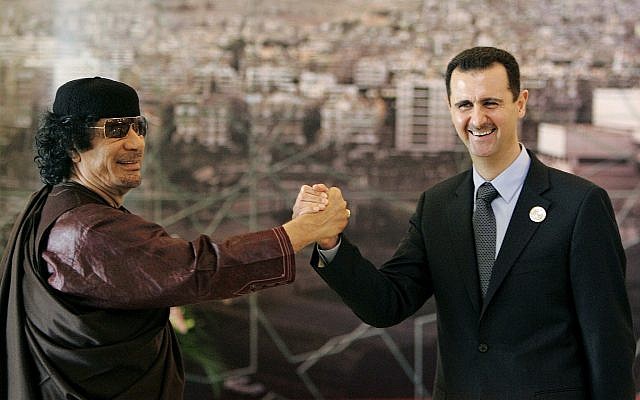
Libya’s Muammar Gaddafi also had a predilection for long, rambling monologues in his speeches at the world body. His 2009 address clocked in at 1 hour, 40 minutes. Dressed in flowing brown Bedouin robes and a black beret, he chastised the United Nations for failing to prevent dozens of wars, suggested that those who caused “mass murder” in Iraq be tried, and defended the Taliban’s right to establish an Islamic emirate. At one point, Gadhafi waved a copy of the UN Charter and appeared to tear it, saying he did not recognize the document’s authority. Later that day, British Prime Minister Gordon Brown told the assembly: “I stand here to reaffirm the United Nations Charter, not to tear it up.”
CHAVEZ AND THE DEVIL
The late Venezuelan leader Hugo Chavez drew gasps at the UN in 2006 when he said of US President George W. Bush, “Yesterday, the devil came here,” adding that the podium “still smells of sulfur.” The US was at the time heavily embroiled in the Iraq War, which Chavez had vehemently opposed.
AHMADINEJAD AND 9/11
Iran’s hard-line President Mahmoud Ahmadinejad prompted disgusted walkouts from the assembly in 2010 when he questioned whether the September 11 attacks were staged. He suggested an inside job, arguing that only an explosion, not planes, could have brought down the twin towers. His visits to New York prompted fury among locals, but delighted the hard-line wing in Iran.
BIBI AND THE BOMB
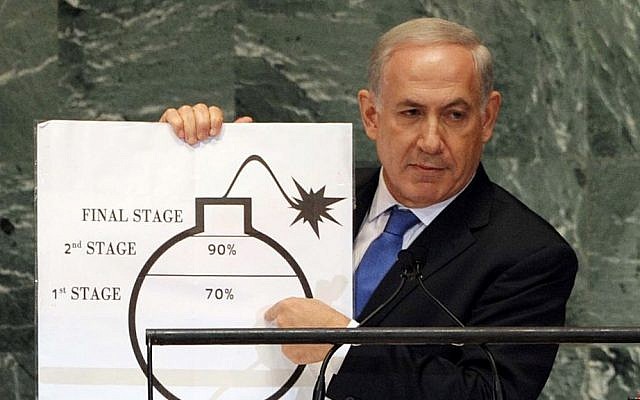
Israeli Prime Minister Benjamin Netanyahu, speaking to the General Assembly about Iran’s nuclear program on Sept. 27, 2012, held up a large, cartoonish diagram of a bomb. The bomb was divided into sections marking 70 percent and 90 percent. Netanyahu said that Iran was 70 percent of the way to enriching uranium for a nuclear weapon and urged the world to draw a clear “red line” and stop the country’s nuclear program. He then drew a red line under 90 percent, asserting that the Iranians would be that far along by mid-2013 and must not be allowed to get there. Netanyahu warned that “nothing could imperil the world more than a nuclear-armed Iran” and insisted that “red lines” prevent wars.
Times of Israel staff contributed to this report.


The Times of Israel Community.