

 From the Liveblog of
Tuesday, November 26, 2024
From the Liveblog of
Tuesday, November 26, 2024
Lapid welcomes findings of independent Oct. 7 commission, defends his own actions
 Add ToI as a Preferred Source on Google
Sam Sokol is a former political correspondent at The Times of Israel. He was previously a reporter for the Jerusalem Post, Jewish Telegraphic Agency and Haaretz. He is the author of "Putin’s Hybrid War and the Jews"
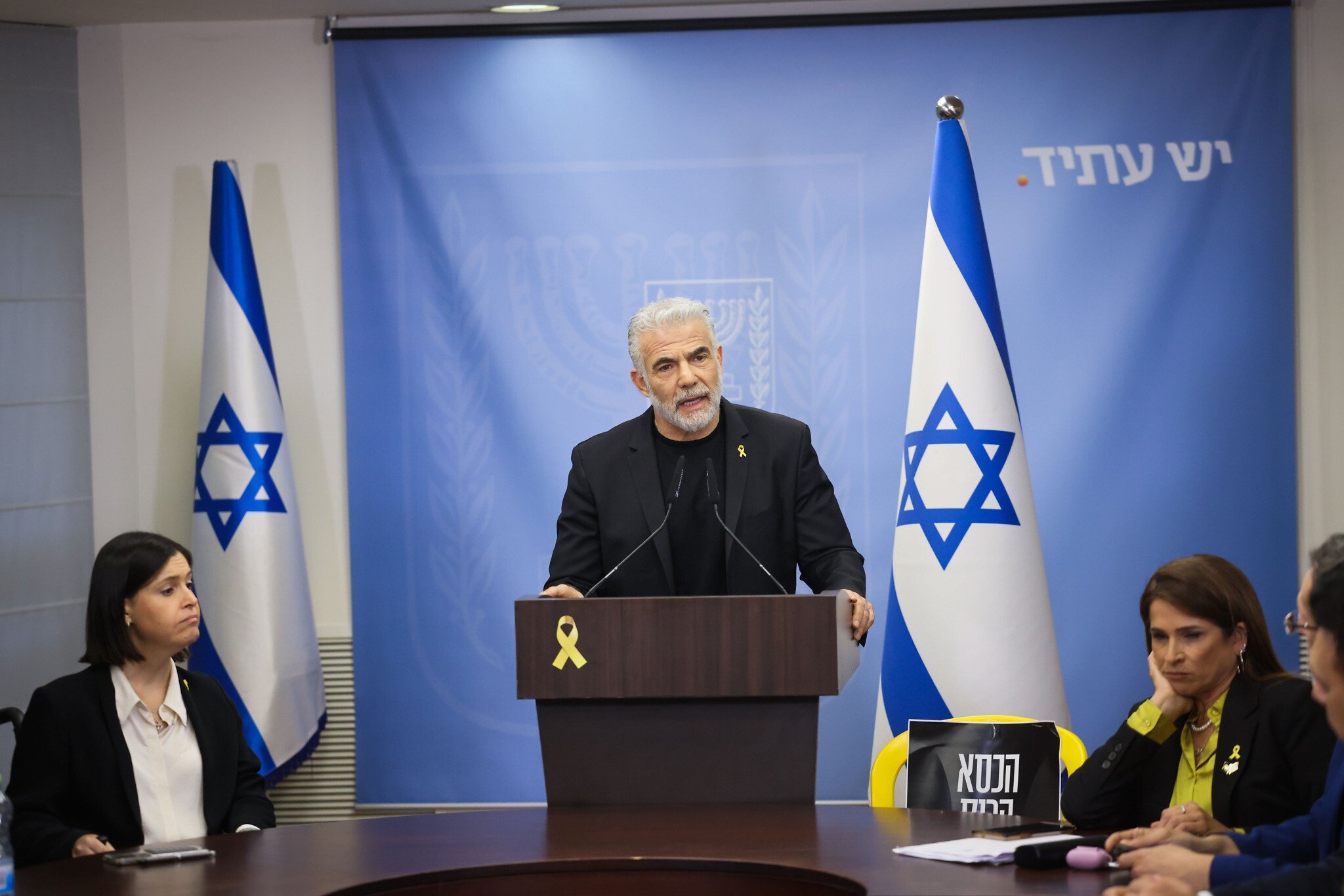
Opposition Leader Yair Lapid welcomes the release of the independent Civilian Commission of Inquiry’s final report on the government’s failure to prevent October 7, calling it “in-depth, comprehensive and important.”
Lapid, who testified before the commission in August, calls for the establishment of an official state commission of inquiry as well. He also argues that while October 7 “could have been prevented,” he believes that “all the symptoms of October 6 are still present in this government a year afterward.”
According to the commission’s final report, while Prime Minister Benjamin Netanyahu was responsible for the decision not to strike Hamas preemptively, former prime ministers Naftali Bennett and Lapid also shoulder blame for “maintaining the concept of cash for quiet, albeit in different ways.”
In a statement, Lapid says that “the possibility of a preemptive strike against Hamas, like the possibility of an operation to assassinate senior Hamas figures, was discussed more than once during the ‘government of change,'” which he co-led with Bennett, but that “the intelligence conditions were not ripe for such operations.”
In a letter to the commission published alongside its final report, Lapid makes similar points, stating that his government had halted the “suitcases of cash” and instead sent funds that could be “traced and tracked, which made intelligence work easier.”
“We led a zero-tolerance approach toward terror attacks, e.g., incendiary balloons or perimeter fence events. The IDF was instructed not to ignore any event and to respond with disproportionate force. This policy led to the elimination of this type of event,” the letter continues.
“I’ve been asked multiple times whether I believe that the October 7 disaster could have happened when I was prime minister. The answer is no… How can I be so confident? And the answer is that there was no scenario in which I would have received warnings of such scope, quality, and frequency as I’ve described, and ignored them. [Our] government’s period in office was the quietest year for southern residents in over a decade,” Lapid insists.


The Times of Israel Community.