

Family goes back in time to mourn soldier killed 70 years ago
Relatives of US Army private first class Bernard Gavrin could finally say Kaddish at burial in Arlington
 Add ToI as a Preferred Source on Google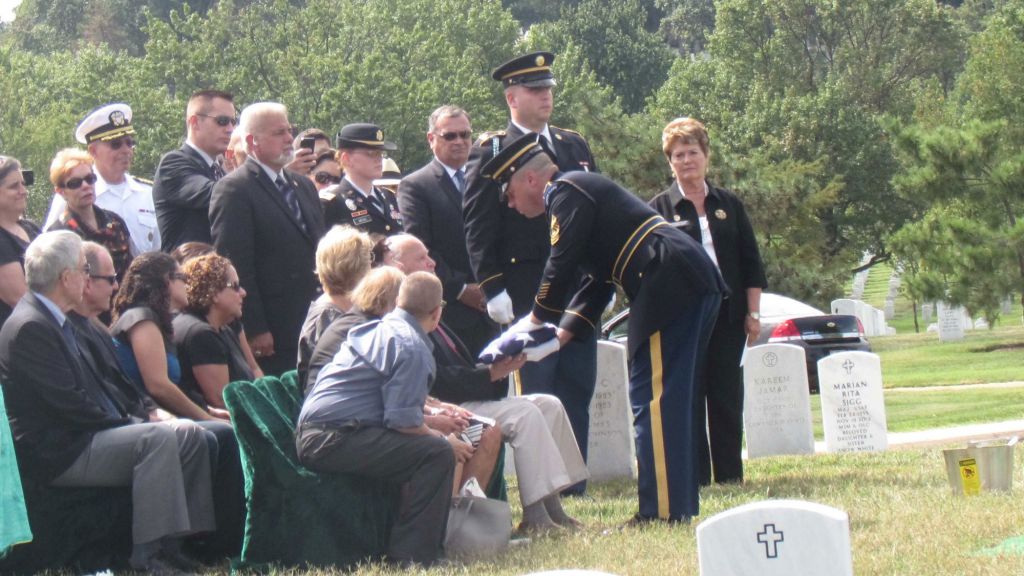
ARLINGTON, Va. (JTA) — The scene at Arlington National Cemetery last Friday was not quite routine, but nor was it unusual: A clergyman said a prayer, an army NCO handed Bernard Gavrin’s closest living relative a folded U.S. flag, and a volunteer — one of the “Arlington Ladies” who attend to the needs of grieving military families — offered words of comfort.
Gavrin stood out for two reasons: The clergyman, Marvin Bash, was a rabbi, and David Rogers, Gavrin’s nephew receiving the flag, last saw his uncle more than 70 years ago in Brooklyn, N.Y., when he kissed him goodnight.
Gavrin, a U.S. Army private first class, was part of an invasion force in the Pacific island of Saipan, then occupied by Japan, in June 1944. The Japanese subjected the forces to suicide attacks, killing and injuring over 900 U.S. soldiers. But Gavrin’s remains were only found recently in Saipan and returned stateside.
“I was 8 years old living in an apartment with my parents,” Rogers, 82, told JTA in a phone interview from Delray Beach, Fla., where he now lives. “I had had a playground accident and went to bed early. He came into my room and kissed me on my forehead.”
Not long after, Gavrin enlisted. Rogers’ next memory of his uncle — his mother’s younger brother — came four years later, in the summer of 1944.
“I was 12 and I was living in the same house my grandmother lived in when a telegram came telling her her son was missing in action,” Rogers said. “She let out a scream I can remember to this day.”
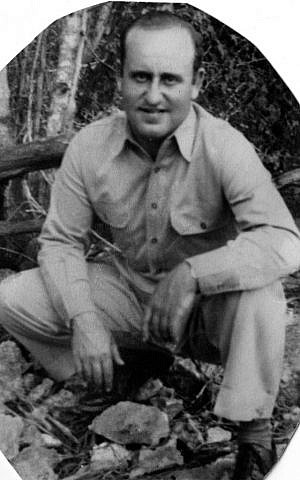
Gavrin was 29.
When Gavrin was declared presumed dead a year later, the family hung a gold star on the window.
“In November 1948, the American Graves Registration Services reviewed the circumstances of Gavrin’s loss and concluded his remains were non-recoverable,” the Pentagon said in a Sept. 10 release outlining the events leading to the recovery of Gavrin’s remains.
It wasn’t until September 2013, when Japanese researchers scouring Saipan — now a U.S. territory — for the remains of Japanese troops uncovered a grave with the remains of four U.S. soldiers, including a bone, a shoe and a dog tag belonging to Gavrin. They turned over the remains to the Joint POW/MIA Accounting Command.
U.S. officials tracked down Gavrin’s two cousins, living in the Washington, D.C., area, and referred them to Rogers, who also had lived for years in suburban Maryland and worked in the garment trade. As the son of Gavrin’s sister, he was the likeliest to be a DNA match.
In May, Rogers, himself a Korean War veteran, got the news: He was a match. The Pentagon asked the family where they wanted to bury Gavrin, and they opted for Arlington.
So early Friday afternoon, under a cloud-dappled blue sky and with a light breeze caressing Arlington’s trimmed lawns, Gavrin was buried with full military honors. Bash, a retired northern Virginia congregational rabbi, delivered a short service, starting “Today, we go back in time.”
‘All that was buried was a bone and a shoe, but I could not be more satisfied’
For the Kaddish, several members of Gavrin’s extended family — about 40 in all attended the service — joined in, and the rhythmic Aramaic incantations of the memorial prayer rose above the breeze and the murmur of distant traffic.
Three volleys were fired. A casket team folded the flag and Sgt. Jason Lewis, a representative of the Army’s 3rd U.S. Infantry regiment, knelt and presented it to Rogers. The U.S. Army band, Pershing’s Own, twice played “Yigdal Elohim Hai,” a hymn, while the casket team brought the casket graveside and “America the Beautiful” as the team folded the flag. A bugler sounded taps.
On Monday, New York Gov. Andrew Cuomo ordered flags on state government buildings to fly at half mast in Gavrin’s memory.
“After far too many years, he has returned home and has been granted a proper burial alongside the many other heroes who answered the call,” Cuomo said in a statement.
Rogers said his family has found peace in the burial.
“All that was buried was a bone and a shoe, but I could not be more satisfied. There are 73,000 who are still lying in far-off lands who have not been identified,” Rogers said, referring to the official figure of 73,536 U.S. missing from World War II.
“To be lost and then to have his remains recovered is astonishing — and to be buried in hallowed ground,” said Rogers.


The Times of Israel Community.