

Ministers shelve bill to avert Amona outpost’s evacuation
A-G says legislation, which would offer other plots and compensation to Palestinian landowners, is unconstitutional
 Add ToI as a Preferred Source on Google
Marissa Newman is The Times of Israel political correspondent.
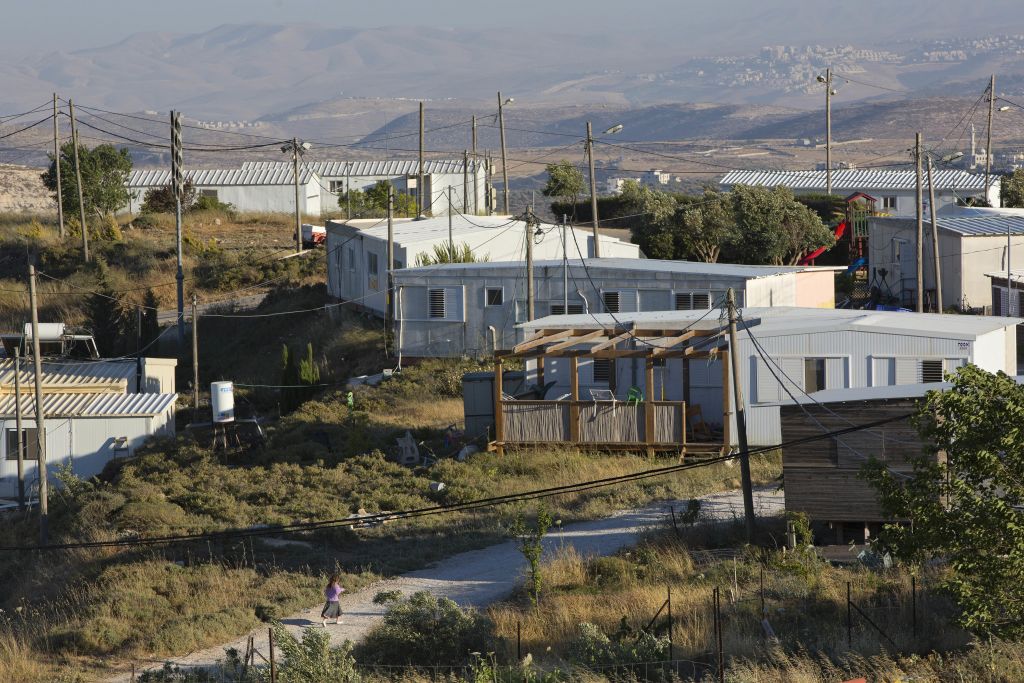
A bill aimed at preventing the Supreme Court-ordered evacuation of the Amona outpost was removed from the Ministerial Committee for Legislation’s agenda on Sunday after the attorney general deemed it “unconstitutional.”
Attorney General Avichai Mandelblit said the legislation would likely be shot down by the High Court of Justice. He also argued the bill would compromise the settlement enterprise as a whole, according to reports.
The ministerial vote was subsequently postponed to a later date.
The proposed legislation would grant the Palestinian landowners of the property on which Amona was built equivalent plots in the West Bank and reimburse them with fifty percent of the land’s value.

Under the Supreme Court order, the government must tear down the outpost by the end of the year — a move expected to face staunch opposition from within the coalition and pit security forces against the wishes of leading members of the cabinet.
Amona is the largest of about 100 unauthorized outposts — built without permission but generally tolerated by the government — that dot the West Bank. A partial evacuation a decade ago sparked violent clashes between residents and security forces. An evacuation, ordered in 2014, could trigger another showdown.
In 2008, a group of Palestinians, represented by the Israeli rights group Yesh Din, petitioned the Supreme Court, claiming Amona settlers had encroached on their land and demanding the entire outpost be dismantled. The court petition set off a protracted legal battle that saw a number of proposed evacuation dates missed and repeatedly delayed until a final ruling in 2014 ordered the state to demolish the outpost by December 25, 2016. The state also agreed to compensate the landowners with about $75,000.

The bill, by Likud MK Yoav Kisch, was designed to override the ruling and keep Amona — and various other unrecognized outposts — intact.
“This law comes to rectify a double injustice — the injustice of thousands of families, residents of a number of settlements in Judea and Samaria, who were mostly sent to found and live there with the knowledge, encouragement, and funding of the authorities, the Israeli government, and other institutions. And the injustice of the owners of the lands on which the houses of those families or their descendants were built, who are eligible for compensation for their properties and have yet to receive it,” wrote Kisch in the proposal’s explanatory text.
“The majority of settlements were established with the encouragement of Israeli governments and their funding, and most of the residents that made their homes there did so innocently, and were unaware they built them on private land,” it said. “In some cases, the government authorities that were involved in building there were not aware that the properties were privately owned land.”
The bill proposes that Palestinian landowners be given equivalent plots near their current homes and be compensated with 50% of the land’s value within a year. The interior minister would be tasked with regulating the outposts.
AP contributed to this report.










The Times of Israel Community.