

Refugee ban calls Jewish asylum bids into question
Of 85,000 refugees admitted into US last year, Jewish agency HIAS resettled 3,884 – including 159 Jews, 89 of them from Iran and several others from Yemen
 Add ToI as a Preferred Source on Google
Cnaan Liphshiz was a Jewish World reporter at The Times of Israel
JTA — A year after they submitted their application for asylum in the United States, Shahi and his mother expected to be let in.
As Iranian Jews who applied for asylum through a federally recognized agency for refugee status, their case was expected to be simple.
Shahi (not his real name) is in his late 20s and already has two sisters waiting for him and their mother. As of now, mother and son are in a third transit country.
But the lives of Shahi’s family were plunged into further uncertainty on Friday when President Donald Trump signed an executive order suspending the admission of all refugees into the United States for four months. The order also imposes a 90-day ban on entry visas to all citizens of seven predominantly Muslim countries, including Iran.
Too fearful to return to Iran, Shahi and his mother don’t know whether they will be eligible to enter the US in the foreseeable future. Trump is said to be mulling suspending indefinitely the intake of refugees from countries deemed “of concern.” The family is also unsure how long the transit country will agree to continue hosting them while the US is stalling their application.
Shahi’s relatives are among several Jewish families and several hundreds of non-Jewish ones handled by HIAS, the former Hebrew Immigrant Aid Society, a 135-year-old Jewish agency that assists refugees and asylum seekers. The US-based agency once focused on helping Jews flee persecution in Europe, but is now working mostly with non-Jews in 30 countries, and has been recognized for decades as an immigration facilitator by the Department of Justice.
“There are hundreds and hundreds of people with approval notices who can’t come to the States now,” the group’s CEO, Mark Hetfield, told JTA on Sunday.
Of the approximately 85,000 refugees admitted into the United States last year, HIAS was responsible for resettling 3,884 – including 159 Jews, among them 89 from Iran and several others from Yemen.
Hetfield said that some of the families processed by HIAS already received a refugee visa, but were turned away at airports while trying to enter.
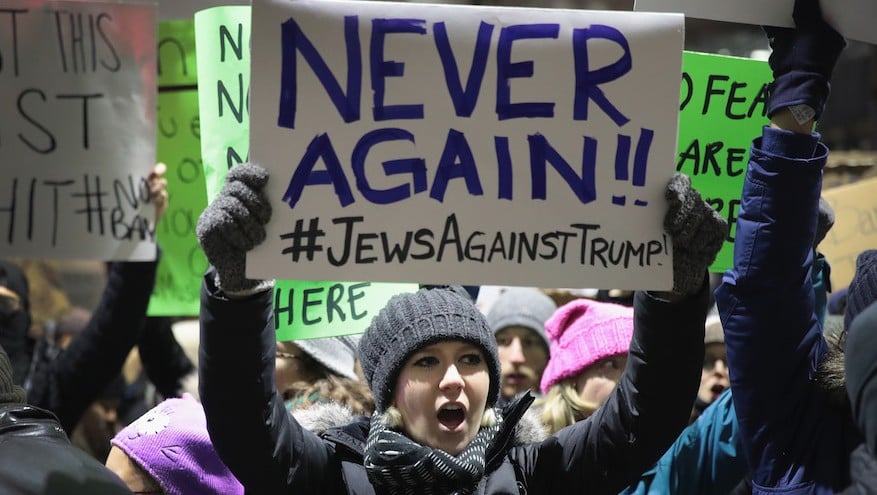
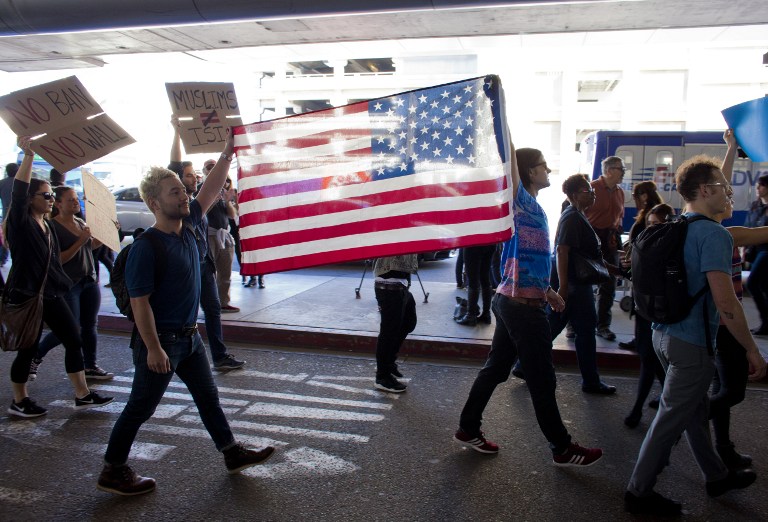
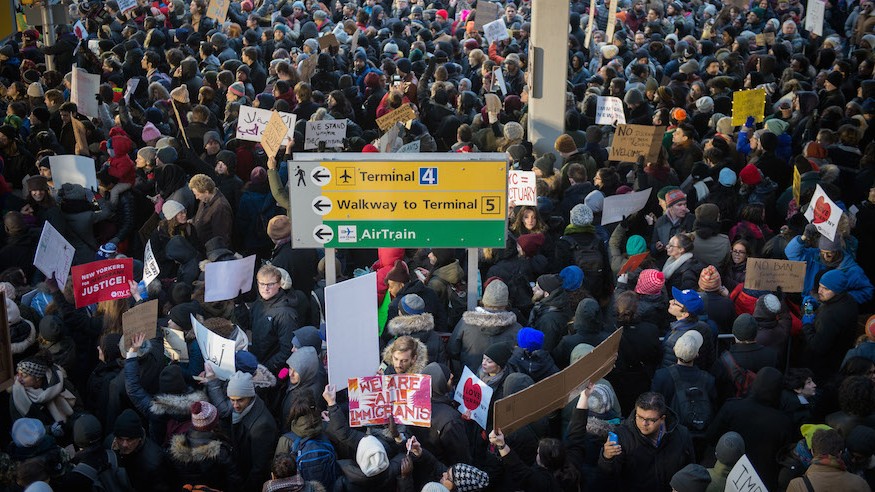
“This inhumane act was done in the most inhumane way possible,” he said, underlining the outrage that on Saturday brought thousands of people to protest the executive order on refugees and Muslim countries at airports around the country. Many Jews participated in the rally, and Jewish community groups have vocally opposed the executive order.
On Saturday, a federal judge in Brooklyn issued a stay of removal for the estimated 100 to 200 people detained at American airports under Trump’s order — some of them children and US legal permanent residents.
But that was only a partial victory for pro-refugee activists.
A non-Jewish family of asylum seekers from Syria who, despite having obtained visas on January 20 to enter the US as refugees following a Homeland Security Department vetting, was turned back to their camp in Jordan on January 27. Citing Trump’s order, airline officials did not let the family — a mother and daughters aged 5 and 8 — fly to the US, Hetfield said.
The mother and her daughters are seeking to reunite with their father, who is already in Connecticut. They were let back into Jordan, “but in such cases, there is a risk that people who leave to become refugees in the United States will not be let back in, or worse,” Hetfield added.
The Zionist Organization of America was one of the few Jewish groups to praise the executive order on refugees enthusiastically, hailing it for addressing “notable failings of the US vetting process.”
“Deteriorating conditions in certain countries due to war, strife, disaster, and civil unrest increase the likelihood that terrorists will use any means possible to enter the United States,” Trump’s executive order on refugees states.
While it acknowledges that security vetting for visa applicants was toughened following the 9/11 terrorist attacks, the order says that the shutdown is necessary to carry out a review to make sure the current vetting tools can “determine that the individual seeking the benefit is who the individual claims to be and is not a security or public-safety threat.”
But Hetfield says that the current vetting procedure is so stringent that “terrorists are not going to look to [the] refugee program as a way in. They are going to try a less intrusive method. We don’t have any worries about it.”
Hetfield could not provide figures for how often asylum seekers are denied visas for security reasons — partly because Homeland Security neither specifies its reason for turning down applications nor offers recourse for appealing it.
Whereas the United Nations estimates that there are about 1 million people who meet its definition of a refugee — not including Palestinians, who have a different refugee classification — only several hundred thousand of them have been offered resettlement.
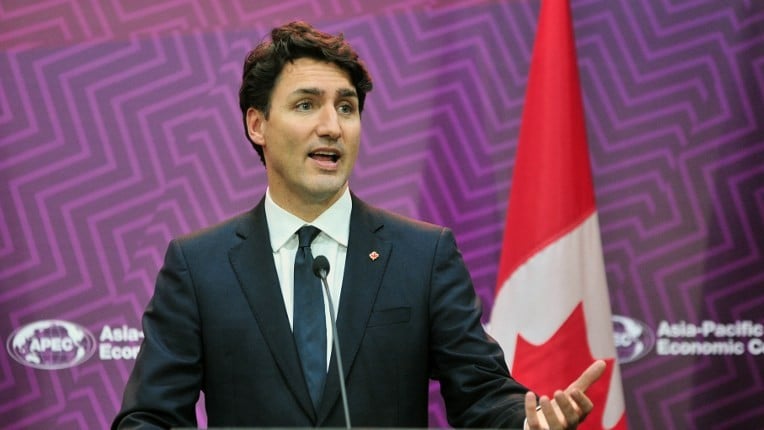
Prime Minister Justin Trudeau of Canada and some lawmakers there suggested that their country would be willing to take refugees affected by the White House crackdown, but have presented no concrete plans on how and when this would be done.
Rather than encourage other countries to take in refugees turned down by the US, Hetfield fears that Trump’s executive order is more likely to have the opposite effect: Other countries will be less willing to bring in refugees.
“If the United States, that has led by example, decides its vetting process isn’t safe enough, well, that will have huge implications for other countries,” Hetfield said.
The fact that the order came on International Holocaust Remembrance Day is “especially painful,” he added, because “the international law pertaining to refugees today is a direct result of the Holocaust and the failure to act and protect Jews trying to leave Germany and Austria” and other places in war-torn Europe before and during World War II.
Another immigration professional from the United States, herself a refugee from the Middle East, said she believed that the language of the executive order signals that when it comes to the Muslim world, the Trump administration seeks to turn its refugee program primarily into an “escape route for non-Muslims.” She asked not to be quoted by name because “things are too unclear right now to make an official statement.”
She cited a passage of the executive order that speaks of “changes, to the extent permitted by law, to prioritize refugee claims made by individuals on the basis of religious-based persecution, provided that the religion of the individual is a minority religion in the individual’s country of nationality.”
But that’s not a good thing for religious minorities in Iran and elsewhere, the professional said.
“Just as Iranian Jews have long been flagged as a fifth column because they are welcome to resettle in Israel,” she said, “now the same will happen to all the other members of religious minorities” in the region.






The Times of Israel Community.