

Secular Israel’s ‘mitzvah:’ Usher the ultra-Orthodox into tech jobs
Hundreds gather to launch the new Kamatech accelerator, the latest program to help Haredi Israeli entrepreneurs
 Add ToI as a Preferred Source on Google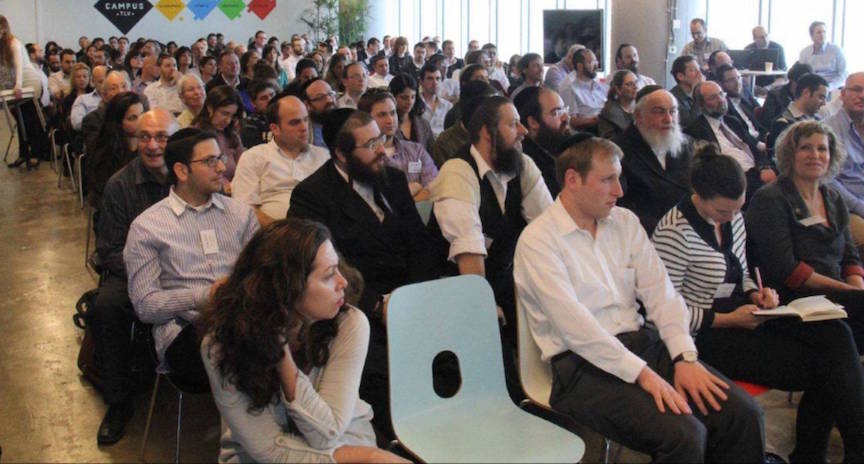
Associated as they are in the public mind with the spiritual life, ultra-Orthodox Jews are quite familiar with the idea of doing mitzvahs — good deeds that benefit “the other,” without seeking remuneration or a favor returned.
And Ariel Finkelstein, manager of the new Kamatech accelerator for ultra-Orthodox tech entrepreneurs, describes his involvement, as well as that of dozens of other tech pros in the project, as one big “mitzvah.”
“None of us are getting paid for this, but we all want it to succeed. So we are putting a great deal of time and energy into this project,” said Finkelstein, speaking at the inauguration of the accelerator before an overflowing crowd — secular, religious, ultra-Orthodox, and otherwise — in Tel Aviv on Monday.
Kamatech, established two years ago, is the latest in what is becoming a crowded field of projects aimed specifically at members of the ultra-Orthodox, or Haredi, community. After working with other organizations — most notably Microsoft, at its Ventures Accelerator — to recruit members of the community who had a good business idea but were lacking in technical or business skills, Kamatech is ready to “strike out” on its own.
Over 200 companies and entrepreneurs applied for the five slots in the first round of Kamatech, which will run for three and a half months. The lucky firms filling those positions are Cognilyze, which uses big data to make product suggestions on retail sites; Pojo.me, which provides drag-and-drop WordPress themes for blog sites; WorkCapital, which makes an engine for granting credit efficiently; Prog, which provides tech training courses for ultra-Orthodox men and women; and EnglishOn, which helps non-English speakers learn the language better.
Among the benefits for participants: personal mentors from the top members of the Israeli high-tech Industry; free help from leading law and CPA firms on copyright, financing, and other issues; a free project development team (from among 500 Haredi women learning computer science at the Lustig Campus, a branch of the Lev Academic Center; assistance in hiring, financing, presentations, and other areas; and a Demo Day in Israel, along with a free trip to London and New York, where the start-ups will present to leading investors.
It takes a high-tech village to put together a program like this, said Finkelstein — himself the CEO of a successful tech firm called Kampyle. One of the things that he did, along with the Kamatech cofounders — Haredi entrepreneur Moshe Friedman; and Zika Abzuk, director of Cisco training operations in the Middle East and Africa — was to put together a coalition of 35 of Israel’s biggest tech, law, and investment firms to help out.
Among the 35: Cisco, Microsoft, IBM, Google, Citi, PWC, Canaan Partners, Plarium, IronSource, Pitango, and many more. In addition, the project has received massive support from the Chief Scientist’s Office and the UJA Federation of New York.
Managing Kamatech is the Kemach Foundation, which for years has provided employment counseling and training, as well as scholarship assistance, for members of the ultra-Orthodox community who want to get into the job market.
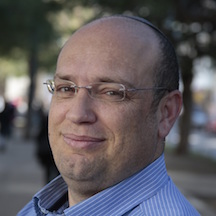
Among the program’s Israeli volunteers are Israel’s “grandfather of tech” Yossi Vardi, and MobilEye inventor Professor Amnon Shashua, who helped develop the curriculum.
Former president Shimon Peres was scheduled to appear at the inauguration event, but was unable to make it because of illness. Instead he sent a warm note, in which he wrote that ultra-Orthodox Israelis were not only welcome in the country’s tech ecosystem, but were needed. “There is no contradiction between religion and technology, but we know that without morality, technology can be destructive.” And Israel, Peres added, is counting on ultra-Orthodox tech workers to ensure that morality finds its place in technology.
Kamatech is far from the only tech effort to assist Haredi entrepreneurs. Other accelerators are Yazam Balev, a new venture managed by the Jerusalem College of Technology; and the Haredi Hi-Tech Forum, a project managed by entrepreneurs Itzik Crombie and Racheli Ganot, together with Jerusalem Venture Partners (JVP is also a backer of Kamatech).
To boot, the Israel Defense Forces, the Chief Scientist’s Office, and numerous tech companies, including Microsoft and Cisco, have run programs designed to specifically recruit ultra-Orthodox talent.
Finkelstein has no problem with the “competition,” and claims there is more than enough “business” for everyone. “We had 224 applicants to the program, and there are many more who said they wanted to apply, but didn’t. The event tonight is overbooked; we had to turn away hundreds of people. That’s how much interest there is in this.”
Little by little, the news about tech — that ultra-Orthodox Israelis can succeed and earn a good living in the industry — is getting out into the community.
“They have excellent skills,” claimed Finkelstein. “I have heard numerous stories of ultra-Orthodox programmers who are self-taught, and master skills that most people spend months in school to learn. And perhaps it’s the level of self-discipline in their studying, which is ingrained in them at an early age, and the lack of distractions such as television, that give them these skills.”
Despite the strong support, Finkelstein admits that efforts like Kamatech are still seen as outside the mainstream in the ultra-Orthodox community.
“There is definitely much more support than there was in the past. Breadwinners who have to feed their kids have found tech to be an excellent way to earn a good living, and the demand is growing.”
Still, it seems as if all the programs are being organized by “outsiders,” such as the government, large corporations, or community outliers. When will the top Hassidic rebbes or heads of the Lithuanian-style yeshivas endorse and support these projects — and perhaps even help organize them?
Finkelstein’s response: “When the first huge Haredi exit takes place. That’s when they’ll all line up to support this.”









The Times of Israel Community.