

Jailed ex-president Katsav said ‘optimistic’ about early release
Parole board to consider freeing convicted rapist on Thursday after he agrees to rehabilitation regimen
 Add ToI as a Preferred Source on Google
Tamar Pileggi is a breaking news editor at The Times of Israel.
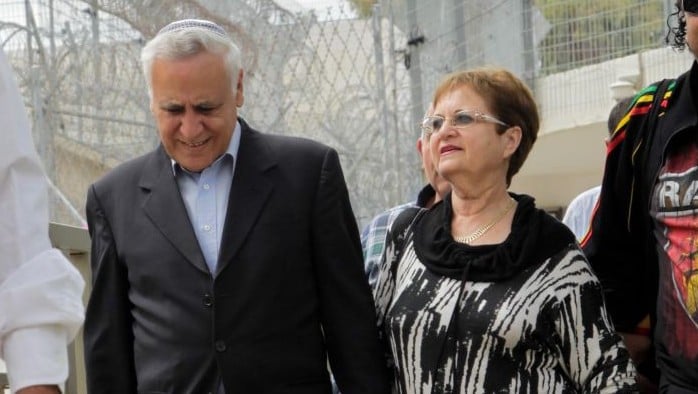
After spending five years behind bars, former president and convicted rapist Moshe Katsav is reportedly “optimistic” the parole board will grant him early release from prison when he faces a hearing Thursday.
Katsav, who is serving a seven-year sentence on two counts of rape and other charges, is seeking to have his jail time reduced by one-third for good behavior.
“I’m optimistic, I hope to return to a quiet life, far from the public eye and to my friends and family,” the 70-year-old former president told associates, according to Channel 2.
“Soon it’ll be five years that I will have spent in prison, and now it’s time for me to be released,” he said.
The Israel Prisons parole board was expected to release its decision on Katsav’s commuted sentence after a Thursday hearing.
Earlier this year, Katsav was denied early parole after the Prisoner Rehabilitation Authority recommended against it, noting he had not acknowledged or expressed remorse for his crimes, showed no empathy for his victims, and saw himself as the victim in the case.
In July, the rehabilitation authority reversed its recommendation following a meeting with Katsav. According to a report in the Yedioth Ahronoth daily, the former president agreed to a rehabilitation regimen after his release that includes religious study, regular meetings with social workers, and a commitment to not besmirch his victims.
According to reports, the state prosecution is expected to oppose early release for Katsav, as it has in previous parole hearings, arguing that Katsav has not participated in any rehabilitation programs offered by the prison.
Katsav’s lawyer, Yehoshua Reznik, last month would not indicate whether his client assumed responsibility or expressed regret for his crimes.
Reznik and Katsav’s family reportedly told him to cooperate with the demands of social workers, after Katsav has for years insisted he does not require therapy or rehabilitation.
One of Katsav’s victims slammed the revised recommendation last month, suggesting political pressure was behind the new call to free the former president.
If he goes free, “it would be unprecedented in Israel, and would send a very negative message, both about women and about sex offenders,” Odelia Carmon, who was assaulted by Katsav in the early 1990s, said in an interview with Army Radio.
Times of Israel staff contributed to this report.








The Times of Israel Community.