

More than 65 killed in 3 days in Aleppo, say Syrian activists
Shelling, airstrikes on embattled city continue unabated as world powers prepare for fresh round of peace talks
 Add ToI as a Preferred Source on Google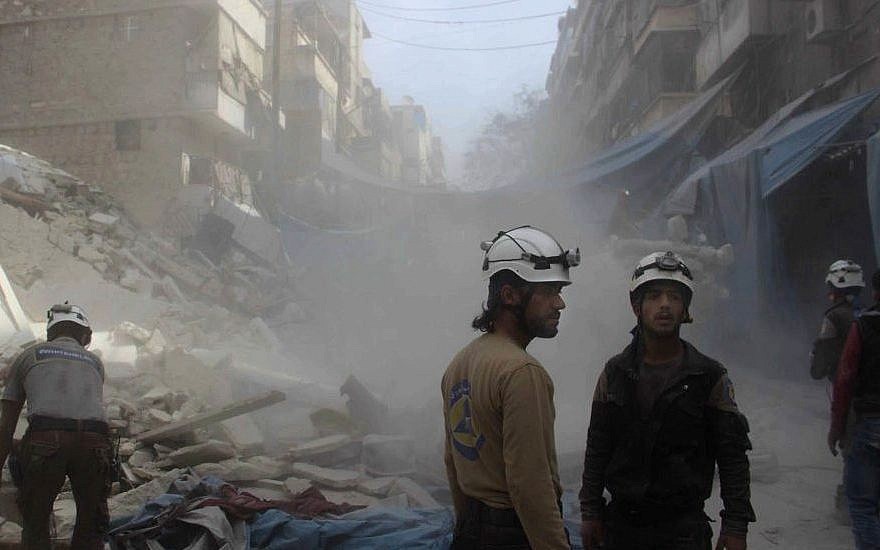
BEIRUT (AP) — Overnight shelling and over a dozen airstrikes on rebel-held parts of the Syrian city of Aleppo killed at least 11 people, bringing the death toll over the last three days in the embattled city to at least 65, activists said Thursday.
Meanwhile, rebel shelling of government-held areas in the divided city killed two girls at a school. The airstrikes came a day after an air raid hit eastern Aleppo’s biggest market, killing at least 15 people and leveling buildings.
Aleppo’s unabating violence has given additional urgency to the upcoming meeting between Russian Foreign Minister Sergey Lavrov and US Secretary of State John Kerry on efforts to find a peace deal in Syria in Switzerland on Saturday. It will be the first face-to-face contact between the two men since Washington broke off bilateral diplomatic contact with Moscow on Syria over the violence in Aleppo earlier this month.
In other developments in Syria’s multi-layered conflict, two Iraqi militia commanders said Thursday they have started withdrawing some of their elite forces from Syria, where they are fighting on the side of President Bashar Assad’s government, to Iraq in preparation for the battle to retake the city of Mosul from the Islamic State group.
The battle for Mosul is expected to be the most complex yet for Iraqi forces, backed by US-led coalition air-power. Since Mosul first fell to IS in June 2014, the extremists have been pushed from more than half of the territory they once held in Iraq, according to figures released by Iraqi Prime Minister Haider al-Abadi’s office.
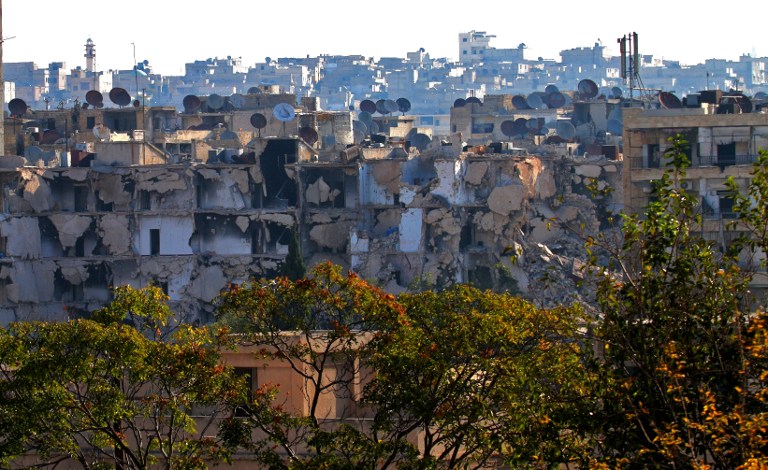
My beloved city #Aleppo after 5 years of bombardment by #Assad and now #Russia. pic.twitter.com/0eAyPDQXcM
— Khaled Khatib (@995Khaled) October 13, 2016
Iraqi Shiite militias are not expected to take part in the operation, although they are likely to be part of the offensive to capture areas nearby such as the town of Tal Afar, which used to have a large Shiite population.
The two commanders, from Iraq’s powerful Asaib Ahl Haq and Kataib Hezbollah militias, said more than 2,000 of their fighters have been withdrawn from Syria, mostly from in and around Aleppo, for redeployment near Mosul and the IS stronghold of Hawija. The two spoke to The Associated Press in Baghdad on condition of anonymity because they were not authorized to discuss military tactics.
But two Syrian opposition activists — Rami Abdurrahman of the Britain-based Syrian Observatory for Human Rights and Turkey-based Ahmad al-Ahmad — said they were unaware of the withdrawal, adding that Iraqi Shiite militias have recently sent reinforcements to Syrian government forces in the Aleppo area.
Earlier this month, an official with the Iraqi Shiite al-Nujaba militia said it sent some 4,000 fighters to Syria, also to the Aleppo area. The two Iraqi commanders said the al-Nujaba militiamen were not part of the pullout. The militia’s leader, Sheikh Akram al-Kaabi, recently visited his fighters on Aleppo’s front lines, vowing to continue to fight Sunni extremists.
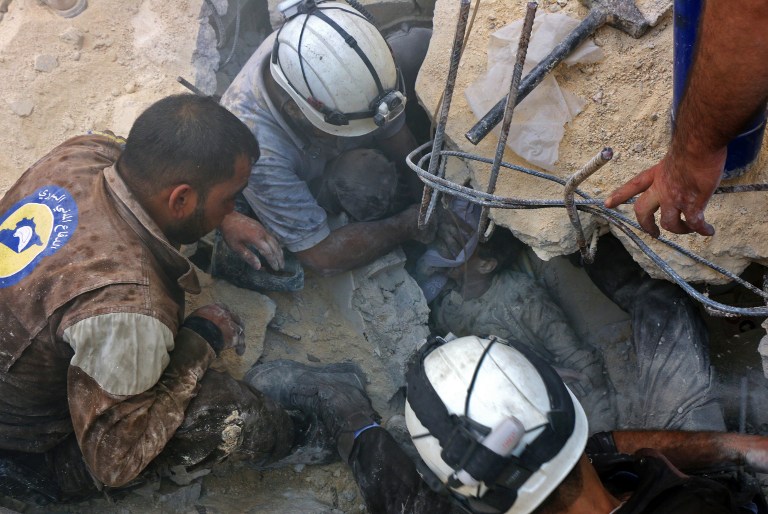
According to the Observatory, over than 20 airstrikes overnight and into Thursday in eastern Aleppo killed seven people while shelling killed four. The activist group also said that clashes were taking place between government forces and rebels on the city’s northern edge. The Halab Today TV channel reported “intense” airstrikes on rebel-held parts of Aleppo, adding that cluster bombs were being dropped.
Ibrahim Alhaj, a member of the Syrian Civil Defense, gave a higher toll, saying the airstrikes killed 13 and wounded 25. He said some people remained buried under the rubble and rescue and search operations were underway.
Syrian state media said two girls were killed and five were wounded in rebel shelling that hit a school in Aleppo’s western government-held neighborhood of Suleimaniyah.
The Observatory said on Wednesday that at least 358 civilians have been killed in eastern Aleppo since a US and Russian-brokered truce collapsed on Sept. 19. The UN says over 100 children have been killed in the campaign, which has also included a limited ground offensive.
Near the capital of Damascus, rebel fighters and civilians agreed to leave the suburbs of Qudsaya and Hammah as part of an arrangement to allow the government to retake control of the two areas. On Thursday evening, government buses set off from the suburbs with the 1,297 people, including women and children, to the rebel-held northwestern province of Idlib, the Observatory and state news agency SANA reported.
The pro-government newspaper Al-Watan reported earlier in the day the government would grant partial amnesty to some 300 remaining fighters as part of the deal.
In August, a similar deal saw the complete evacuation of the Daraya suburb — which a UN aid official compared to “forced displacement.” Under-Secretary-General Stephen O’Brien warned at the time that the arrangement could not be a precedent for other areas.
In Geneva, Ramzy Ramzy, the top deputy to UN envoy for Syria, Staffan de Mistura, said al-Qaeda’s affiliate in Syria — the Fatah al-Sham Front, previously known as the Nusra Front — rejected a recent offer to withdraw from the city of Aleppo under de Mistura’s personal escort.
“Not surprisingly, (they gave a) negative response,” Ramzy said.
Also Thursday, the Russian military denied its warplanes targeted Aleppo’s residential areas, saying they have only struck militant facilities outside Syria’s largest city.
Lt. Gen. Sergei Rudskoi said Russian airstrikes follow a thorough analysis of data gathered by satellites, drones and agents on the ground to identify militant targets and insisted that facilities located close to residential areas, schools, hospitals, street markets and mosques are never targeted.
Russia’s air raids in support of Syrian army’s offensive on Aleppo have drawn international outrage, and both the US and France called for investigating Russia for possible war crimes in Syria. Moscow has rejected the accusations as unfounded.
Copyright 2016 The Associated Press.






The Times of Israel Community.