

Sporadic fighting mars second day of Syria ceasefire
Activists say Hezbollah-backed regime forces violating truce, claim latest offensive on Damascus area threatens 100,000 civilians
 Add ToI as a Preferred Source on Google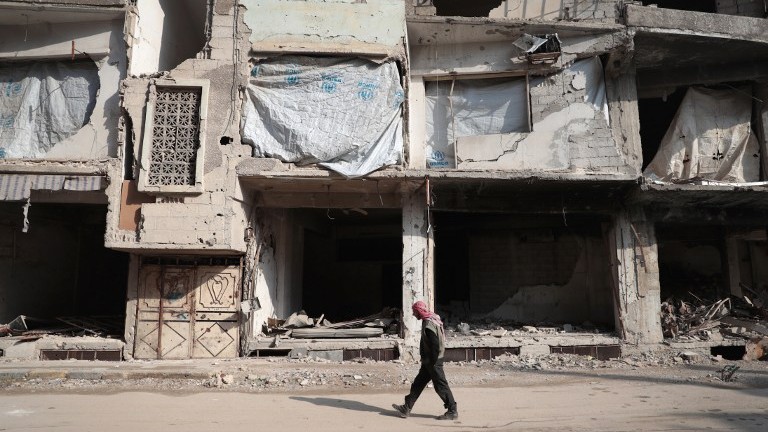
Parts of Syria saw continued fighting Saturday, on the second day of a nationwide ceasefire intended to pave the way for peace talks between the government and the opposition in the new year.
Activists reported Hezbollah-backed government forces were pressing on several fronts against two strategically located opposition pockets around the capital, Damascus, while Russia’s military in Syria reported twelve ceasefire violations it blamed on rebels Friday. Russia is a key ally of the Syrian government.
Nevertheless, the Russian and Turkish brokered truce held for the most part on a day marked by rain and overcast skies, preserving the possibility for peace talks in the Kazakhstan capital of Astana in the second half of January.
The UN Security Council was scheduled to meet at 11 a.m. EST (1600 GMT) to vote on a resolution to endorse the cease-fire and roadmap to peace beginning with a transitional government for the country.
The resolution also calls for the “rapid, safe and unhindered” access to deliver humanitarian aid throughout the country.
The developments signal the possibility of a diplomatic breakthrough after nearly six years of conflict that has drawn in world powers, displaced half the Syrian population, and killed more than 400,000 people. The parties have defied previous peace initiatives.
Pics showing the aftermath of #SyAF airstrikes on #WadiBarada. pic.twitter.com/ESjyMcTmaK
— Qalaat Al Mudiq (@QalaatAlMudiq) December 30, 2016
It follows months of talks between Ankara and Moscow that culminated in a cease-fire agreement that went into effect Thursday at midnight.
Moscow along with Iran provides crucial military support to Syrian President Bashar Assad, while Turkey has long served as a rear base and source of supplies for the opposition.
The three powers, Russia, Iran, and Turkey, have agreed to sponsor talks between the government and the opposition in Astana if the truce holds holds.
The Britain-based Syrian Observatory for Human Rights monitoring group said at least two civilians and five militants have been killed in battles over opposition-held Eastern Ghouta and Wadi Barada regions around Damascus, since the truce came into effect Thursday at midnight.
A joint statement by local civil organizations, NGOs and activists in Wadi Barada said the strikes by regime forces and its “allied militia of Hezbollah” were threatening over 100,000 civilians.
The latest offensive on the villages that has led to water shortages affecting some four million people in the capital, were taking place with “full support and guidance from Iran,” the statement said.
What truce? SOS calls from #WadiBarada which is under siege,bombing & invasion attempts now #Syria pic.twitter.com/X2M4uPPo6H
— Lina shamy (@Linashamy) December 31, 2016
The raids have coincided with a severe water shortage in Damascus since Dec. 22. The valley is the region’s primary source of water.
The forces in Wadi Barada include former al-Qaeda affiliate Fateh al-Sham Front, previously known as Al-Nusra Front, which Syria’s government says is excluded from the ceasefire.
On Friday, Damascus denied attacking the valley, saying it would not violate the truce brokered by Russia and Turkey.
Meanwhile, Turkey’s state-run Anadolu news agency reported the death of an Islamic State commander in a Turkish airstrike near the north Syrian town of al-Bab on Friday. The truce does not cover operations against the Islamic State or al-Qaida’s Syria affiliate, the Fatah al-Sham front.
Anadolu identified the commander as Abu Ansari. The report could not be independently verified.



The Times of Israel Community.