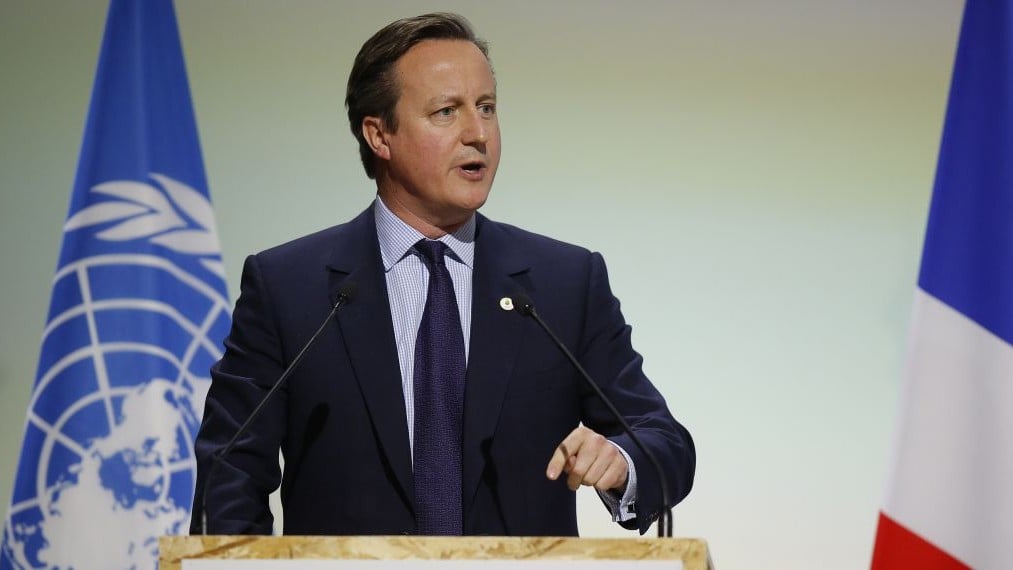
British Prime Minister David Cameron addresses world leaders at the COP21, United Nations Climate Change Conference, in Le Bourget, outside Paris, Monday, Nov. 30, 2015. (AP/Michel Euler)
LONDON — Britain on Thursday summoned the Russian ambassador after a report into the radiation poisoning murder of ex-spy Alexander Litvinenko and imposed asset freezes on the two men identified as the perpetrators.
Home Secretary Theresa May also told parliament the killing was “a blatant and unacceptable breach of the most fundamental tenets of international law.”
The office of Prime Minister David Cameron called Thursday’s findings by British Judge Robert Owen who said that Putin was “probably” involved in the poisoning of Litvinenko, “extremely disturbing.”
“The conclusion that the murder was authorized at the highest levels of the Russian state is extremely disturbing,” said Cameron’s spokeswoman.
“It is not the way for any state, let alone a permanent member of the UN Security Council, to behave,” she said.
Get The Times of Israel's Daily Editionby email and never miss our top stories
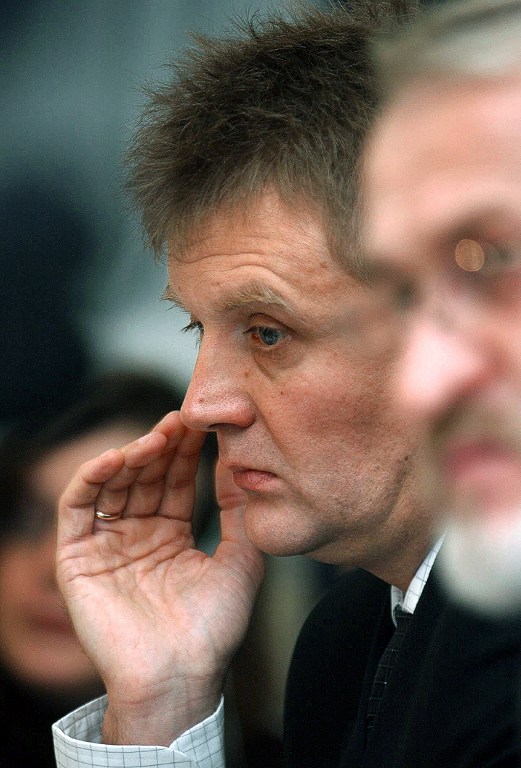
A file photo taken on September 14, 2004, shows Alexander Litvinenko (L), a former Russian intelligence agent, speaking at a press conference in London. (AFP PHOTO / MARTIN HAYHOW)
“Regrettably, these findings confirm what we and previous governments already believed.”
Cameron’s spokeswoman said the leader would “weigh carefully” any response with the “broader need to work with Russia on certain issues.”
“He recognizes the importance of engaging and co-operating with Russia where this is in the national interest and limiting our engagement with Russians… where that is in our interest.”
Advertisement
Litvinenko, a prominent Kremlin critic, died three weeks after drinking tea laced with radioactive polonium at an upmarket London hotel in 2006.
Two Russians, Andrei Lugovoi and Dmitri Kovtun, were identified by British police as prime suspects but attempts to extradite the pair have failed.
Help us report truthfully on social media
As a multimedia journalist, my job is to take the quality, fact-based journalism produced by The Times of Israel newsroom and make it accessible across every platform — from Instagram posts to podcasts to short-form videos.
This is how many, especially young people, consume news these days. But misinformation is rampant on social media. Our team at ToI produces accurate, responsible short-form reporting on Israel and the Jewish world.
If you believe in the importance of factual social media journalism, please consider joining our reader support group, The Times of Israel Community. Your financial support is essential to sustain responsible multimedia reporting.
We’re really pleased that you’ve read X Times of Israel articles in the past month.
That’s why we started the Times of Israel - to provide discerning readers like you with must-read coverage of Israel and the Jewish world.
So now we have a request. Unlike other news outlets, we haven’t put up a paywall. But as the journalism we do is costly, we invite readers for whom The Times of Israel has become important to help support our work by joining The Times of Israel Community.
For as little as $6 a month you can help support our quality journalism while enjoying The Times of Israel AD-FREE, as well as accessing exclusive content available only to Times of Israel Community members.
Thank you, David Horovitz, Founding Editor of The Times of Israel


 Add ToI as a Preferred Source on Google